For a long time, satellite communications felt "distant" to most people. It showed up mainly in high-barrier scenarios national comms systems, military networks, aerospace engineering, emerge
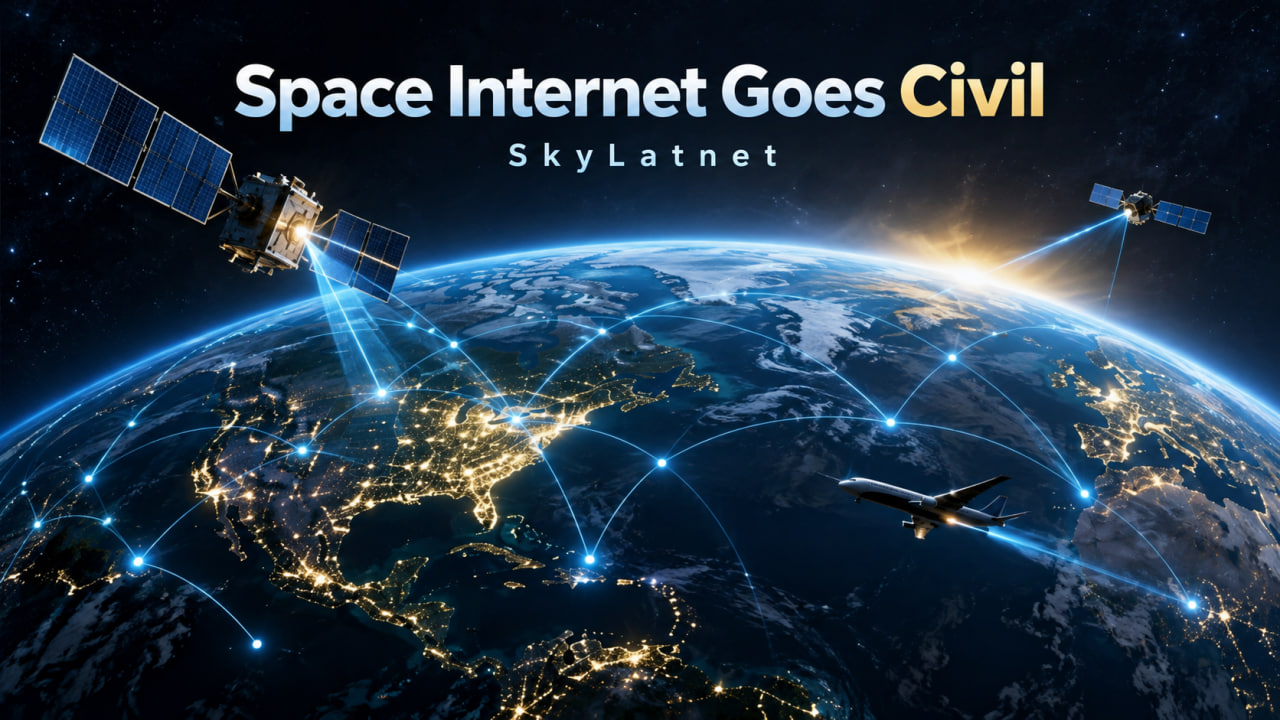
For a long time, satellite communications felt "distant" to most people. It showed up mainly in high-barrier scenarios national comms systems, military networks, aerospace engineering, emergency response. Regular consumers rarely felt any real connection to it. But that boundary is now breaking down fast. With low-orbit satellites, in-flight internet, direct-to-device satellite links, maritime comms, IoT, and rural network access all advancing, satellite comms is moving from strategic infrastructure toward a much broader commercial and consumer market.
The Real Big Opportunity in Satellite Communications Might Just Be Getting Started
Imo, what's really exciting about satellite internet isn't just "launching more satellites" — it's that it's starting to enter real demand scenarios of ordinary industries. Planes need constant connectivity, deep-sea vessels need stable data transmission, energy and mining facilities need remote monitoring, cross-border logistics needs connected devices, and when disasters hit, comms need to come back fast. Traditional ground base stations cover most densely populated areas, but when it comes to oceans, aviation, mountains, deserts, and tons of scattered devices — build costs, maintenance difficulty, and coverage efficiency all hit obvious limits.
This is also why I've recently started focusing on SkyLatnet.
It's not just another "space concept" play. It's trying to combine satellite communication resources, ground gateways, edge nodes, and blockchain incentives into an open communication collaboration network built for Space Internet 2.0. The project doesn't position itself as a direct competitor to Starlink or AST SpaceMobile — instead it emphasizes complementing existing satellite networks, letting different resource providers, node operators, developers, and enterprises plug into the same collaborative system.
What SkyLatnet Wants to Build Isn't a Satellite — It's a Network
This is what I find pretty interesting about SkyLatnet.
Traditional satellite internet is a heavy-asset industry by nature. Satellite manufacturing, launches, spectrum, ground stations, and global operations all demand massive capital. That's why big players are better suited to building global backbone networks. But the real demand of the future won't all come from the backbone — it'll come from a long tail of scattered industry use cases.
SkyLatnet's approach is to turn these resources into a network that can collaborate, meter, and settle. Satellite resources handle broader connectivity, ground gateways relay data between satellite links and local networks, and edge nodes sit close to real users—handling device connections, data forwarding, and task execution. The project sums up this architecture as "space, sky, ground, chain": space links, aviation internet, ground nodes, and blockchain settlement together form the network's foundation.
If this model actually works, satellite comms won't just be infrastructure owned by a handful of giants — we could see a far more open market for resource collaboration.
In-Flight Internet Could Be the Most Underrated Breakthrough to Watch
Compared to all these space narratives still stuck in concept phase, I'm way more focused on SkyLatnet's play in aviation internet.
Project docs show the foundation's team has already been involved in aircraft Wi-Fi retrofits and in-flight network upgrades, building up hands-on experience across in-flight network deployment, device integration, ops coordination, and service acceptance. Next up, they plan to dig deeper into how aviation internet nodes, in-flight edge gateways, and ground settlement networks can work together.
This angle is actually super practical. Aviation is one of the most obvious civilian use cases for satellite comms, and the demand is dead simple. Flying long-haul used to mean being offline by default. But as satellite connectivity improves, planes are going from comms dead zones to always-online mobile terminals.
Extend this logic further, and shipping, cross-border logistics, remote-area comms, energy infrastructure, agricultural IoT, disaster relief, and enterprise backup networks could all become similar demand scenarios. What SkyLatnet really wants to connect is exactly these scattered real-world communication needs.
SLAT's Value Ultimately Comes Back to Real Network Usage
For a DePIN project, what I care about most isn't how many stories the token tells — it's whether the token actually has a shot at plugging into a real business loop.
SLAT powers payments, node incentives, staking, and governance in the SkyLatnet system. When enterprises and devs tap into bandwidth, node access, data transmission, gateway services, and APIs, they settle up in SLAT. Node and resource providers earn rewards based on uptime, coverage, bandwidth contribution, and service quality.
Meanwhile, SkyLatnet also designed Proof of Coverage, Proof of Bandwidth, and Proof of Uptime. Through multi-source verification, reputation scoring, staking constraints, and slashing mechanisms, it validates real service capability. This logic matters because DePIN ultimately can't just answer "how many nodes are there" — it also has to answer "are these nodes actually providing real service."
SLAT has a total supply of 10 billion tokens. Node rewards make up 30%, ecosystem incentives 20% — meaning half the supply is earmarked for long-term network and ecosystem growth. Team, advisors, and early backers are subject to lockups and linear vesting on different schedules.
From Terrestrial Internet to Space Internet 2.0
The more I think about it, the more I feel the biggest change in satellite comms won't be some sudden tech breakthrough — it's that its boundaries of use keep expanding into the consumer market.
It used to be a national strategic resource. Now it's moving into aircraft, ships, logistics, energy, IoT, and everyday comms. As LEO satellites, ground gateways, edge devices, and terminals keep multiplying, the new infrastructure market built around these resources could end up far bigger than anything we see today.
And what SkyLatnet wants to do is plant itself right at that intersection ahead of time: on one side, satellite comms going mainstream at scale, and on the other, DePIN moving from digital resources like compute and storage toward real physical infrastructure.
Sure, it's still early days. Satellite resource integration, node growth, aviation internet pilots, enterprise client demand, and regulatory requirements across different regions all need long-term validation. The project docs themselves clearly list risks across tech, market, regulation, and supply chain.
But that doesn't stop me from keeping an eye on it.
What really excites me isn't just SLAT or a short-term market story — it's the industry trend behind it:
Satellite comms are moving from niche professional use cases to broad civilian infrastructure.
If satellites, aircraft, ground stations, edge devices, and enterprise networks really do enter a more open resource collaboration system in the future, then the boundaries of DePIN will be redefined too.
Next, what I really want to see is SkyLatnet's testnet, real node count, aviation internet pilot progress, and enterprise-level demand.
The story's already big enough.
What really determines value in the next phase is whether it can actually connect this network — stretching from the ground all the way to the sky — step by step.
#SkyLatnet #SLAT #DePIN #SpaceInternet #Web3 #BinanceSquare