Selling Bitcoin at an ATM: the tax duties Austrian users need to know Bitcoin ATMs are usually associated with a quick and simple crypto purchase. Some machines, however, work in both directi
Selling Bitcoin at an ATM: the tax duties Austrian users need to know
Bitcoin ATMs are usually associated with a quick and simple crypto purchase. Some machines, however, work in both directions: you can send bitcoin from your wallet to the operator and receive banknotes in return. In tax terms, that transaction amounts to more than a withdrawal from your own digital assets.
Anyone who sells bitcoin for euros at a machine in Austria generally realises a taxable event. For bitcoin acquired after February 28, 2021, the gain can be taxed at 27.5 percent. The taxable figure is the difference between the sale proceeds and the tax acquisition costs of the coins sold, rather than the full cash amount handed over.
Whether the ATM operator already withholds capital gains tax depends on its tax status and on how the transaction is settled. Where no correct withholding takes place, you generally have to work out the gain yourself and report it in your Austrian income tax return. A cash payout makes a bitcoin sale neither anonymous nor tax free.
How selling Bitcoin at an ATM works
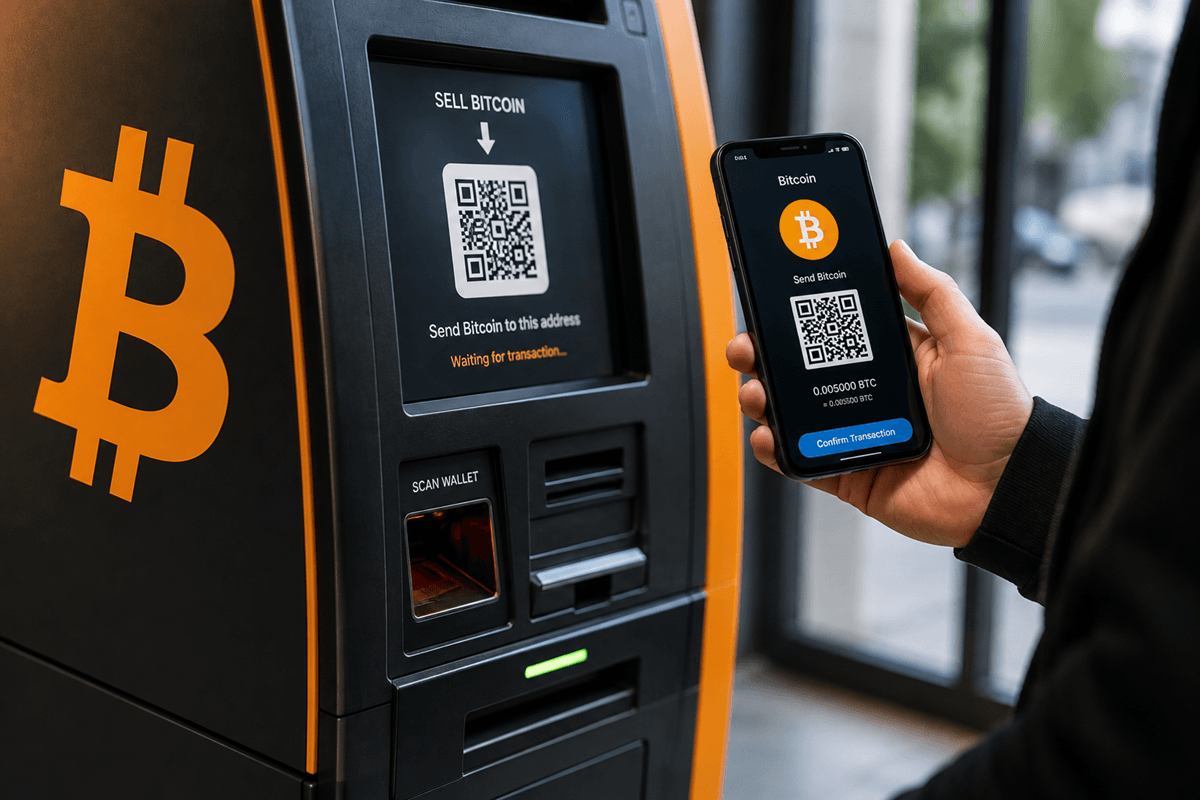
At a so called two-way machine you can buy bitcoin as well as sell it. The machine usually displays a receiving address or a QR code. You send the bitcoin you want to sell from your wallet to that address and receive cash once the required number of blockchain confirmations has been reached.
The Austrian financial market authority explicitly describes two-way machines as devices through which bitcoin can be sold from the customer wallet to the operator, with cash paid out in exchange.
In economic terms, two connected steps take place:
- You transfer bitcoin to the ATM operator.
- The operator pays you euros in cash.
For Austrian income tax purposes this is generally a sale of cryptocurrency for euros. It makes no difference whether the proceeds are transferred to a bank account or handed over immediately in banknotes.
Selling Bitcoin for cash is a taxable disposal
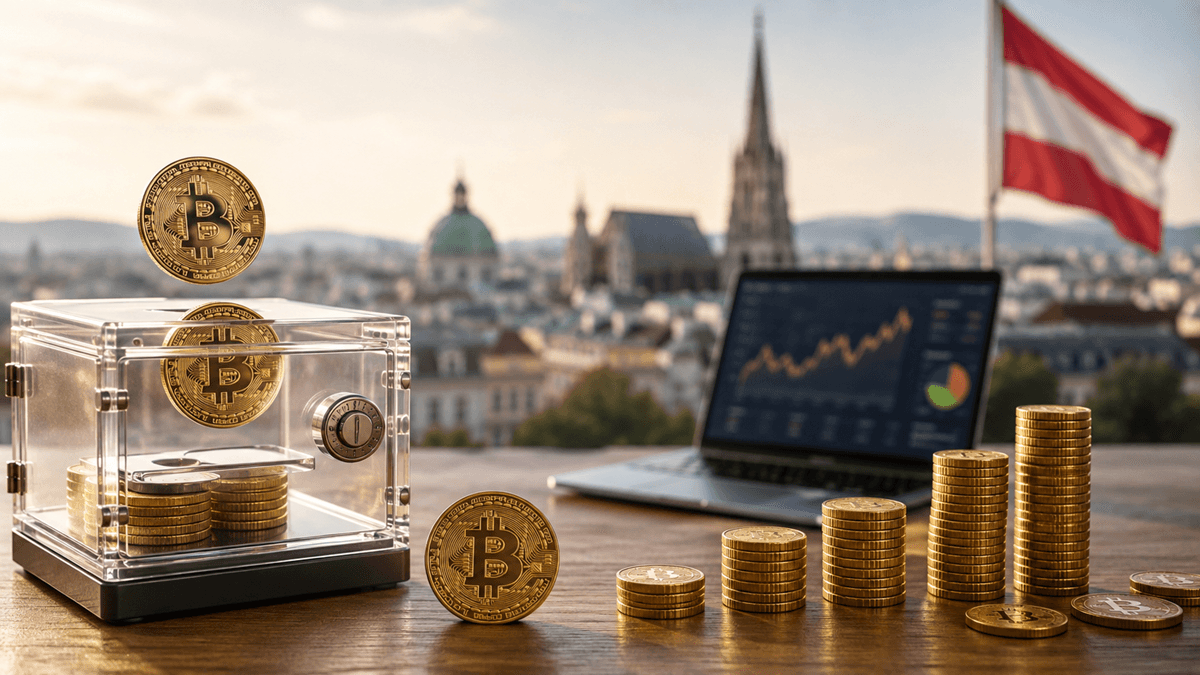
The Austrian Income Tax Act explicitly counts the disposal of cryptocurrencies for euros among income from realised capital gains. An exchange for recognised foreign currencies or for other goods and services can also constitute a taxable disposal.
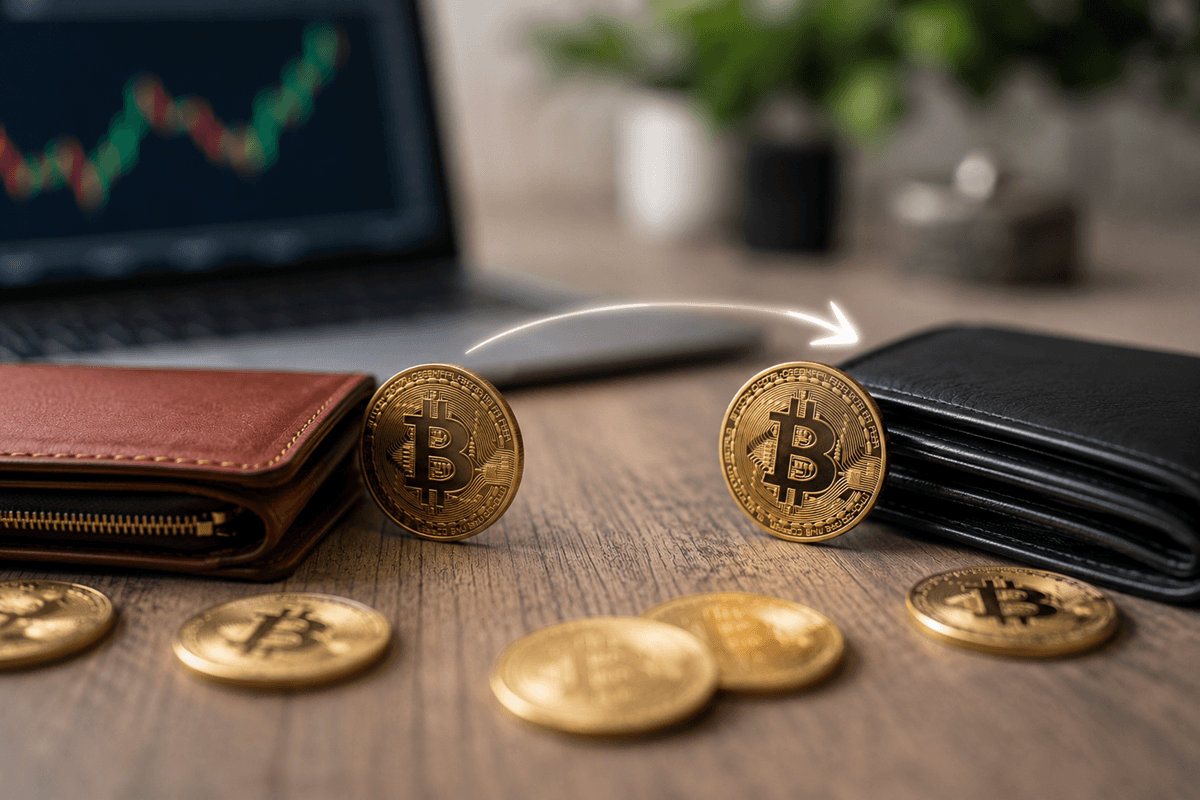
When you sell at a bitcoin ATM, part of your bitcoin holdings leaves your assets and euros come in. That distinguishes the transaction from a simple transfer between two wallets you own yourself.
Transfer between your own wallets: generally not a saleTransfer to a machine in exchange for cash: generally a taxable sale
The tax treatment does not change because no conventional exchange account is involved. What counts is the economic substance: bitcoin is disposed of in exchange for legal tender.
Only the gain is subject to tax
Tax is not levied on the entire amount paid out at the machine. As a rule, only the gain is taxed.
The simplified calculation is:
Sale proceedsminus the acquisition costs of the bitcoin soldminus any deductible transaction costsequals the taxable gain
An example:
- bitcoin originally bought for 4,000 euros
- later sold at a machine for 7,000 euros
- taxable gain before further costs: 3,000 euros
- tax at 27.5 percent: 825 euros
The 4,000 euros originally invested are not taxed a second time. They represent the tax acquisition costs.
The Austrian finance ministry confirms that the disposal gain is calculated from the difference between the proceeds and the acquisition costs. Directly attributable incidental acquisition and transaction costs can reduce the taxable gain where the statutory conditions are met.

Which amount counts as the sale proceeds?
At a machine, the economic consideration can differ from the publicly quoted bitcoin market price. Operators frequently apply their own exchange rate and factor their margin or fee into the payout.
If you sell bitcoin with an exchange value of 1,000 euros and receive only 920 euros at the machine, the amount actually obtained is generally decisive for the gain calculation. Whether the difference is treated as a separately deductible fee or as part of the agreed sale price depends on how the operator settles the transaction.
The receipt should therefore show:
- how much bitcoin was sold,
- which euro rate was applied,
- which gross value formed the basis,
- which fee or margin was charged,
- which amount was actually paid out.
Without a detailed statement it may later be unclear which part of the difference stemmed from the exchange rate and which from a separate transaction fee.
Which Bitcoin purchase price applies?
If you bought bitcoin in several tranches at different prices, you cannot simply pick the purchase price of any transaction you like.
For units of the same cryptocurrency acquired one after another and held at the same crypto address or wallet, Austria generally requires the moving average price in euros. This valuation method applies to income from realised capital gains received after December 31, 2022.
An example:
- purchase of 0.05 BTC for 1,000 euros
- later purchase of 0.05 BTC for 2,000 euros
- total holding: 0.1 BTC
- total acquisition costs: 3,000 euros
- average acquisition costs: 30,000 euros per BTC
If you then sell 0.02 BTC at a machine, the calculated acquisition costs of that portion generally come to 600 euros. With several wallets, exchange accounts and a mix of legacy and new holdings, the calculation can become considerably more complex. The machine does not know that history automatically.
When does the 27.5 percent rate apply?
The current Austrian crypto tax regime generally applies to bitcoin acquired after February 28, 2021. Such coins are treated as new holdings.
Gains from selling them within private assets are generally subject to the special tax rate of 27.5 percent. The holding period does not change that. A bitcoin held for three, five or ten years does not become tax free on account of that holding period alone.
The special rate normally does not push up the progressive tax rate applied to your remaining income. It applies whether the tax is withheld directly as capital gains tax or assessed later through the income tax return.
A different treatment can apply above all where crypto trading goes beyond private asset management and qualifies as a commercial activity.

What applies to legacy Bitcoin holdings?
Bitcoin acquired on or before February 28, 2021 generally counts as a legacy holding. The new tax regime does not automatically apply to it. The earlier legal position has to be examined instead.
For bitcoin held privately and not invested in an interest bearing way, a sale could be tax free under the old rules, in particular where more than one year lay between acquisition and disposal.
An example:
- bitcoin bought privately in 2019
- no interest bearing investment
- sale at a machine in 2026
In a typical case the former one year speculation period may have expired long ago. The sale could therefore remain tax free. The precise assessment depends on how the coins were used at the time.
Particular care is needed where legacy holdings were later:
- lent out,
- used in lending products,
- invested in an interest bearing way,
- swapped for other tokens,
part of a business activity.
You also have to be able to prove that the coins sold really were those old bitcoin. Merely asserting that a holding is legacy stock is regularly not enough where the transaction history is missing.
Does the machine withhold capital gains tax automatically?
Since 2024, certain domestic debtors and crypto service providers have generally been obliged to withhold capital gains tax on relevant crypto income and pay it to the tax office. After a correct withholding, the income concerned is regularly final taxed within private assets.
At a bitcoin ATM you should nevertheless not assume that the tax has already been settled. Among the decisive points are:
- who operates the machine,
- whether the operator qualifies as a domestic withholding agent,
- whether the statutory conditions for the withholding are met,
- whether the operator holds the correct acquisition costs,
whether the receipt actually shows a tax deduction.
A machine receipt showing a general service fee is no evidence of capital gains tax paid. Withheld tax would have to be clearly identifiable as a tax deduction.
Where no capital gains tax was withheld, the tax liability does not disappear. You generally have to calculate the gain yourself and enter it in your income tax return. The finance ministry makes clear that capital income without a possible domestic tax deduction has to be declared in the assessment. The special tax rate can still apply.
Missing acquisition costs are the biggest practical risk
The operator essentially sees how much bitcoin you send and which euro amount you receive for it. It does not necessarily know:
- when the coins were originally bought,
- how high the purchase price was,
- whether they come from an earlier crypto to crypto swap,
- whether they are legacy or new holdings,
- whether the wallet contains several acquisition tranches,
- whether the coins were inherited or received as a gift,
whether a relocation value is decisive.
Without acquisition costs the gain cannot be determined correctly.
You should therefore not wait until the sale to reconstruct your history. Closed exchange accounts, missing CSV files and bank statements that are no longer available can cause serious problems years later.
The records to secure include:
- purchase statements from the original exchange,
- account statements showing payment of the purchase price,
- complete transaction histories,
- wallet addresses and transaction IDs,
- evidence of transfers between your own wallets,
- information on earlier crypto to crypto swaps,
- documents relating to inheritances or gifts,
documentation of your tax relocation to Austria.
Which fees apply when you sell at a Bitcoin ATM?
Several costs can arise on a sale:
- the machine fee charged by the operator,
- the margin built into the exchange rate,
- the bitcoin network fee,
- an additional processing or payout fee.
These fees should be looked at separately.
A machine or transaction fee directly connected with the sale can generally reduce the taxable disposal gain, provided you actually bear it and can document it in a comprehensible way. The finance ministry generally recognises directly attributable transaction fees when the gain is determined.
The bitcoin network fee can carry a tax component of its own. Where it is paid in bitcoin, coins are used that leave the investor assets. The Austrian income tax guidelines generally treat fees paid in cryptocurrency for a transfer to another address as an exchange for a transaction service.
A machine sale can therefore bring two realisations together:
- the sale of the bitcoin transferred to the operator for euros
- the use of further bitcoin to pay the network fee
In practice the second amount is often small, yet it belongs in a complete tax calculation.
A simplified worked example
An Austrian investor sells 0.02 BTC at a machine.
- average acquisition costs: 20,000 euros per BTC
- acquisition costs of the 0.02 BTC: 400 euros
- market value at the general exchange rate: 1,200 euros
- actual cash payout: 1,100 euros
- separately stated machine fee: already reflected in the payout
- additional network fee: 0.00005 BTC
For the sale itself the simplified result is:
Cash proceeds: 1,100 eurosAcquisition costs: 400 eurosGain: 700 eurosTax at 27.5 percent: 192.50 euros
You then also have to check whether the bitcoin used for the network fee produced a further small gain.
The example shows why the publicly quoted bitcoin price cannot simply be equated with the sale proceeds for tax purposes. What counts is the actual payout and the specific fee structure.
A cash payout does not mean anonymity
Some users associate bitcoin machines with a sale outside conventional financial accounts. For tax purposes the form of payment is irrelevant. Proceeds received in cash also belong in the tax calculation.
Operators of crypto services can also be subject to anti money laundering duties. These can include establishing the identity of the customer and making flows of funds traceable. The FMA points out that participants in the financial market have to collect customer data and make transactions traceable in order to prevent money laundering.
Depending on the operator, the amount and the risk classification, the machine may ask for:
- a mobile phone number,
- proof of identity,
- a scan of an identity document,
- facial recognition or video identification,
- further information on the source of funds.
Independently of that, the bitcoin transaction remains visible on the blockchain. Choosing a cash payout in order to hide a taxable disposal does nothing to remove the statutory duty to declare it.
Does the sale belong in your tax return?
Where Austrian capital gains tax was withheld correctly, a private disposal gain is generally final taxed and regularly does not have to be included in the income tax return again. A voluntary assessment can still make sense, for example for an overall loss offset or for the option to be taxed at the standard rate.
Where no capital gains tax was withheld, a taxable gain generally has to be declared in the income tax assessment.
- That can apply in particular where:
- the machine operator is not an Austrian withholding agent,
- the receipt shows no capital gains tax,
- the acquisition costs were unknown to the operator,
- the tax calculation of the operator does not match the actual result,
- you sell through a foreign operator.
An ordinary employee assessment is not sufficient in every case. Capital income you have to declare yourself can require a full income tax return.
Losses from a Bitcoin ATM sale
Where the payout falls below the tax acquisition costs, the sale can produce a loss.
An example:
- acquisition costs of the bitcoin sold: 1,500 euros
- cash payout after fees: 1,100 euros
- tax loss: 400 euros
Losses from cryptocurrencies can generally only be offset against certain positive income from private capital assets, and only under the statutory rules. Offsetting them against a salary or against any other income is not possible.
An automatic loss offset across several providers, or between cryptocurrencies and other types of capital assets, does not take place in every case. Any offset beyond that can require an income tax return and the corresponding evidence.
Keep the machine receipt permanently
Users should not treat the printout from the machine like an ordinary till receipt that is thrown away after a few days.
The receipt should be stored together with the following data:
- the date and exact time of the sale,
- the location and operator of the machine,
- the transaction ID on the bitcoin blockchain,
- the amount of bitcoin sent,
- the network fee,
- the exchange rate applied,
- the cash amount paid out,
- machine and service fees,
- any capital gains tax shown,
- the acquisition costs of the bitcoin sold,
- the calculation of the tax gain or loss.
Thermal paper can fade over time. A digital copy of the receipt is therefore advisable, together with an export of the wallet transaction and the underlying acquisition history.
VAT is not the main problem for a private user
Under the case law of the European Court of Justice, the exchange of bitcoin into legal tender and back is generally exempt from VAT. The Austrian finance ministry adopts that classification for the exchange of euros into bitcoin and back.
For a private seller the focus is therefore regularly on income tax on the realised price gain rather than on VAT.
The situation can look different where bitcoin is held as business assets or where sales are carried out in the course of a commercial activity. Additional accounting, record keeping and corporate questions then have to be examined alongside income tax.
Conclusion: a cash sale is an ordinary Bitcoin sale for tax purposes
Anyone who sells bitcoin for cash at an Austrian machine generally realises a sale for euros. For new bitcoin holdings, the difference between the payout and the acquisition costs is regularly taxed at 27.5 percent.
The key points are:
- The cash payout is a sale for euros in tax terms.
- The gain is taxed, not the entire amount paid out.
- Bitcoin acquired after February 28, 2021 is generally taxed at 27.5 percent.
- Legacy holdings can be sold tax free under the earlier rules.
- A machine operator does not necessarily withhold the correct capital gains tax.
- Without a withholding, you generally have to declare the gain yourself.
- Machine, trading and network fees have to be documented separately.
- The receipt alone does not replace evidence of the original acquisition costs.
The greatest tax risk therefore does not necessarily lie in the size of the sale. An incomplete history is the real problem. If you can prove neither the purchase price nor the acquisition date, you risk an incorrect gain calculation and difficulties in a later audit.
(As of August 10, 2026. This article is not investment advice. Prices and fee structures change; check the terms with the provider before you buy.)
Transparency note: This article was produced with the assistance of artificial intelligence and reviewed by our editorial team before publication. All figures and claims were checked against the primary sources linked in the text. The feature image was generated with AI.