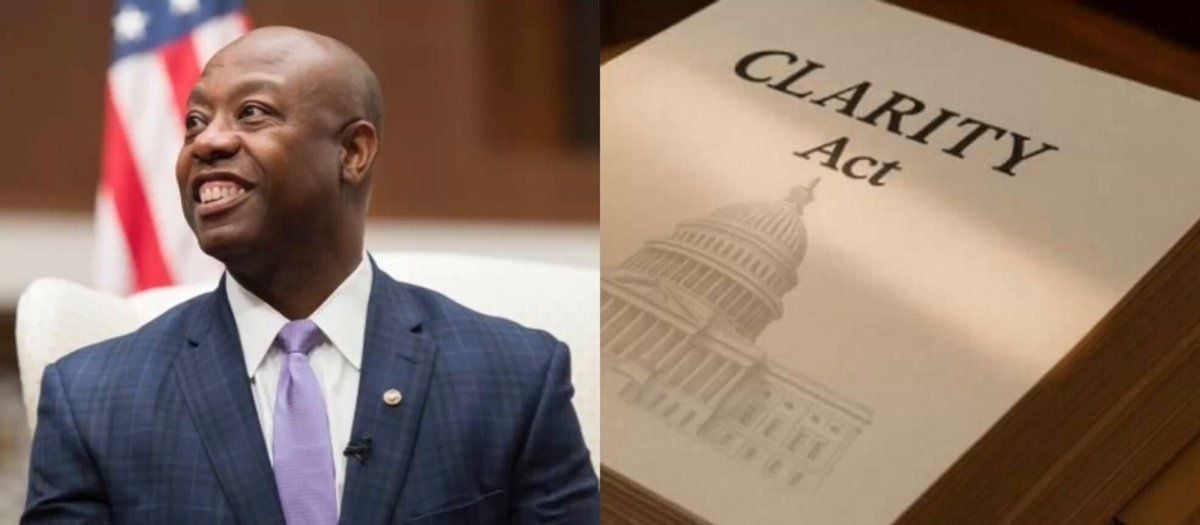
Senate Banking Committee Chairman @SenatorTimScott is stepping up his public commitment to passing the Digital Asset Market Clarity Act, signalling that the window for comprehensive crypto ma
Senate Banking Committee Chairman @SenatorTimScott is stepping up his public commitment to passing the Digital Asset Market Clarity Act, signalling that the window for comprehensive crypto market structure legislation in the United States is narrowing fast.
A Federal Framework for Digital Assets
The Clarity Act is designed to establish a broad regulatory framework for cryptocurrencies and digital assets, resolving a long-standing jurisdictional dispute between the SEC and CFTC over which agency governs which assets. The bill draws a hard line between SEC and CFTC authority, with digital commodities falling under CFTC jurisdiction. Scott has framed the legislation around protecting ordinary investors and keeping innovation on home soil. "This legislation is about making America the crypto capital of the world," Scott has said, adding that clear rules give entrepreneurs the confidence to start companies, hire workers, and grow in the United States, while also making it harder for criminals and foreign adversaries to exploit new technology.
The bill passed the House on July 17, 2025, by a 294-134 margin, with more than 70 Democrats crossing the aisle, the strongest congressional endorsement of digital asset legislation in U.S. history.The Senate Banking Committee, chaired by Scott, then advanced the bill 15-9 on May 14, 2026.The Clarity Act would create a regulatory framework for cryptocurrencies and other digital assets, much like the GENIUS Act did for stablecoins when it was enacted into law.
Bipartisan Push and a Shrinking Timeline
Scott is working alongside @SenLummis and @JohnBoozman in a bipartisan effort to close remaining gaps in the legislation before a critical deadline. The Digital Asset Market Clarity Act passed out of the Banking Committee by a 15-9 bipartisan vote in May 2026.The Clarity Act is now set for a full Senate floor vote, with the development marking a notable advancement in the legislative process.
The bill must still achieve a 60-vote threshold in the Senate, undergo House-Senate reconciliation, and receive a presidential signature to become law. Time is pressing. Brian Gardner, chief Washington policy strategist at Stifel, has written that the bill "probably needs to get through the Senate by the end of July" and that missing the August recess would cause its prospects to "deteriorate materially."Galaxy Digital has lowered the probability of the Clarity Act becoming law in 2026 to 50% despite ongoing Senate negotiations.
Negotiators are still discussing ethics rules, anti-money laundering measures, and digital asset market oversight.The legislation needs at least 60 votes in the Senate, while Republicans currently hold 53 seats. Full Republican backing is not guaranteed, making Democratic support important for the Clarity Act as well. With Scott, Lummis, and Boozman all publicly behind the bill, senior Republican leadership is signalling it intends to push through to a final vote before the legislative calendar closes.
Sources:Yahoo Finance: CLARITY Act Stalls in Senate as Three Disputes Block Crypto RegulationCNBC: Clarity Act Clears Senate Banking CommitteeThe Hill: Crypto Bill Faces Make-or-Break Moment Ahead of August Recess