Singapore Exchange has reportedly secured authorization from the U.S. Commodity Futures Trading Commission to offer its Bitcoin and Ether perpetual futures directly to U.S. institutional inve
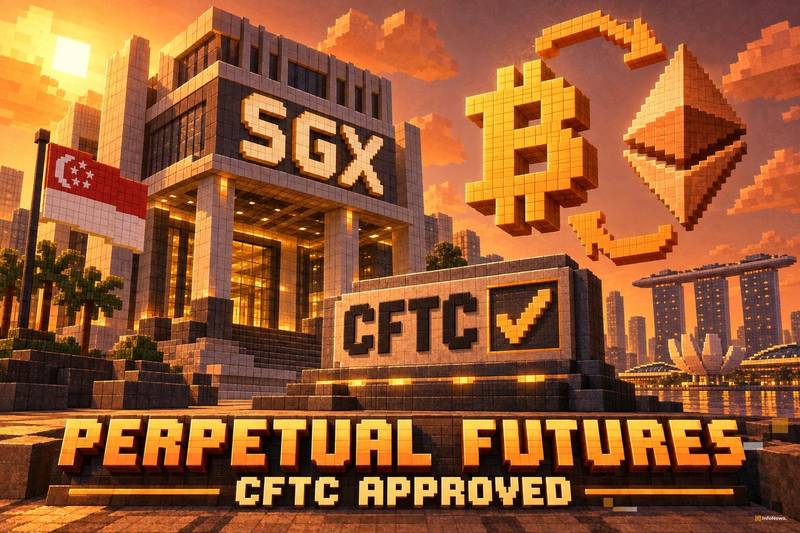
Singapore Exchange has reportedly secured authorization from the U.S. Commodity Futures Trading Commission to offer its Bitcoin and Ether perpetual futures directly to U.S. institutional investors, a move that would connect American capital to Asian crypto derivatives liquidity even as onboarding remains months away. The SGX CFTC approval, as reported, covers the exchange's Bitcoin perpetual and Ether perpetual contracts rather than any spot Bitcoin product.
The development matters most to Bitcoin because the contract dominates the venue's activity: Bitcoin accounts for 83% of the average daily volume across SGX's crypto perpetuals, according to reporting from Blockhead. These are cash-settled derivatives on Bitcoin's price, not exposure to the underlying network or its fixed supply schedule. For related coverage, see OpenReserve Wins Preliminary OCC Approval to Launch National Bank.
What to Know
- Reporting indicates SGX has received CFTC authorization for its crypto perpetual futures.
- The reported access covers U.S. institutions and applies to Bitcoin and Ether perpetual futures.
SGX Wins CFTC Approval for US Institutional Access
Singapore Exchange, the operator known as SGX Group, received clearance from the Commodity Futures Trading Commission (CFTC), the U.S. derivatives regulator, to open its crypto perpetual futures to American institutions, Blockhead reported on September 14, 2026. The report links to an SGX announcement but attributes several operational details to secondary coverage. For related coverage, see Best Bitcoin Hardware Wallets in 2026.
The contracts in scope are SGX's Bitcoin perpetual (BTP) and Ether perpetual (ETP), which launched in November 2025. SGX describes the products as authorized under the CFTC's foreign board of trade framework in its own market update, though the full announcement text and the operative legal instrument could not be independently verified. For related coverage, see World Liberty Wins Preliminary Charter for National Bank.
The exact regulatory action, the specific SGX entity covered, the effective date, and the product-specific conditions under Regulation 48.10 remain unconfirmed, according to unconfirmed reports tied to the exchange's announcement. Readers should treat the underlying authorization document as reported rather than directly established. For related coverage, see Solo Miner Solves Bitcoin Block 960,804, Earns Nearly $200K.
The framework at issue is not new. The CFTC's registration regime for foreign boards of trade, as explained in an official 2016 CFTC release, permits identified U.S.-located members direct access to a foreign exchange's electronic order-entry and trade-matching systems. Qualifying venues must be subject to comprehensive, comparable home-regulator supervision and must continue meeting the representations made in their applications. This regulatory clarity around exchange access parallels other institutional milestones such as Revolut's conditional OCC approval for a U.S. national bank charter.
What the Approval Means for US Institutions
Authorization is not the same as live access. Blockhead reports that clearing-member onboarding is expected to take one to two months, followed by individual account setup of two to four weeks, meaning eligible institutions cannot execute trades immediately. These are reported expectations, not guaranteed dates.
The access change is framed as institutional only; nothing in the reporting extends eligibility to U.S. retail traders. The broad wording that U.S. participants can trade without any domestic registration requirement should be read cautiously, as that claim comes according to unconfirmed reports and the historical CFTC framework does not establish a blanket exemption for all participant or intermediary obligations.
SGX's traditional risk plumbing carries over to these products. KC Lam, SGX Group's head of crypto derivatives as identified by Blockhead, described the authorization as a milestone connecting U.S. institutions with Asian liquidity and noted that the exchange applies a conventional margin-call risk framework, with stablecoins excluded as acceptable collateral due to depegging risk.
On volume, the venue remains modest by global standards. SGX's crypto perpetuals have logged cumulative trading volume of $5.8 billion across roughly 400,000 lots, with average daily volume as of August of about 1,300 lots, or $19 million. The cumulative measurement cutoff was not independently established.
For market context, Bitcoin traded at $77,547 in the September 14, 2026 research snapshot, up 0.42% over 24 hours, with a market capitalization near $1.56 trillion. This is background only and not a reaction to the reported SGX authorization.
Bitcoin spot price — research snapshot $77,547 USD · 24-hour change: +0.42% Bitcoin USD spot price in the supplied September 14, 2026 CoinGecko research snapshot; 24-hour change: +0.42%. Background market context only, not an announcement-time price or evidence of a reaction to SGX. The API supplied no last-updated timestamp; the linked public page may show newer values.
Ether, the second asset covered, changed hands at $2,511.45 in the same snapshot, down 0.42% on the day. Broad market sentiment sat at 57 on the Fear & Greed Index, in "Greed" territory, though that gauge measures overall conditions and cannot establish any response to SGX.
Ether spot price — research snapshot $2,511.45 USD · 24-hour change: −0.42% Ether USD spot price in the supplied September 14, 2026 CoinGecko research snapshot; 24-hour change: −0.42%. Background market context only, not an announcement-time price or evidence of a reaction to SGX. The API supplied no last-updated timestamp; the linked public page may show newer values.
How Perpetual Futures Differ From Dated Futures
Perpetual futures are derivatives that, unlike traditional dated futures, carry no fixed expiry, allowing positions to be held indefinitely subject to margin. Whether SGX's BTP and ETP contracts share the funding-rate and settlement mechanics common on other venues was not established in the available reporting and should be confirmed against SGX product documentation.
Critically, these instruments give exposure to Bitcoin's price movement rather than ownership of the asset itself. An institution trading BTP holds a cash-settled contract, not Bitcoin in self-custody, a distinction that matters for anyone weighing derivatives access against direct holdings and cold storage, a topic covered in our guide to the best Bitcoin hardware wallets in 2026.
Blockhead also reports that dated Bitcoin and Ether futures and options are next in SGX's pipeline and that its benchmarks are managed under EU Benchmark Regulation, though those attributed details come according to unconfirmed reports and were not checked against a product filing.
For Bitcoin, the significance is that regulated institutional access channels continue to widen without altering the network's fundamentals: the 21-million supply cap, the roughly ten-minute block cadence maintained by difficulty adjustment, and the mining-secured settlement layer remain unchanged whether or not a Singapore-listed perpetual clears U.S. institutional review. Derivatives venues reprice exposure; they do not mint new coins.
Disclaimer: This article is for informational purposes only and does not constitute financial or investment advice. Cryptocurrency and digital asset markets carry significant risk. Always do your own research before making decisions.
Bitcoininfonews first published the article titled SGX Wins CFTC Approval for Bitcoin, Ether Perpetual Futures.