The Shiba Inu price stands at $0.00000468 on Sunday midday. That is 0.8 percent below the previous day and 0.2 percent above the October 31 close. The figure on its own says little. It become
The Shiba Inu price stands at $0.00000468 on Sunday midday. That is 0.8 percent below the previous day and 0.2 percent above the October 31 close. The figure on its own says little. It becomes interesting only once you set it against the three months behind the token.
The record shows this: anyone who bought SHIB on August 1, 2026 now sits at 97 out of 100 points, so slightly down. Anyone who bought Dogecoin the same day sits at 109 points, Bitcoin at 123, Pepe at 180. We calculated that from daily closing prices ourselves, and the series appears as a chart further down. Our own assessment follows at the end of the article: the shortfall has less to do with the direction of the overall market than with the money that flows through SHIB each day.
The Shiba Inu price on November 1, 2026 at a glance
As of Sunday midday, SHIB trades at $0.00000468. Over seven days the token is down 3.7 percent, over 30 days down 21.0 percent, according to CoinMarketCap. Market capitalisation comes to $2.76 billion, which puts Shiba Inu 32nd among all crypto assets.
Supply in circulation stands at 589.24 trillion SHIB. That number explains the many zeros in the price: market capitalisation divided by supply gives the price per token. A price of one cent would require a market capitalisation of $5.89 trillion at this supply, roughly three times what Bitcoin weighs in at today. Anyone counting on one cent is counting against the entire crypto market.
Three months compared: 97 points for SHIB, 180 for Pepe
For this article we indexed the daily closing prices from August 1 to October 31, 2026 for four tokens to a common starting value of 100 points. The result: Shiba Inu ends at 97 points, Dogecoin at 109, Bitcoin at 123 and Pepe at 180. The gap between SHIB and Pepe therefore comes to around 82 points, the gap to Dogecoin to around 12 points.
What stands out is not the loss itself but how it came about. SHIB kept pace until mid-October, if more weakly: on October 10 the curve stood at 123 points, Dogecoin at 138. The slide came after that. Over the past 30 days SHIB lost 21.0 percent; over 90 days that adds up to a small loss, because August and September made up most of it. In other words: the entire quarterly loss comes from the last three weeks.
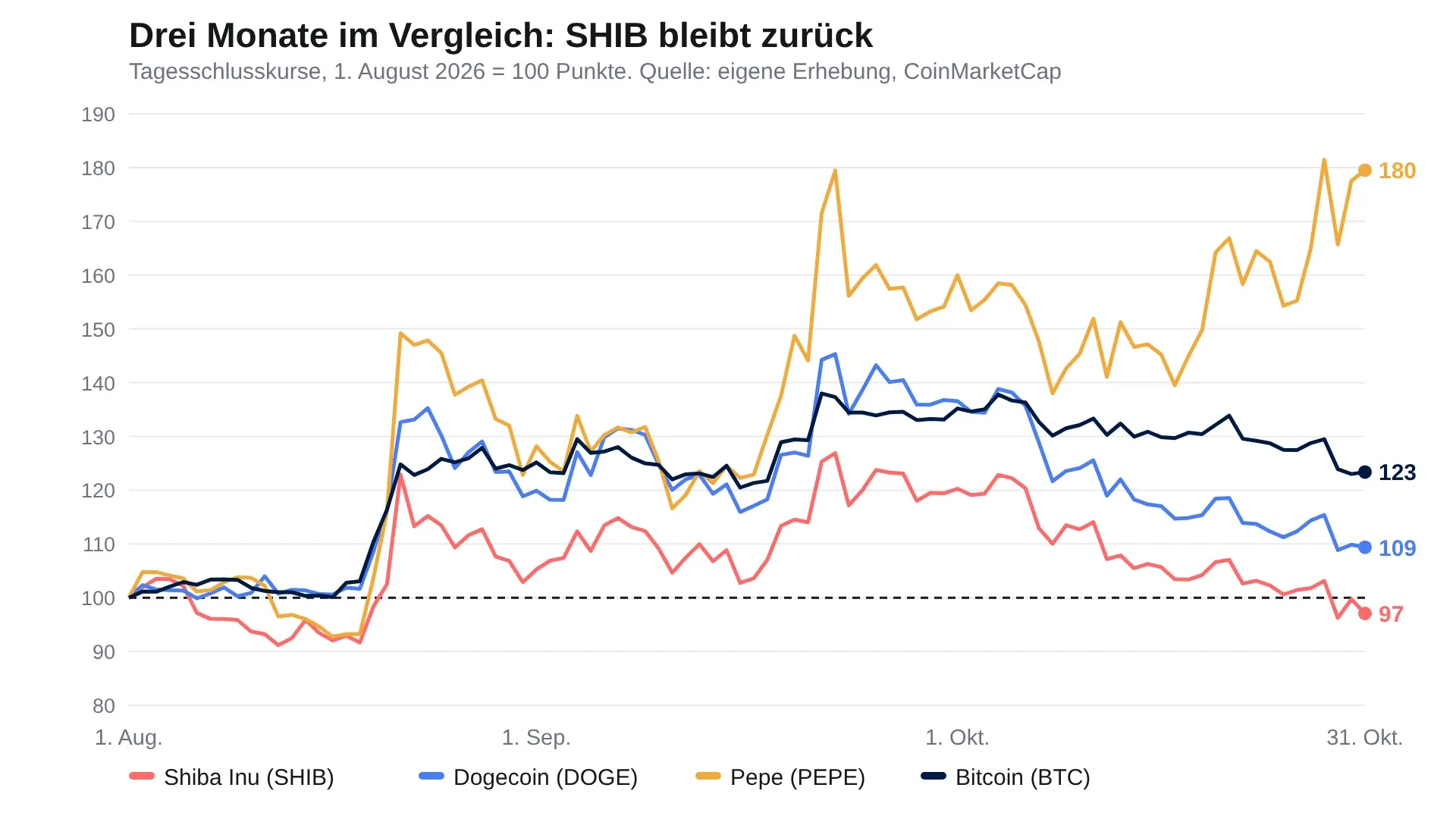
Own survey of daily closing prices from August 1 to October 31, 2026, starting value 100 points. Data source: CoinMarketCap.
What has changed since October 30
On October 30 we reported here on the day's low of $0.00000448 and put the distance to the August low at 2.7 percent. Since then the following has happened: the price has not returned to that low. On October 31 SHIB closed at $0.00000467, and at midday today the token stands at $0.00000468. The distance to the monthly low has widened to 4.4 percent.
At the same time trading volume has fallen sharply. On October 30, SHIB worth $110.4 million changed hands; on October 31 it was $35.1 million, and over the past 24 hours $30.9 million. That is a drop of a good 72 percent within two days. The level held, but it held because hardly anyone tested it.
The levels: $0.00000519 above, $0.00000448 below
Two values currently cap the price above and below, and both can be reasoned rather than asserted.
Above: $0.00000519. That is the average of the closing prices of the past 30 days, calculated from the same series as the chart above. The current price sits 9.8 percent below it. A moving average is not a prophecy but an arithmetic aid: it shows where the market has paid on average in recent weeks. As long as SHIB trades below it, anyone buying now buys cheaper than the monthly average, and anyone who bought in October is on average sitting on a paper loss.
Below: $0.00000448. That is the low of October 30 and at the same time the lowest level of the past 30 days. The distance comes to 4.4 percent. Below it there is no further support from the past 30 days, because the price did not enter that area in October.
The monthly high came on October 3 at $0.00000600. The price is 22.0 percent away from it today. Betting on a return there means betting on a move worth almost a quarter of today's price.
Turnover ratio: why 1.1 percent a day becomes a problem for SHIB
The turnover ratio is daily volume divided by market capitalisation. The figure says what share of all existing tokens is actually traded in a day. For Shiba Inu that is 1.1 percent today: $30.9 million in volume against $2.76 billion in market capitalisation.
By comparison, calculated from the same Sunday midday figures: Dogecoin comes to 2.6 percent, Pepe to 23.0 percent. Pepe therefore turns over almost a quarter of its entire market capitalisation in a single day, Shiba Inu one hundredth. That is the second point of entry alongside the chart picture, and it explains the shortfall better than any price line.
The mechanism behind it is simple. Every buy or sell order meets an order book holding bids and offers. If that book is thinly populated, even a mid-sized order clears several price steps, and the price moves before the order is fully filled. That is exactly what happened on October 29 and 30: across two days with $94 million and $110 million in volume, the price fell from $0.00000496 to $0.00000448, so by 9.7 percent. At Pepe the same volume would barely have left a trace.

Unlike Bitcoin and Ethereum, Shiba Inu has no exchange-traded product in Europe through which larger sums flow into the token on a regular basis.
Liquidity before a SHIB order: three values in the order book
The turnover ratio points to one step that costs nothing and takes a few minutes. You can read these three values at any regulated crypto exchange before you place an order:
- The spread between bid and ask. At the top of the order book sit the highest bid and the lowest offer. You pay the difference immediately with every market order. Above 0.3 percent, the market is thin at that moment.
- The depth next to the current price. Add up the volume sitting in the steps up to one percent above and below the price. If your intended order size is larger than that amount, you move the price with your own order.
- The volume at your exchange, not the total volume. The $30.9 million is the sum across all venues. What decides your fill is the venue where you trade.
In practice, that leads to one consequence: a limit order with a fixed maximum or minimum price protects you in thin books from a fill that deviates sharply from the quoted price. A market order, by contrast, takes whatever price the book offers. For a token with 1.1 percent turnover, that difference is no detail.
MiCA: what applies to trading meme tokens in Europe
The European regulation on markets in crypto assets, MiCA for short, has applied in full since December 30, 2024. The regulation governs who may offer and trade crypto assets in the EU: providers need an authorisation, must segregate client funds and must keep a whitepaper on file. The supervisory authority ESMA maintains the details and the list of authorised providers in its MiCA section.
For holders, that means two things. First, you now trade Shiba Inu only at venues with MiCA authorisation; the German providers received their licences over the course of 2025 and 2026. Second, MiCA changes nothing about the nature of the token itself: a meme token without an issuer falls under the general obligations, not under the stricter rules for asset-referenced tokens or e-money tokens.
Anyone planning to hold SHIB for the longer term should decide custody separately from that. A token on an exchange belongs to you economically but sits in the provider's care. A hardware wallet moves the keys to you, but it also moves the entire responsibility for securing them.
Supply: 589 trillion SHIB and what burning moves
The Shiba Inu project has been burning tokens for years, sending them to an address without a key from which they never return. The idea behind it: a smaller supply lifts the price per token at unchanged demand.
The order of magnitude puts that into perspective. With 589.24 trillion SHIB in circulation, a burn would have to run into the trillions to cut supply by one percent. The amounts actually burned have been orders of magnitude below that for months. Anyone pricing in burning as a price driver should first set it against supply, not against the absolute number of tokens burned.
The same applies to Shibarium, the project's own blockchain. This blockchain generates fees that finance burns. As long as the capital locked there stays small, so does the contribution to burning.
Our assessment of where Shiba Inu stands
From the newsroom's point of view, the quarterly shortfall of 12 points against Dogecoin and 82 points against Pepe is no verdict on the project's technology but a finding about demand. Three documented points support that: the turnover ratio of 1.1 percent against 23.0 percent at Pepe, the volume slump from $110.4 million to $30.9 million within two days, and the fact that the entire quarterly loss stems from the last three weeks, while August and September moved with the market.
Against it stands the fact that SHIB has not revisited the monthly low of October 30 since and trades 4.4 percent above it. A thin order book works in both directions: the same thinness that pushed the price down 9.7 percent on October 29 can carry it up just as quickly on fresh demand. What is missing is the trigger for that. There is no spot ETF on Shiba Inu in Europe, and without such a product there is no route through which institutional money flows into a token on a regular basis.
No buy recommendation follows from this. What follows is a check: anyone holding SHIB should know how much volume turns over daily at their venue, because that determines the price at which they get out if it matters.
SHIB quarterly scorecard: 97 points and turnover still falling
Shiba Inu closes the quarter below its starting value, while Dogecoin, Bitcoin and Pepe sit above it. The price stands at $0.00000468, 9.8 percent below the 30-day average and 4.4 percent above the monthly low. Three steps that follow from this:
- Look up the volume at your own venue. The depth of the order book decides your fill price, not global total volume. Which venues are authorised in the EU and what their fees look like is set out in the overview of crypto exchanges.
- Decide custody separately from the price. Whether the token sits on the exchange or on your own hardware is a question of counterparty risk, not of market conditions. The hardware wallet comparison ranks the devices by handling and price.
- Document purchases and sales cleanly. For the tax return, every single position counts with its date and price. How to solve that without manual work is shown in the overview of crypto tax software.
(As of November 1, 2026. This article is not investment advice. Prices and fee structures change; check the terms with the provider before you buy.)