The Shiba Inu price stood at $0.00000385 at around 9:40 pm CET on Tuesday evening, according to CoinGecko. That is down 0.4 percent on the previous day, 12.5 percent on the week and 21.5 perc
The Shiba Inu price stood at $0.00000385 at around 9:40 pm CET on Tuesday evening, according to CoinGecko. That is down 0.4 percent on the previous day, 12.5 percent on the week and 21.5 percent on the month. The 24-hour range ran from $0.00000375 to $0.00000389. SHIB is therefore still trading below the summer's lowest daily close of $0.000004115, set on July 17.
Two figures from Tuesday show that something is moving beneath this calm surface. According to data from the analytics firm CryptoQuant, evaluated by the news site U.Today on November 17, around 312 billion SHIB flowed out of centralised exchanges, the first notable outflow since the weekend sell-off. On the same day, the number of addresses holding SHIB passed 1.7 million for the first time, according to Etherscan. This article explains what both figures mean, and what they do not.
Shiba Inu exchange outflow: what 312 billion SHIB at CryptoQuant means
An exchange outflow measures how many coins have left the addresses of the large trading venues, net of inflows. It is read as a sign that investors are moving coins into their own custody rather than keeping them ready to sell. CryptoQuant does this by tagging known exchange addresses and adding up the movements on the Ethereum blockchain, where SHIB runs as a token.
312 billion SHIB sounds enormous but is small in relative terms. According to the same data, the tracked exchanges hold around 86 trillion SHIB. The outflow therefore equals about 0.36 percent of that balance. At Tuesday evening's price, 312 billion SHIB are worth around $1.2 million. Trading volume over the past 24 hours was $44.1 million according to CoinGecko, roughly 37 times as much.
The news site TokenPost also cited the same order of magnitude on November 17 and warned against reading too much into it. A single withdrawal, it said, does not prove a lasting accumulation trend. U.Today put it plainly: the trend is unlikely to reverse at this point. Both assessments are the sites' opinions, not measurements.
Etherscan counts 1.7 million Shiba Inu holders: why that is not 1.7 million investors
The second figure of the day comes straight from the blockchain. The block explorer Etherscan, a public database of all Ethereum transactions, has listed around 1,700,247 holder addresses for the SHIB contract since Tuesday. U.Today reported in the morning that the 1.7 million threshold had been crossed for the first time.
A holder address is not the same as an investor, however. One person can own many addresses, and anyone who buys SHIB on an exchange usually does not show up as a separate address at all, because the exchange pools its customers' holdings in a few omnibus addresses. Conversely, every withdrawal from an exchange to a private wallet often creates a new address. Rising holder numbers in a week of exchange outflows therefore fit together well; in part, they measure the same process.
The trend says more than the level. The number of SHIB addresses has been growing slowly for years, even in weak phases. A record holder count is therefore no buy signal but rather a sign that holdings are being spread more widely. What matters for the price is whether new demand arrives, and that shows up in trading volume and inflows, not in the number of addresses.
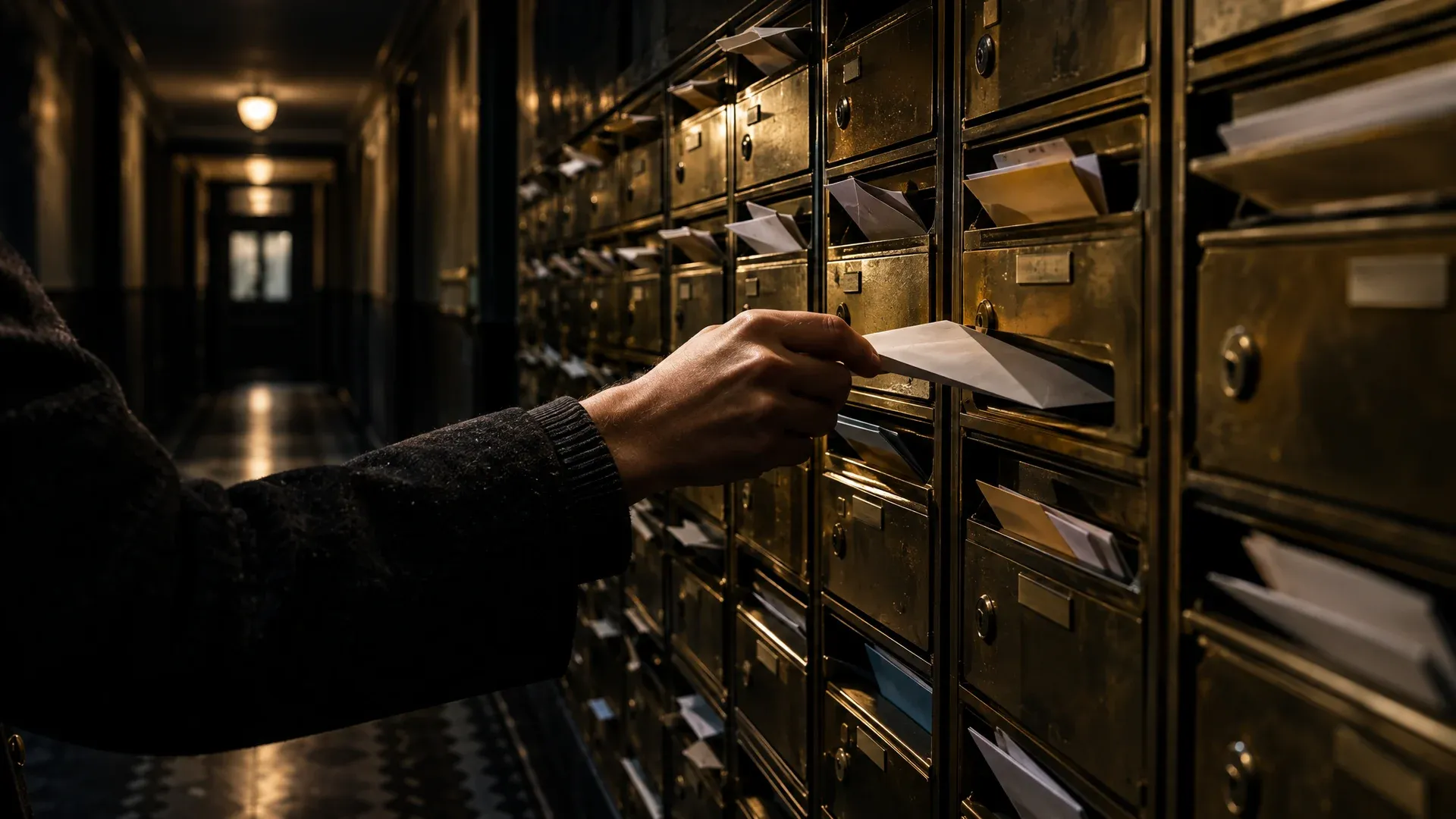
Many letterboxes, but not as many residents: an address is not the same as an investor.
Shiba Inu price below the July low: where the levels are now
On the chart, SHIB left a zone over the weekend that had held since the summer. In July, the price never closed below $0.000004115 on CoinGecko's daily data, and a jump to $0.0000053 followed at the end of July. On Sunday, November 15, the daily close fell to $0.00000383, the lowest level of the past twelve months. Since then the price has hovered just above it.
On the upside, the first level is the July floor itself. U.Today names $0.00000413 as the zone where the price turned in July. A move back above it would at least partly repair the weekend's break. Above that sit the moving averages: TokenPost puts the 50-day average at around $0.0000047 and the 200-day average at around $0.0000053.
On the downside, TokenPost sees support at around $0.0000035, while U.Today expects $0.000003 if losses continue. The relative strength index, a gauge of how one-sided a price move has been, stood at 27 on the daily chart according to TokenPost. Readings below 30 are considered oversold. That does not mean the price will turn, only that the recent decline was unusually steep.
Death cross and rank 39: what has happened to SHIB since the weekend
Regular readers know the background. On November 15 we reported on the first Shiba Inu death cross since September 2025, when the 50-day average fell below the 200-day average. On Monday the focus was on the weekly burn tally: the tokens destroyed in a week were worth just $606 at the time. Tuesday changed nothing there; the burn rate still carries no weight for the price.
Market value has shifted further. On Tuesday evening CoinGecko ranked Shiba Inu 39th among the largest cryptocurrencies with $2.27 billion, down from 38th on Monday. A year ago, on November 18, 2025, its market value was $5.05 billion and the price $0.00000857. That is a fall of 55 percent in twelve months. SHIB is 95.5 percent below its record high of $0.00008616 from October 27, 2021.
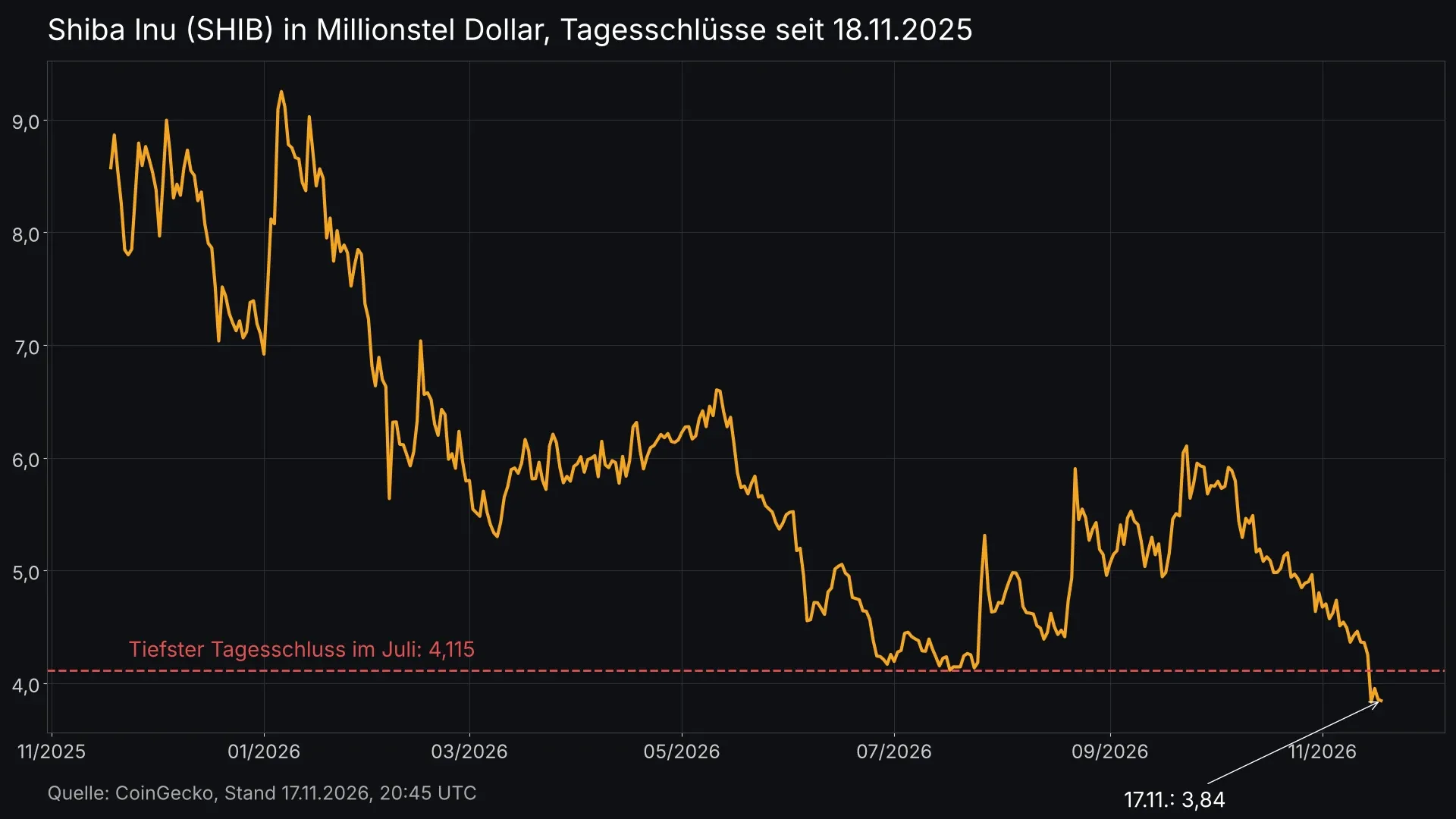
Shiba Inu price in millionths of a dollar over 365 days; the line marks the lowest daily close in July. Source: CoinGecko, as of November 17, 2026, 20:45 UTC
Storing SHIB after the withdrawal: what to keep in mind
For many holders, the outflow from exchanges means a switch to self-custody. With SHIB this is particularly easy and at the same time error-prone. Because Shiba Inu is an ERC-20 token, a token built to the Ethereum blockchain's standard, the destination needs an Ethereum address, and every transfer costs a fee in ETH. Anyone who withdraws SHIB without holding ETH in the wallet will not be able to move the tokens later.
The network chosen for the withdrawal also matters. Some exchanges offer SHIB on other networks besides Ethereum. Pick the wrong one and the tokens go to an address that cannot process them. Before every withdrawal, check that the exchange and the wallet use the same network, and for larger amounts send a small test transaction first.
Buying SHIB under MiCA: which exchanges may offer it in the EU
Since the transition periods of the EU's MiCA regulation ended, trading venues that offer crypto assets to customers in the EU need authorisation as a crypto-asset service provider. In Germany that licence is granted by BaFin; an authorisation from another EU country is valid across the bloc. Anyone who wants to buy or sell SHIB should first check whether the exchange holds such an authorisation and whether Shiba Inu is listed there at all. Which providers qualify and what they charge is shown in our crypto exchange comparison.
With a coin priced in millionths of a dollar, fees are more noticeable than many expect. The gap between the buying and selling price, the spread, can amount to several tenths of a percent on small exchanges. On a 500-euro purchase, that quickly adds several euros on top of the stated fee.
SHIB after the outflow: below $0.00000413 the signal is missing
Tuesday evening's picture can be summed up like this: 312 billion SHIB have left the exchanges, 1.7 million addresses hold the token, and at $0.00000385 the price sits below the summer floor. The outflow is too small to tighten the supply on exchanges noticeably. As long as the price does not return above $0.00000413, the weekend's break stands. Two things you can do today:
- Check your exchange's licence: Make sure your trading venue is authorised under MiCA. Our comparison of regulated crypto exchanges gives an overview.
- Set your levels: If you hold SHIB, decide what you will do on a daily close above $0.00000413 or below $0.0000035. Our Shiba Inu price prediction looks at the months ahead.
(As of November 17, 2026. This article is not investment advice. Prices and fee structures change; check the terms with the provider before you buy.)