The Monetary Authority of Singapore offered a tokenized MAS Bill on 6 November 2026, with S$100 million in short-term sovereign debt settled entirely via wholesale central bank digital curren
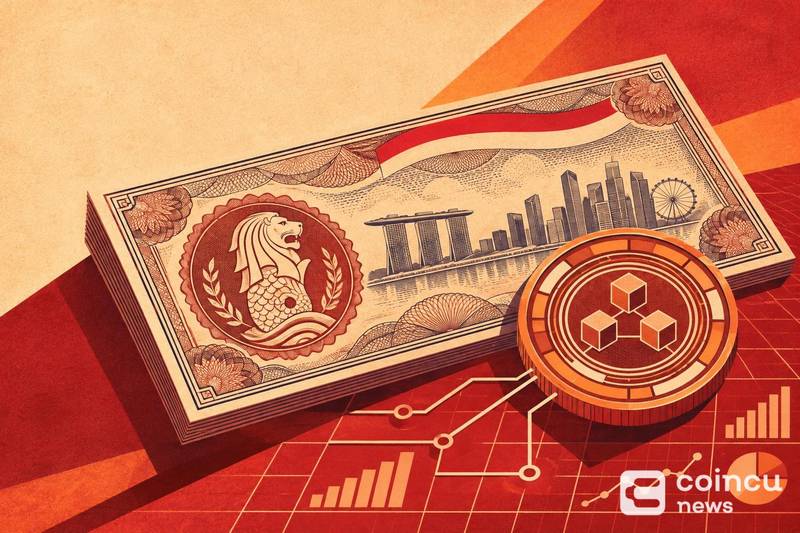
The Monetary Authority of Singapore offered a tokenized MAS Bill on 6 November 2026, with S$100 million in short-term sovereign debt settled entirely via wholesale central bank digital currency. The final allotment amount has not been publicly confirmed.
Singapore's S$100 million tokenized Treasury-bill issuance at a glance
The instrument, identified by Issue Code TD26102S and ISIN SGXZ46841136, was announced on 3 November 2026, auctioned on 4 November, and settled on 6 November 2026 with a maturity date of 4 December 2026, giving it an approximately 28-day tenor, per the official MAS auction calendar. The bill is non-coupon bearing, carries a minimum denomination of S$1,000, and is restricted to institutional investors under Section 4A of Singapore's Securities and Futures Act. For related coverage, see Cyber Revolution Summit – Singapore 2026.
Settlement is conducted in wholesale CBDC through the Singapore Dollar Test Network (SGD Testnet), making MAS simultaneously the issuer of the debt instrument and the provider of the settlement asset, an arrangement that eliminates the settlement-asset credit risk present in conventional T-bill auctions where commercial bank money clears the transaction. The tokenized bills are also excluded from standard MAS Bills reporting statistics, keeping the program's data trail separate from conventional issuance aggregates, according to the MAS auction calendar. Context on this theme: Bitmine ETH Treasury: Asia Session Roundup, Nov. 18, 2026.
What has been announced
The S$100 million figure represents the total amount offered at auction; MAS has not publicly confirmed the final allotment amount, and a single independent analysis noted that published figures reflect offered amounts rather than amounts actually allotted, meaning final placement could differ. The QDS (Qualifying Debt Securities) tax incentive treatment has been confirmed through 31 December 2028, providing institutional buyers with a tax-efficient wrapper alongside the digital settlement mechanics. More on this in VALR Launches ‘VALR Business’ to Power Global Payments and Treasury Management for Modern Enterprises.
Why the issuance amount matters
Independent analyst Kate Grey's APAC Tokenisation Week review reported S$1 million in September 2026, S$10 million in October 2026, and S$100 million offered in November 2026. Background reading: Bitcoin ETF Outflows: US Session Roundup.
How tokenized Treasury bills work
The underlying T-bill
A Treasury bill is a short-term, zero-coupon debt obligation issued by a sovereign government; the investor buys the bill at a discount to face value and receives par at maturity, with the difference representing the yield. MAS bills are the Singapore equivalent, issued routinely to manage domestic liquidity. The tokenized variant carries identical sovereign credit characteristics: the obligation is MAS's, the maturity and face value are fixed, and the QDS tax treatment applies on the same terms as conventional issuance.
The role of tokenization
Tokenization in this context means the bill's ownership record and settlement instructions exist on a permissioned digital ledger rather than in a conventional securities depository. The critical difference from earlier tokenization experiments is the settlement layer: rather than using commercial bank money or a stablecoin as the payment leg, the SGD Testnet delivers wholesale CBDC directly between institutions, creating atomic delivery-versus-payment where the securities leg and the cash leg finalize simultaneously without intraday credit exposure. DBS, OCBC, and UOB participated in the first live trial of the SGD wholesale CBDC through interbank overnight lending transactions, according to Fintech News Singapore's coverage of MAS's BLOOM initiative and Project Guardian, establishing the same banking consortium as likely participants in the T-bill auction channel.
This architecture directly addresses the critique that tokenized real-world assets remain dependent on traditional settlement rails for the cash leg, which reintroduces the credit and timing risks that tokenization is designed to remove. MAS Managing Director Chia Der Jiun framed the broader challenge at the Singapore FinTech Festival: "Are asset-backed tokens clearly out of the lab? Without a doubt. But have asset-backed tokens achieved escape velocity? Not yet," according to The Block's reporting on the announcement. The November issuance is MAS's operational answer to that question, moving the CBDC settlement rail from interbank lending tests to sovereign debt auctions.
What the November issuance could mean for Singapore's digital-asset market
A signal for tokenized real-world assets
For asset managers and primary dealers evaluating tokenized real-world asset programs, an S$100 million sovereign instrument settled in wholesale CBDC carries different risk weighting than a corporate or fund-level token; it establishes a sovereign-grade benchmark for digital settlement finality in Singapore dollar markets. Singapore's approach also arrives amid concurrent activity from other central banks: Hong Kong launched tokenized Exchange Fund Bills and Kazakhstan issued KZT 10 billion in tokenized notes in the same period, per Kate Grey's comparative APAC tokenization analysis, forming a simultaneous regional wave rather than isolated experiments.
WisdomTree's registration of three tokenized funds in Singapore, alongside Synthesys's related collaboration, illustrates the private-sector infrastructure being built in parallel with MAS's sovereign issuance program. The gap between sovereign CBDC-settled instruments and fund-level tokenization products is narrowing as the SGD Testnet matures.
Chia Der Jiun stated that "as usage of private digital money scales, CBDCs will ultimately be needed to anchor monetary stability," per Fintech News Singapore's coverage of his remarks at the INSEAD Digital Finance Summit on 9 October 2026. The November T-bill issuance operationalizes that position: wholesale CBDC as the foundational settlement layer for tokenized sovereign instruments creates a central bank anchor beneath the growing private tokenized asset ecosystem.
Questions for investors and market participants
Several material details have not been publicly disclosed as of this writing. The list of primary dealers who participated in the 4 November auction has not been confirmed. The final allotment figure, as distinct from the S$100 million offered amount, has not been published. MAS has also not stated publicly whether the SGD Testnet will transition from a test network to a production settlement rail, nor under which legal finality rules settled transactions would be treated, a gap that matters significantly for participants computing netting exposures and capital requirements under Basel frameworks. These open questions limit direct comparisons between the tokenized MAS Bill program and conventional repo or money-market infrastructure.
Scaling trajectory and next milestones
MAS has not publicly announced a fourth issuance date, tenor, or target size.
The QDS tax incentive window runs through 31 December 2028, per the MAS auction terms, giving the program a 25-month horizon in which tokenized MAS Bills carry the same tax treatment as conventional qualifying debt. That window is likely the operational runway MAS has set for determining whether wholesale CBDC settlement can graduate from test network to permanent infrastructure. Market participants watching for concrete next steps should monitor MAS announcements on the SGD Testnet's production timeline, any expansion of the institutional investor base beyond current primary dealer channels, and whether MAS publishes allotment data that would reveal actual market demand at the S$100 million size.
"Are asset-backed tokens clearly out of the lab? Without a doubt. But have asset-backed tokens achieved escape velocity? Not yet."
Chia Der Jiun, MAS Managing Director, via The Block
FAQ: Singapore's tokenized Treasury bills
What are tokenized Treasury bills?
Tokenized Treasury bills are conventional short-term government debt instruments whose ownership records and settlement instructions are represented on a digital ledger. The underlying credit obligation remains sovereign; the difference lies in how transactions are recorded and settled. In MAS's program, settlement uses wholesale CBDC through the SGD Testnet rather than commercial bank money, eliminating the cash-leg credit exposure present in conventional T-bill auctions.
How large is the reported Singapore issuance?
The tokenized MAS Bill offered S$100,000,000, auctioned on 4 November 2026 and issued on 6 November 2026, with maturity on 4 December 2026. The S$100 million figure is the amount offered; the final allotted amount has not been confirmed publicly.
Does tokenization make Treasury bills a cryptocurrency?
No. A tokenized MAS Bill is a Singapore government debt obligation; it carries sovereign credit risk, is restricted to institutional investors under Section 4A of the Securities and Futures Act, and matures at face value within a fixed short-term tenor. The digital representation on the SGD Testnet is a settlement and record-keeping mechanism, not a speculative asset. It qualifies for QDS tax incentives on the same basis as conventional Singapore government securities through 31 December 2028.
As of 6 November 2026, the following details are unconfirmed: the final allotment figure versus the S$100 million offered amount; the specific primary dealers who participated in the 4 November auction; whether and when the SGD Testnet transitions to a production settlement rail; and the legal finality framework that would govern settled transactions under Basel capital rules. MAS has not announced a fourth tokenized bill issuance date, size, or tenor.
Editorial credits
EZ
Elena Zenth
Writer · Coincu
SD
Samantha Doyle
Duty editor · Coincu
Monitors published articles around the clock and can correct or withdraw them.
Checked by Coincu QC Team before publishing on November 19, 2026 for headline accuracy, factual consistency, metadata and authorship claims: our AI review system checks every article before it goes live, and our duty editor monitors it after publication. Report an error.
Coincu uses AI for research, drafting and review. Our editorial team is responsible for every article and corrects or withdraws articles when needed. How we review.
Disclaimer: This article is for informational purposes only and does not constitute financial or investment advice. Cryptocurrency and digital asset markets carry significant risk. Always do your own research before making decisions.
The post Singapore Offers S$100M Tokenized MAS Bill; Final Allotment Unconfirmed was initially published on Coincu.