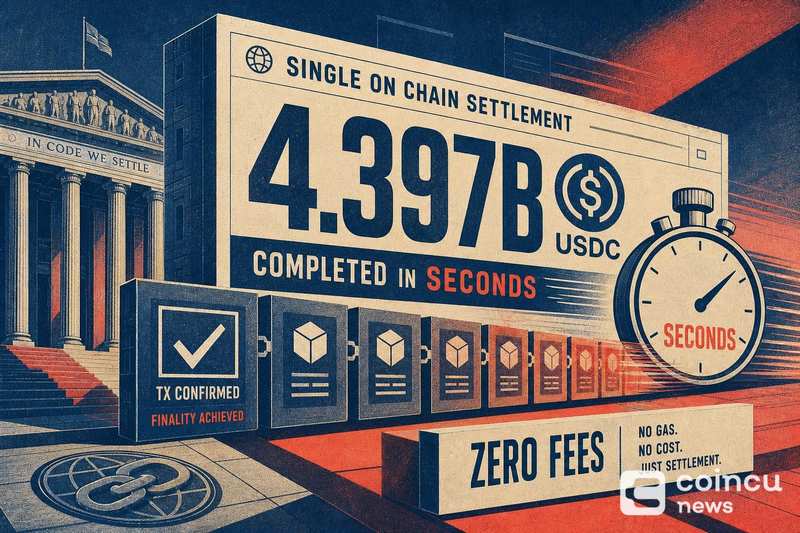
A single on-chain settlement of 4.397 billion USDC reportedly completed in seconds with zero transaction fees, marking one of the largest stablecoin transfers ever recorded on a public blockc
A single on-chain settlement of 4.397 billion USDC reportedly completed in seconds with zero transaction fees, marking one of the largest stablecoin transfers ever recorded on a public blockchain.
4.397 Billion USDC Settlement Draws Attention
The transfer took place on HyperEVM, the Ethereum-compatible execution layer of the Hyperliquid network. According to a Blockchair report, Circle moved the USDC to Coinbase via HyperEVM in a single transaction rather than splitting it across multiple batches.
The settlement completed on-chain without visible network fees. The address involved in the transfer can be viewed on the HyperEVM block explorer.
ON-CHAIN DATA
- Network: HyperEVM (Hyperliquid)
- Amount: 4,397,000,000 USDC
- Reported fees: Zero
- Settlement address: 0xb883...630f
Why Settlement Speed and Zero Fees Matter
The reported completion time of seconds for a transfer exceeding $4 billion stands in contrast to traditional wire transfers of comparable size, which typically require multiple intermediaries, compliance checkpoints, and settlement windows measured in hours or days.
The zero-fee aspect warrants careful interpretation. HyperEVM operates with a distinct fee model compared to Ethereum mainnet, as described in Hyperliquid's technical documentation. Whether "zero fees" reflects a permanent network characteristic, a subsidized period, or a specific transaction type exemption remains unclear from available data.
For large-value transfers, even small percentage-based fees become significant at the billion-dollar scale. A traditional correspondent banking fee structure applied to a $4.4 billion transfer would result in meaningful costs that this settlement reportedly avoided entirely.
The settlement speed reflects the block finality time of the HyperEVM chain rather than any special treatment of this particular transaction. All transactions on the network benefit from the same confirmation speed, which positions the infrastructure as a potential channel for high-value institutional settlement.
What the Transaction Suggests About On-Chain Capital Movement
A multi-billion-dollar stablecoin amount moving in one settlement demonstrates the technical capacity of blockchain infrastructure to handle transfers at a scale typically associated with central bank operations or major interbank settlements.
The transfer between Circle and Coinbase suggests treasury management or liquidity provisioning rather than speculative trading activity. Both entities have a well-documented commercial relationship, with Coinbase serving as a key distribution partner for USDC. Investors tracking institutional-scale capital flows may also want to monitor developments like BTC liquidation risks on major centralized exchanges, which reflect how large movements can ripple through crypto markets.
However, one transaction, however large, does not by itself demonstrate that a network can handle sustained high-volume settlement activity. Capacity under load is a different benchmark than a single large transfer, and institutional adoption depends on consistent performance over time.
Key Questions Around the Transfer Details
Several details about the transfer have not been independently verified. The exact timestamp, block number, and full transaction hash have not been confirmed in publicly available reporting beyond the Blockchair summary and the HyperEVM address page.
The purpose of the transfer, whether it relates to exchange liquidity management, reserve rebalancing, or another operational function, has not been disclosed by either Circle or Coinbase. Large stablecoin movements between issuers and exchanges are routine but rarely explained publicly.
The "zero fees" claim also requires clarification. It is unclear whether the transaction incurred no network gas fees whatsoever, or whether fees were subsidized or absorbed by the network at its current stage of development. This distinction matters for evaluating the long-term cost structure of using HyperEVM for institutional settlement.
As the crypto industry faces increasing regulatory scrutiny, the ability to move billions in seconds raises both efficiency and oversight questions. This tension is visible across the sector, from legitimate infrastructure advances to enforcement actions like the recent indictment targeting a multimillion-dollar crypto fraud scheme, underscoring why regulators are working to establish clearer frameworks.
For the Hyperliquid ecosystem specifically, processing a settlement of this size serves as a practical stress test. Whether additional institutional participants route large settlements through HyperEVM will depend on factors including security track record, regulatory clarity, and integration with existing compliance workflows. Market participants watching for similar large-scale developments may note parallel moves in traditional finance-crypto convergence, such as BitMine's planned NYSE listing of its preferred stock.
FAQ About the 4.397 Billion USDC Settlement
What happened?
A single on-chain transaction moved 4.397 billion USDC on the HyperEVM network, reportedly completing in seconds with zero transaction fees. The transfer was between Circle and Coinbase.
What is USDC?
USDC is a stablecoin issued by Circle that maintains a 1:1 peg with the U.S. dollar. Each token is backed by cash and short-duration U.S. Treasury securities held in reserve.
Why does zero fees matter for this transfer?
Zero transaction fees on a multi-billion-dollar settlement demonstrate that blockchain networks can process large-value transfers without the percentage-based or flat fees charged by traditional payment networks and correspondent banks.
Does this prove blockchain is ready for institutional settlement?
A single transaction does not prove sustained institutional readiness. It demonstrates technical capability, but broader adoption depends on regulatory frameworks, security guarantees, and consistent performance under varied conditions.
What remains unconfirmed?
The exact transaction hash, precise timestamp, and the specific reason for the transfer have not been publicly disclosed or independently verified beyond available block explorer data and a Blockchair report.
Disclaimer: This article is for informational purposes only and does not constitute financial or investment advice. Cryptocurrency and digital asset markets carry significant risk. Always do your own research before making decisions.
The post Single On-Chain Settlement of 4.397 Billion USDC Completed in Seconds With Zero Fees was initially published on Coincu.