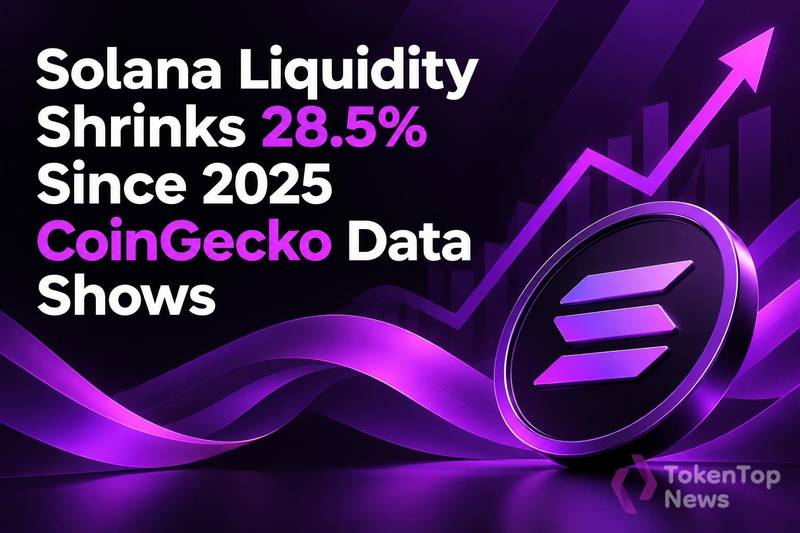
CoinGecko data shows Solana liquidity has contracted by more than 28.5% since the start of 2025, a shift that changes the risk profile for traders and market makers operating on the network.
CoinGecko data shows Solana liquidity has contracted by more than 28.5% since the start of 2025, a shift that changes the risk profile for traders and market makers operating on the network. Shrinking liquidity depth affects how efficiently large orders can be filled and how sharply prices can move on relatively modest volume.
What the reported decline actually measures
Liquidity, in this context, refers to the depth of available buy and sell orders on exchanges and decentralised venues at any given price level, not raw trading volume or market capitalisation. A CoinGecko reading of more than 28.5% contraction since 2025 indicates that the market can absorb meaningfully less order flow at current prices before moving against the trader. For related coverage, see 3x Bitcoin ETF Approved by SEC: Market Impact Explained.
The distinction matters: a token can record high daily volume while its underlying order book thins out, masking a deterioration in execution quality. Solana has seen periods of rising open interest and ETF inflows, which makes a concurrent liquidity contraction a signal worth examining separately from headline price action. For related coverage, see Ethereum Address-Poisoning Attack Drains $12,000 USDC.
Why the percentage matters for SOL markets
A decline of this magnitude pushes spreads wider and increases slippage for orders above a certain size threshold. Market makers who provide depth need adequate fee revenue and low inventory risk to maintain tight quotes; when conditions shift against them, they pull back, compressing the order book further. The result is a feedback loop that can amplify both upside and downside moves from a thinner starting point.
On-chain liquidity data tracked by DeFiLlama for Solana-based DeFi protocols provides a parallel view of how much capital is actively deployed across the network's decentralised venues, and any divergence between centralised exchange depth and on-chain TVL can signal where liquidity has migrated rather than simply disappeared.
What thinner Solana liquidity means for traders
Reduced depth raises the cost of execution for institutional and high-frequency participants most immediately, but retail traders feel the impact through wider bid-ask spreads and less predictable fill prices during volatile sessions. Solana's speed advantage at the network layer does not insulate it from order book thinning at the market-structure level.
Risks for SOL traders and market makers
With less depth buffering price impact, the same dollar volume of selling pressure will move SOL's price further than it would in a deeper market. This dynamic works in both directions: a smaller buy order can also push price higher, but it increases the risk of sharp reversals when that momentum fades. Traders relying on technical levels should account for the possibility that thinner liquidity makes those levels easier to breach and easier to reclaim.
The growing institutional interest in Solana through ETF products creates an interesting tension here: structured products that track SOL's price can attract capital without directly adding order book depth, meaning demand growth and liquidity growth can diverge.
Signals that would confirm or challenge the trend
A sustained narrowing of bid-ask spreads across major SOL trading pairs, combined with rising depth figures on CoinGecko's liquidity tracker, would indicate the contraction is reversing. Conversely, continued withdrawal of market-maker capital from both centralised order books and on-chain pools would confirm that the trend reported since 2025 remains intact. Monitoring CoinMarketCap volume-to-liquidity ratios alongside raw price data gives a more complete picture than either metric alone.
Indicators to monitor going forward
Traders and analysts tracking the Solana market should watch bid-ask spread data on major centralised venues alongside on-chain pool depth for Solana's largest decentralised exchanges. A widening spread relative to volume is the clearest confirmation that liquidity remains constrained.
TVL shifts across Solana DeFi protocols, available through DeFiLlama's chain-level dashboard, provide a secondary signal. If total value locked continues to decline while trading volume holds, it points to concentrated rather than broad-based liquidity, which creates fragility at times of stress. Broader macro-driven crypto market moves can accelerate the impact of thin order books, making the liquidity backdrop especially relevant during periods of elevated cross-market volatility.
Readers tracking this trend should verify updated figures directly against CoinGecko's Solana market page, as liquidity conditions can shift materially between reporting periods.
Disclaimer: This article is for informational purposes only and does not constitute financial or investment advice. Cryptocurrency and digital asset markets carry significant risk. Always do your own research before making decisions.
Read original article on tokentopnews.com