On this Monday, November 2, 2026, Solana has run for exactly 1,000 days without a network-wide halt. The SOL price is not celebrating: on Monday evening a token cost $92.78, the lowest since
On this Monday, November 2, 2026, Solana has run for exactly 1,000 days without a network-wide halt. The SOL price is not celebrating: on Monday evening a token cost $92.78, the lowest since August 21, and the line on which much now depends sits at $88.86.
What is established: the last full outage of the Solana blockchain began on February 6, 2024 at 09:53 UTC, and since then the network has not lost a block in a way that stopped the whole chain. It is also established that SOL has lost 22 percent in 30 days and that US spot funds are shedding money for the fourth week in a row. Our assessment follows further down: the technical record is better than ever, but in the short term it does not carry the price as long as capital stays away.
Where the price could head over a horizon of months is covered by our Solana price prediction. This piece stays with the coming days and weeks: which levels matter now, why the network's reliability is not a buy signal, and what you as an investor in Germany can actually do with this knowledge.
Solana without a halt since February 6, 2024: what exactly is being counted
What is counted is a so-called network-wide outage. That means a state in which the validators, the machines that produce and confirm new blocks, can no longer reach consensus and the entire blockchain stops. No user can send a transfer, and no exchange can book deposits or withdrawals in SOL. Slow confirmations, overloaded interfaces at individual providers or failed wallet servers do not count.
From the halt on February 6, 2024 to today, November 2, 2026, it is 1,000 days to the day. We checked the arithmetic ourselves: 366 days to February 6, 2025, another 365 to February 6, 2026 and 269 days to today. The news site U.Today reported the milestone on Monday afternoon, citing a project statement from September according to which the network has achieved 100 percent availability since February 2024.
How robust that figure is can be seen in an incident from August 2026, which U.Today also lists: a routing error at a large infrastructure provider knocked out validators holding almost 29 percent of staked capital. Block production carried on regardless. In 2021 and 2022 far less had been enough to stop the network for hours.
The last outage: five hours of downtime caused by the JIT cache
The developer firm Anza published a detailed review of the February outage three days later. According to the outage report from the developer firm Anza, the cache for compiled programs, the so-called JIT cache, got stuck. A JIT compiler translates smart contract code into machine code only at execution and stores the result in that cache. A program of the old loader type fell into a loop of deployment, eviction and renewed request and was recompiled without end.
Because more than 95 percent of stake weight ran the same software version 1.17, almost all validators got stuck on the same block. Nobody voted any more, and consensus broke down. Operators restarted the network after almost five hours with the corrected version 1.17.20. Anza itself conceded that the same bug had halted the Devnet test network a week earlier.
For today's assessment the second number matters most: 95 percent on a single piece of software. According to U.Today, the incidents since 2024 stayed confined to parts of the network. A residual risk remains, because every blockchain of this size depends on a small number of codebases.
SOL at $92.78: lowest level since August 21
At around 18:30 German time on Monday evening, SOL stood at $92.78, 2.1 percent below the previous day and 8.3 percent below its level a week ago. That took it below the low of the past 24 hours once more. Around $2.26 billion worth of SOL changed hands over that period, and market capitalisation was $54.8 billion. Those are the figures shown by CoinGecko's market overview.
Over 30 days the loss comes to 22 percent. That leaves SOL roughly 68 percent below its all-time high of $293.31. The fall below $100 came on October 30, and the price has not reclaimed the round number on any day since. The last daily close lower than today's came on August 21, when SOL finished at $87.65 in the middle of the summer rally.
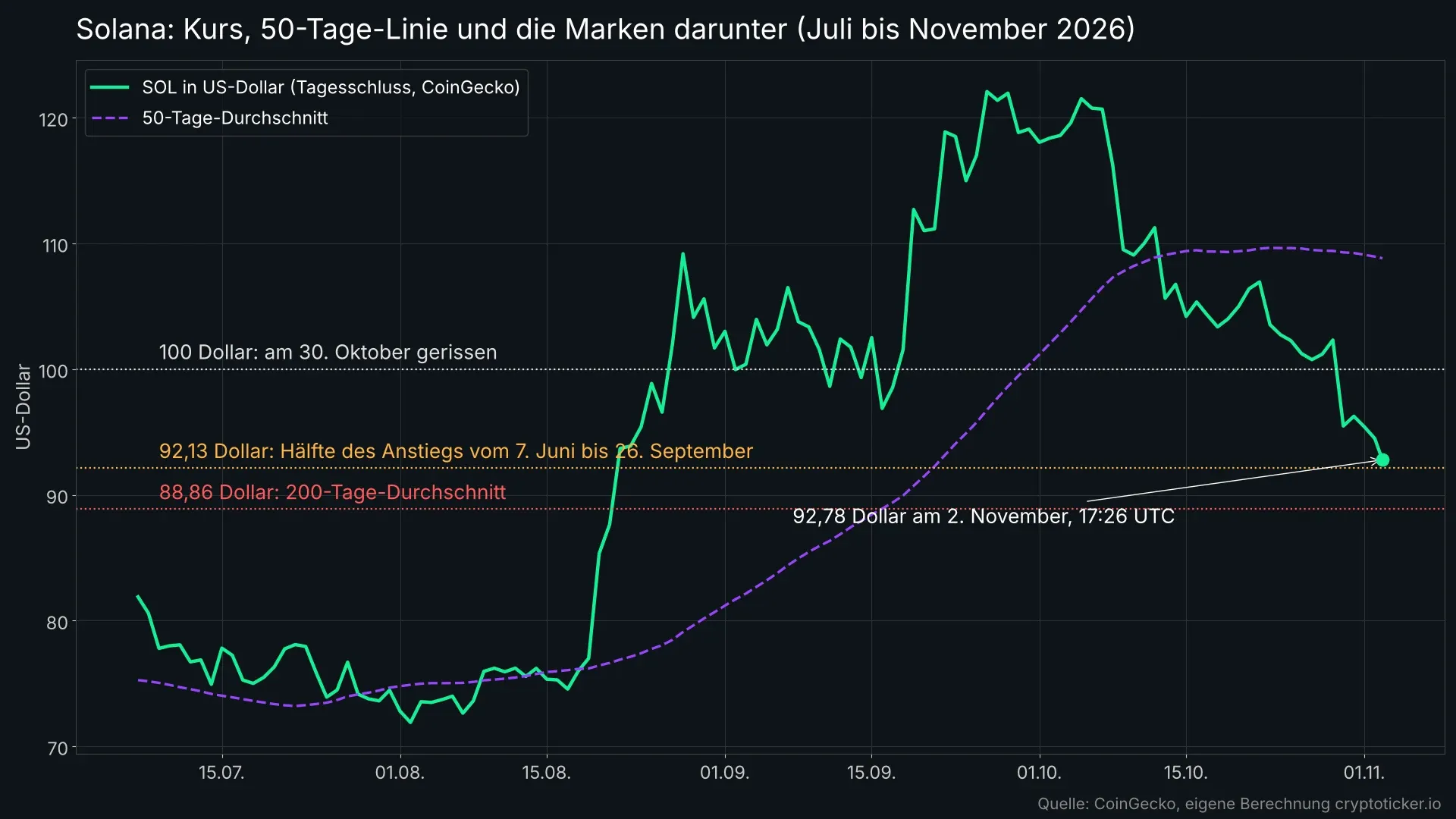
Since the high on September 26, SOL has lost its 50-day average and is approaching the 200-day line. Source: CoinGecko, own calculation.
50-day and 200-day moving averages: the key levels on the Solana chart
For these levels we analysed CoinGecko's daily closing prices ourselves. A moving average is the mean of closing prices over a fixed number of past days; it smooths the curve and many traders treat it as the boundary between an upward and a downward phase.
Upside: $100 and $108.82
The first hurdle is the $100 mark, which gave way on October 30. Above it, the 50-day average sits at $108.82. The price slipped below this line in mid-October, and the line itself is starting to fall. Only a close above $108.82 would formally end the downtrend that began at the September 26 high of $122.08.
Downside: $92.13, $88.86 and $77
At $92.13 lies the halfway point of the summer rally from the June 7 low ($62.18) to the September 26 high. That level is already being tested on Monday evening. Below it is the 200-day average at $88.86. It is still rising slightly, because prices in early summer were far below today's level. If SOL fails to hold this line, the zone around $77 comes into view: on August 19 SOL closed at $77.00, the last day before the big breakout of the summer.
Why network stability does not support the SOL price
The mechanism is quickly explained. An outage weighs on the price because traders can no longer move their positions and exchanges halt deposits and withdrawals. On February 6, 2024, according to FXStreet, long positions worth more than $2 million were forcibly closed within a few hours. The absence of such an event, however, creates no new demand. Reliability is a precondition for funds, payment providers and banks to use the network, but it is no reason to buy SOL on any particular day.
In the short term the price follows the flow of capital: spot funds, the futures market, large wallets and the daily issuance of new tokens. That is exactly where things look weak. The 1,000 days are therefore more of an argument for the long run, for valuing Solana as a platform on which applications settle. If you think in terms of years, you can give the figure a lot of weight. If you are looking at the next few weeks, you should give it very little.
What has changed since our Solana analysis of November 1
Our Solana analysis of November 1 dealt with two wallets that moved $111 million in SOL to Coinbase Institutional, and with $71.5 million in outflows from the funds. At the time, on Sunday afternoon, SOL cost about $94.70. Today it is $92.78, a little more than 2 percent less.
The $94 level around which the price was still oscillating on Sunday gave way on Monday afternoon. New is the test of the halfway line of the summer rally at $92.13, which was still a few dollars away at the weekend. The direction is unchanged: since September 26 SOL has not closed a single week in positive territory, and according to FXStreet this is the fifth losing week in a row.

Green signals on the network say little about how much freight is moving: at Solana it is capital that is missing, not technology.
Solana spot ETFs: fourth straight week of outflows
US spot funds on Solana lost a net $71.47 million in the week to October 30. According to data from CoinCentral, citing SoSoValue, that was the largest weekly outflow since the products launched and the fourth negative week in succession; the week before it had been $17.30 million. Over the same period bitcoin funds shed $202.59 million and ether funds $431.53 million, while XRP funds took in $4.32 million.
Relative to market capitalisation of $54.8 billion the outflow is small, equivalent to just over 0.1 percent. But it shows that the institutional buyers who carried the rally to $122 in September are absent for now. SoSoValue publishes fund flows for every trading day. If they turn positive, that would be an early sign that the 200-day line can hold.
Investors in Germany generally cannot buy the US spot funds directly, because they lack the mandatory key information document. Access runs through exchange-traded crypto ETNs or through buying SOL directly on an exchange. Which providers are suitable and what they cost is shown in our comparison of crypto exchanges.
SOL in Germany: MiCA licence, staking and the holding period
If you are considering a first purchase or adding to a position at prices around $90, you should settle three points first. The first concerns the provider. Since the end of the German transitional period on December 30, 2025, crypto service providers serving customers in Germany need a licence under the EU's MiCA regulation. Whether a provider has one is shown in the register of the European Securities and Markets Authority ESMA and at BaFin; checking takes two minutes.
The second point is staking. When you stake, you make your SOL available to a validator and receive newly issued tokens as a reward. For tax purposes these rewards currently count as other income under Section 22 No. 3 of the German Income Tax Act at the moment they are received. If they stay below €256 a year together with other income of this kind, they are tax-free; above that, the entire amount is taxed. In its circular of March 6, 2025, the Federal Ministry of Finance confirmed that staking does not extend the holding period to ten years.
The third point is the holding period itself. If you sell SOL after more than a year, the gain is tax-free under current law. Within the first year an exemption limit of €1,000 applies to all private disposal gains. A reform that could change this period from 2027 is under political discussion, but there is no cabinet decision yet; we keep the current status of the holding period reform up to date. If you have held SOL since autumn 2025, note the purchase date of every tranche before any deadline expires.
What the levels mean for adding to a position
Splitting a buy order into several parts takes away the pressure to hit the perfect day. If you buy in stages, you can use the levels from the chart as a guide: a first tranche close to the 200-day line at $88.86, a second only if the price closes above $100 again. Trading with leverage is especially risky in this situation, because a break of the 200-day line can quickly open up another ten dollars of distance to the zone around $77.
Our view: technology at a record level, capital in retreat
Our view: the 1,000 days without an outage are the best technical record in Solana's history and real progress compared with 2021 and 2022, when the network stood still for hours on several occasions. The evidence is the Anza report on the last halt and the August incident, in which almost 29 percent of stake weight dropped out without any blocks going missing. For the coming weeks, however, more points to a further test of the 200-day line than to a recovery: four weeks of fund outflows, five losing weeks for the price and a price below the 50-day average.
Against this view, the 200-day average itself is still rising and the fund outflows remain small relative to market capitalisation. A day of inflows into the spot funds and a close above $100 would quickly turn the picture. This is not a recommendation to buy or sell. Cryptocurrencies can fall all the way to a total loss.
Solana at $92.78: the 200-day line is the next test
- Check the provider: only buy SOL from a provider with a MiCA licence. We have compiled a selection of regulated crypto exchanges with a MiCA licence.
- Record staking income properly: note every reward with its daily price in euros so you keep the €256 limit in view. Which providers offer staking for SOL is shown in our staking platforms comparison.
- Set levels instead of guessing: create price alerts for $88.86 and $100. Many exchanges offer this free of charge; the differences in fees and features are set out in the exchange comparison.
(As of November 2, 2026. This article is not investment advice. Prices and fee structures change; check the terms with the provider before you buy.)