Anza published a 2027 roadmap for Solana on November 19 at Breakpoint, and the network’s own summary of it runs to four lines. Compute capacity doubles. Token accounts get 80% cheaper in comp

Anza published a 2027 roadmap for Solana on November 19 at Breakpoint, and the network’s own summary of it runs to four lines. Compute capacity doubles. Token accounts get 80% cheaper in compute units. Vector processing arrives so AI models can run fully onchain. And the protocol gets simpler.
SOL traded at $68.80 at 08:20 UTC on November 22, up 4.64% in 24 hours and down 2.81% over seven days, according to CoinGecko. That is 76.5% below the $293.31 record set on January 19, 2025. The roadmap describes capacity the chain is not yet straining to use, which is the part worth examining: a doubling of throughput lands differently on a network taking $317,052 in daily fees than on one whose blocks are full.
What Anza Committed To, In Its Own Words
The primary record is a post from the official @solana account summarising a Breakpoint talk by Brennan Watt, who runs Anza, the validator client team spun out of Solana Labs. Roadmaps lose their edges when paraphrased, so here is the post as published:
Read as engineering rather than marketing, the four pillars divide into two kinds of work. Performance and expressivity are capacity changes: more compute per second, a cheaper unit cost for the most common account operation, and a larger account footprint per transaction. Market structure and resilience are changes to how the chain decides what happens first and how often the rules have to be rewritten. The first kind is measurable in benchmarks. The second kind is measurable in who stays in the validator set.
The Arithmetic Behind “Doubles”
Three numbers in the post do most of the work, and they compound. Raising the account limit from 64 to 96 per transaction is a 50% increase in the account footprint of a single transaction. Cutting token-account compute units by 80% means the same block budget carries five times as many of those operations. Doubling network compute capacity then doubles the budget itself.
Take them together, as our arithmetic rather than Anza’s, and a block that today clears a given volume of token transfers could clear roughly ten times that volume on the same fee schedule, before any change in bandwidth. The post adds a bandwidth detail that matters more than it reads: reading account data instead of copying it reduces the bytes moved per transaction, which is the constraint that has historically produced congestion on Solana rather than raw compute.
None of that is free. Capacity added to a network whose blocks are not full lowers the price of block space, and the fee take is where that shows up.
What The Fee Base Says About Timing
DefiLlama’s fee series puts Solana at $317,052 in the last 24 hours, $3.00 million over seven days and $13.81 million over 30 days. Ethereum, on the same methodology, recorded $236,218, $2.30 million and $20.15 million over the same windows.
The comparison is the useful part. Solana’s market capitalisation of $40.73 billion is 20.1% of Ethereum’s $202.6 billion. Over 30 days it collected 68.6% as much in fees. Over the past seven days it collected 129.9% as much, and over the past 24 hours 134.2%. On fee revenue, Solana already behaves like a network close to Ethereum’s size while being priced at a fifth of it.
Annualising the 30-day figure gives $165.7 million against $40.73 billion of market value, a fee yield of 0.41%. That is the number a capacity doubling has to improve, not dilute. Doubling throughput does nothing for that ratio unless demand grows at least as fast, and an 80% cut in the compute cost of token accounts makes each unit of that demand cheaper to serve. The roadmap is, in that specific sense, a bet that cheaper blocks generate more fee revenue than they give away.
Alpenglow Is The Part Already Running
The 2027 plan starts from something that shipped. Solana’s upgrade tracker lists Alpenglow as live on mainnet with Agave 4.3, with target finality of about 150 milliseconds against 12.8 seconds for TowerBFT, and describes the change as 99% faster finality. The same page records XDP, kernel-bypass networking for block propagation, as live with a 200x latency reduction against standard networking.
Finality speed is the figure institutions price. A settlement system that waits 12.8 seconds for finality has to hold a position open through that window; one that waits 150 milliseconds does not. The rest of the roadmap builds on that base rather than replacing it, which is why the novelty in the 2027 list sits in the two pillars that are harder to test.
Rotor And Constellation Are The Hard Half
The market-structure pillar names Rotor as a faster replacement for Turbine, Solana’s block-propagation tree, and Constellation as a set of clearer ordering rules that produce “more competition among validators”. Ordering is where priority fees are won. A change to who sees a transaction first, and in what order it lands, redistributes revenue inside the validator set even when total fees are flat.
The post gives no ship date for either. That is consistent with how client teams publish roadmaps, and it also means the only firm commitment in the document is directional: the protocol becomes simpler, with fewer special cases, so upgrades cost less to deploy. Anyone pricing 2027 revenue off this post is pricing a direction, not a schedule.
The Tape Around The Announcement
SOL’s session on November 22 ran between $66.64 and $70.94 on $2.61 billion of turnover, equal to 6.4% of market value. The token is down 34.1% over 30 days and 45.4% over a year. Fully diluted value on a supply of 637.98 million tokens is $43.89 billion, with 92.8% of that supply already circulating, so dilution is not the explanation for the drawdown.
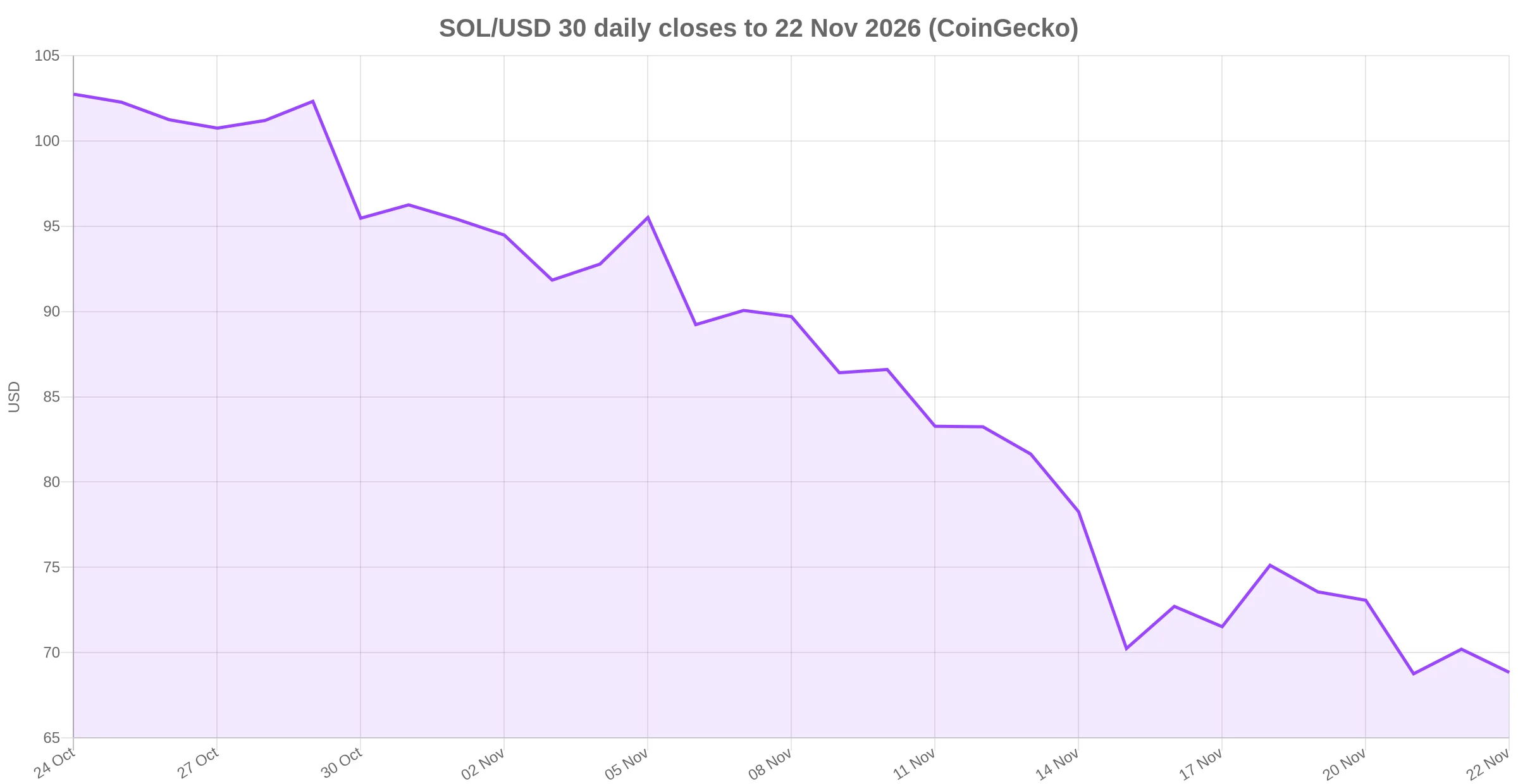
SOL/USD, 30 daily closes to November 22, 2026. Data: CoinGecko.
The 30-day window opens at $102.74 on October 23 and closes at $68.84, a 33% decline with the low made on the way down rather than at the end. Two levels follow from the data rather than from a chart pattern. The session high of $70.94 is the first level SOL has to close above to break the sequence of lower daily highs; a close back above $102.74 would put the token where it traded before the November slide began. On the downside, $66.64 is the November 22 low, and the 30-day closing low sits at $68.76, essentially where price is now.
A return to the $293.31 record would require a 326% gain and would value the circulating supply at $173.6 billion. That arithmetic is not a forecast; it is the size of the move the roadmap has to justify.
Relative performance is the one part of the tape that is not uniformly negative. Bitcoin fell 9.44% over the same seven days in which SOL fell 2.81%, and Solana’s 24-hour gain of 4.64% came on a day when the whole market rebounded off a two-year low. A high-beta asset that falls less than Bitcoin on the way down is a change in behaviour, though one week is not evidence of a regime.
The Demand Side Moved Without The Roadmap
Two institutional developments this month matter more to 2027 revenue than any benchmark in the post. The Depository Trust and Clearing Corporation has said it will put DTC-tokenised securities on Solana in 2027, making it the third network in that rollout. And the Solana Foundation’s purchase of a majority stake in CoinGecko, which we reported on November 18, says more about the foundation’s balance sheet ambitions than about throughput.
Both are demand events that do not depend on Rotor or Constellation arriving on time. Securities settlement and data ownership generate fees the moment they go live; a faster block tree only lowers the cost of serving them. If the roadmap slips, those still ship. If the roadmap lands and demand does not, the fee base does not move.
The broader argument that Solana is no longer only a memecoin venue, which we examined in our November 12 analysis, is the thesis this roadmap is meant to serve. The fee split above is the first hard evidence for it: more fee revenue than Ethereum over seven days is not a memecoin statistic.
What Would Have To Be True
Three conditions decide whether the 2027 roadmap shows up in the token price.
First, fee revenue has to grow faster than capacity. If 30-day fees stay near $14 million while compute doubles, the roadmap is a cost of goods reduction for users and a margin problem for anyone valuing SOL on fees.
Second, vector processing needs workloads that pay. Running models fully onchain is technically interesting and, on today’s evidence, a small market. It becomes material when an inference provider bills customers through Solana rather than through a cloud account, and no such volume appears in the fee data yet.
Third, ordering changes cannot push validators out. Constellation’s stated goal is more competition among validators, which is also a description of thinner margins for the largest ones. A validator set that shrinks in response would undercut the resilience pillar that sits beside it.
The invalidation is simple and observable: if the 30-day fee line is still near $14 million a quarter from now while the network advertises doubled capacity, the market’s indifference is the correct read.
Frequently Asked Questions
What is Solana’s 2027 roadmap?
It is a four-part plan published by Anza, Solana’s validator client team, and summarised by the official @solana account on November 19, 2026. It covers doubling network compute capacity, cutting token-account compute units by 80%, adding vector processing for onchain AI models and raising the account limit per transaction from 64 to 96, plus faster block distribution through Rotor and clearer ordering rules through Constellation.
When do these Solana upgrades go live?
No dates were given in the announcement. The post describes four pillars and their goals, not a release schedule. Alpenglow, the consensus change the roadmap builds on, is already live on mainnet with Agave 4.3, with target finality of about 150 milliseconds.
What does doubling compute capacity mean for Solana fees?
More block space at the same hardware cost, which lowers the price of that space unless demand rises with it. Solana collected $13.81 million in fees over the 30 days to November 22, against $20.15 million for Ethereum, on a market capitalisation a fifth of Ethereum’s. Cheaper blocks help users and pressure fee-based valuations until usage grows.
Why is SOL still 76% below its all-time high?
SOL trades at $68.80 against a record of $293.31 set in January 2025, a 76.5% drawdown, and is down 45.4% over twelve months. The decline coincided with a broad crypto selloff in which Bitcoin fell 9.44% in the last seven days alone; the available data does not establish a single cause for SOL’s underperformance.
Is the 2027 roadmap already priced into SOL?
That cannot be answered from price alone. What the data shows is that SOL trades at 20.1% of Ethereum’s market value while collecting 68.6% as much in fees over 30 days and 129.9% as much over seven days. Whether that gap closes depends on fee growth, not on capacity announcements.
Data: CoinGecko, DefiLlama, solana.com/upgrades.
The post Solana’s 2027 Roadmap Doubles Compute and Puts AI Models Onchain. SOL Is Still 76% Below Its High appeared first on BlockchainReporter.