Solana (SOL) processed nearly $6 billion in tokenized asset trades last quarter, and almost all of it came from tokenized stocks rather than crypto. Solana is a high-performance blockchain ne
Solana (SOL) processed nearly $6 billion in tokenized asset trades last quarter, and almost all of it came from tokenized stocks rather than crypto.
Solana is a high-performance blockchain network best known for its speed and low transaction costs, capable of processing thousands of transactions per second at a fraction of a cent each. Those qualities have long made it a popular venue for crypto trading and meme coins.
But new research from Blockworks shows the network's growth in the second quarter of 2026 came almost entirely from a different source: tokenized versions of real-world stocks.
Related: Over $700 million in Bitcoin left major exchanges in a single day
Tokenized stocks had their breakout quarter
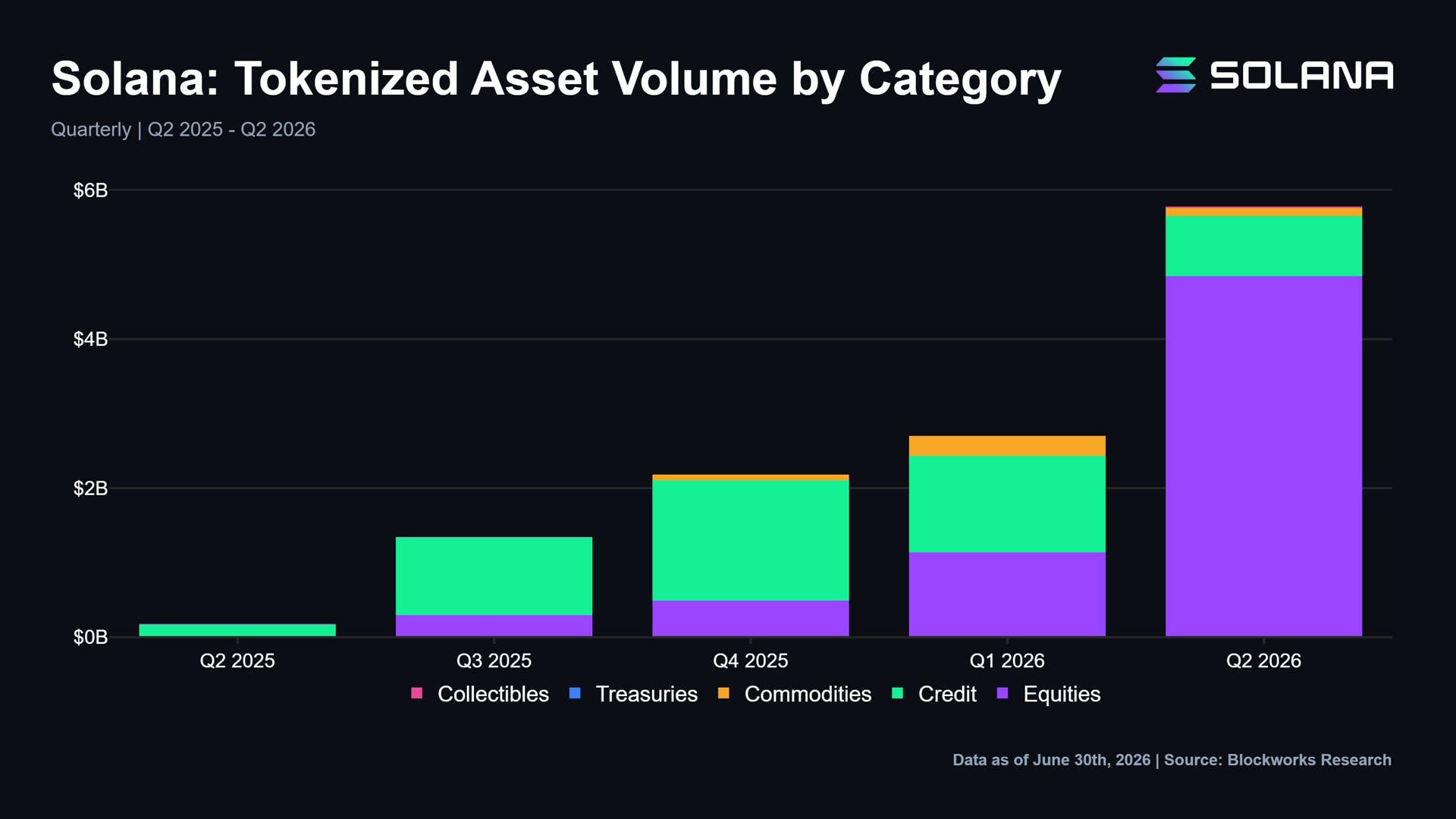
Tokenized asset trading on Solana hit an all-time high of $5.8 billion in the second quarter, up 114% from the previous quarter, according to Blockworks Research.
The vast majority of that came from tokenized equities specifically, which reached $4.8 billion, more than four times what they did in the first quarter.
The growth accelerated as the quarter progressed. Tokenized equity volume was $670 million in April, $871 million in May, and then jumped to $3.3 billion in June alone, an all-time high for the category. Solana now handles roughly 97% of all tokenized-equity trading across every blockchain.
 Source: Blockworks Research
Much of June's surge traces back to a single event: SpaceX's public listing on June 12, the largest IPO in history.
A tokenized version of the SpaceX stock, issued through Sunrise and distributed via Backpack, accounted for roughly $770 million of that month's volume on its own. Issuers have since added tokenized versions of other companies, including Micron, SanDisk, and the Roundhill Memory ETF, and together with SpaceX, these four assets brought in more than $1 billion in June trading alone.
Trending on TheStreet Roundtable:
The rest of the network told a different story
Not everything on Solana grew this quarter. Real Economic Value, a measure of the network's total revenue from fees and tips, fell 43% to $51 million, continuing a decline that has followed the fading of last year's meme coin frenzy. Priority fees dropped 45% to $30.8 million, and tips paid to validators through Jito fell 50% to $9.9 million.
 Source: Blockworks Research
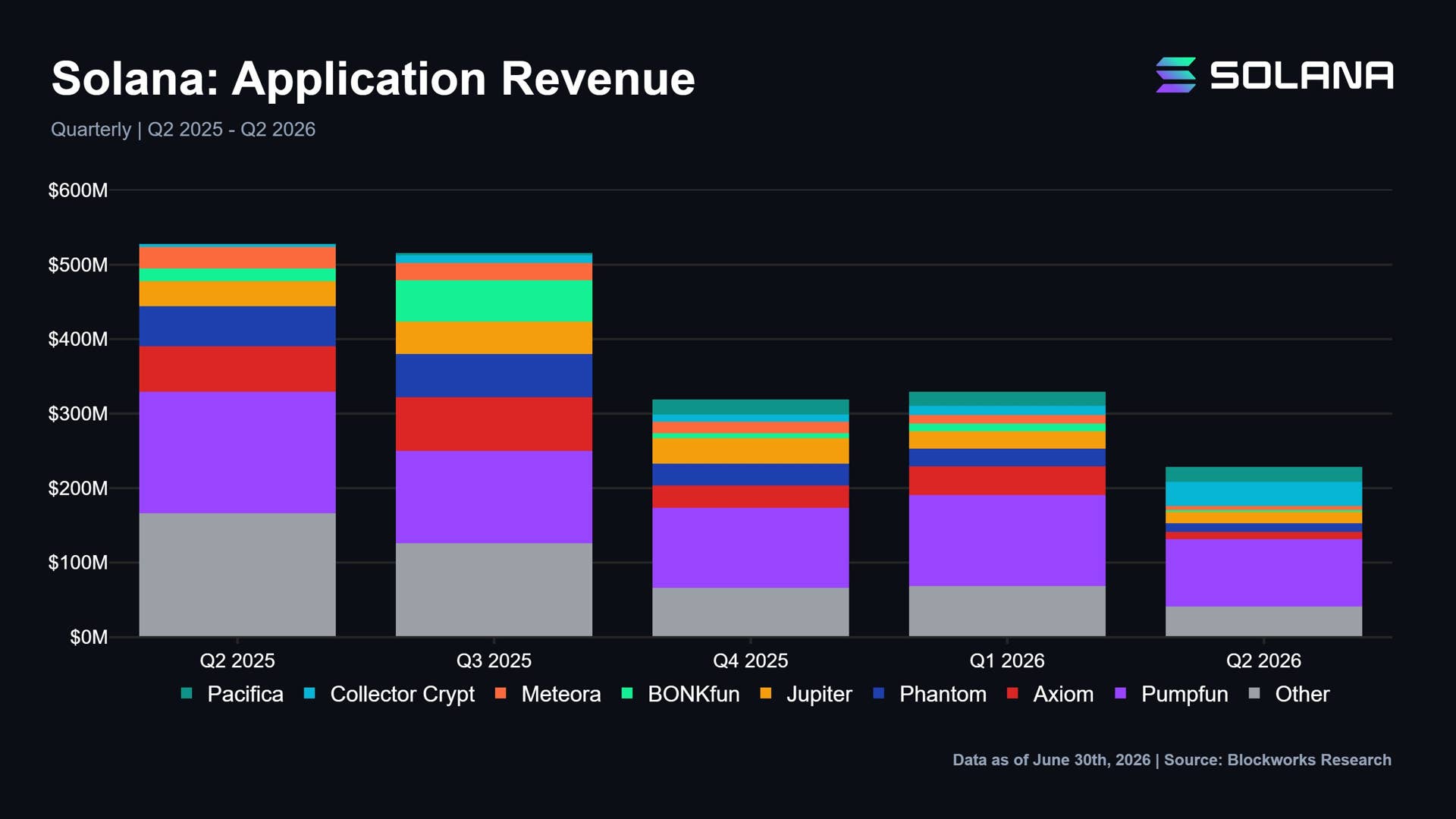
Revenue generated by applications built on Solana, a separate measure that tracks how much money user-facing products are actually making, fell 31% to $228.4 million, the lowest quarterly total since the first quarter of 2024. Solana's overall share of blockchain revenue also slipped.
The network ranked fourth among all blockchains in Q2 with a 12% share, behind Hyperliquid at 33%, Tron at 21%, and Ethereum at 15%, a decline from the 18% share Solana held in the first quarter.
Most Popular on TheStreet Roundtable:
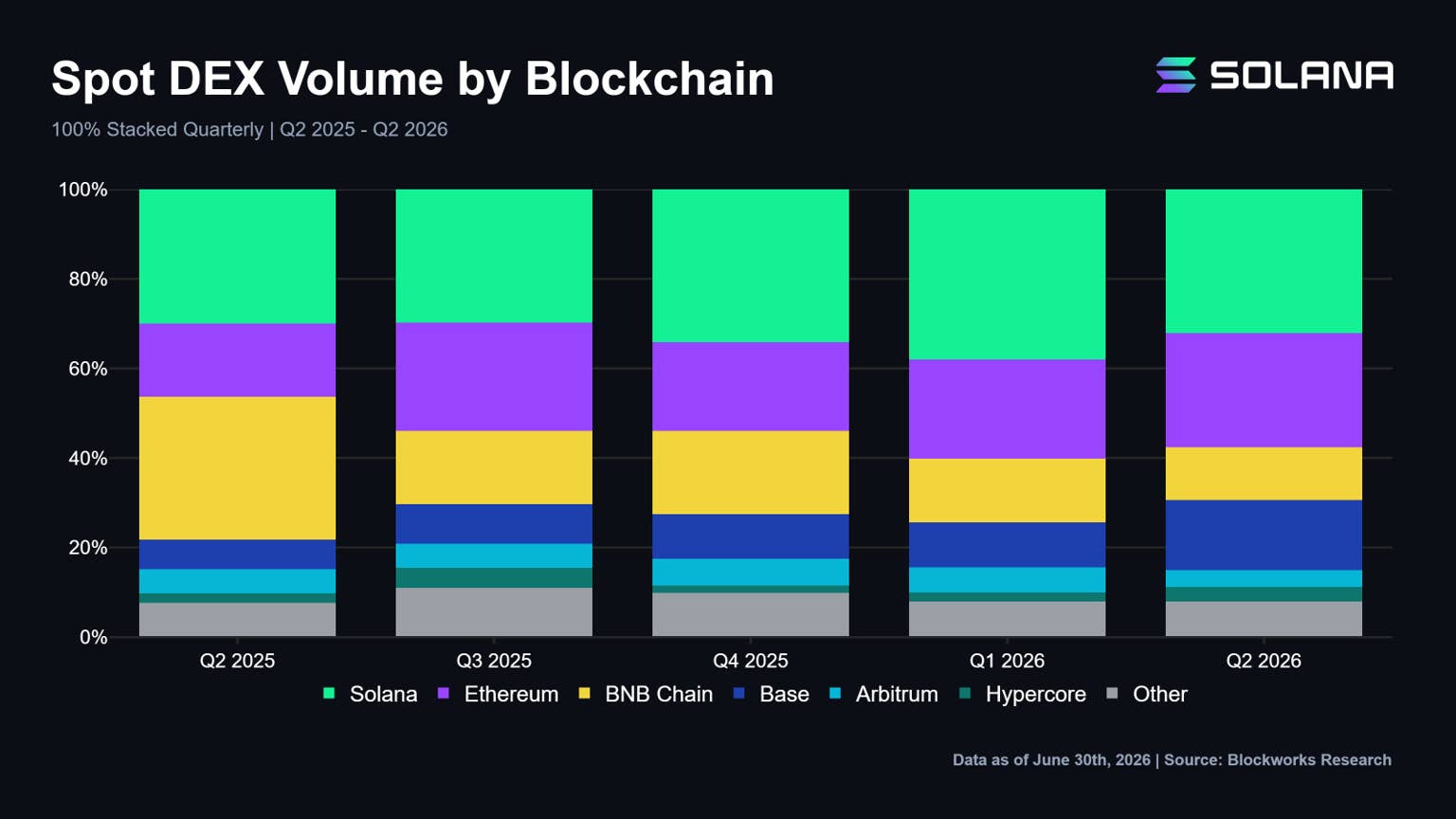
Overall trading volume on Solana's decentralized exchanges also fell, down 44% to $160.8 billion for the quarter. Even so, Solana still handled more spot trading volume than any other blockchain, representing 32% of the market, ahead of Ethereum's 25%, Base's 16%, and BNB Chain's 12%.
It marked the eighth straight quarter Solana has held more than 30% of that market. Monthly volume also recovered late in the quarter, climbing from $48 billion in May to $60.5 billion in June.
Source: Blockworks ResearchInstitutional demand held steady
Bitcoin and Ethereum ETPs saw billions of dollars pulled out during the quarter, but funds tracking SOL kept taking in new money, with $120 million in net inflows, slightly ahead of the first quarter's pace. The amount of SOL staked also hit a new high, ending the quarter at 427 million tokens, roughly two-thirds of the entire supply.
Stablecoin supply on the network held steady at $16.3 billion, while the total number of non-vote transactions processed reached 9.8 billion, Solana's second-highest quarterly total on record. Median transaction fees averaged just $0.0004 throughout the quarter.
Solana's next major test is a protocol upgrade called Alpenglow, described as the network's largest to date. It is expected to cut confirmation times to 150 milliseconds, alongside larger blocks, faster slot times, and a new standardized way of sharing block revenue directly with stakers.
Related: Solana's biggest upgrade in history is now live for testing. Here's what Alpenglow actually changes.