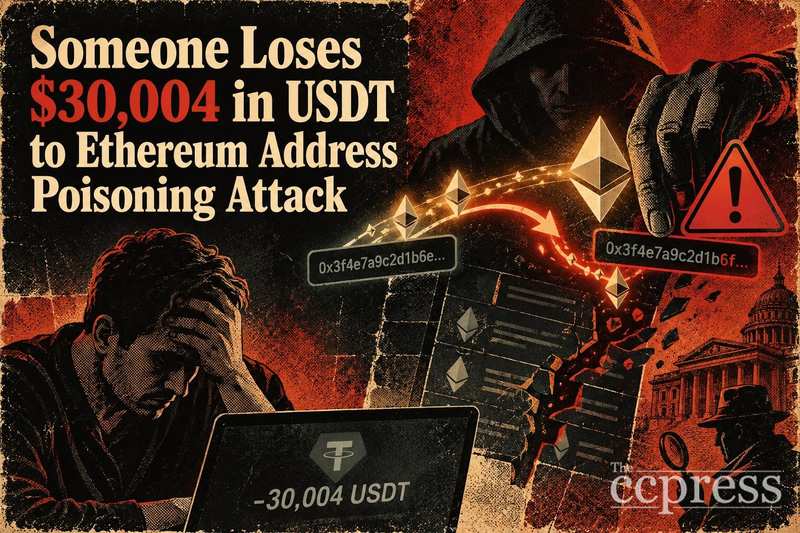
A crypto user lost $30,004 in USDT after sending funds to a fraudulent Ethereum address in what on-chain security monitors identified as an address-poisoning attack, one of the most deceptive
A crypto user lost $30,004 in USDT after sending funds to a fraudulent Ethereum address in what on-chain security monitors identified as an address-poisoning attack, one of the most deceptively simple scams in crypto.
The incident was flagged by ScamSniffer, a Web3 anti-scam platform that monitors Ethereum for wallet-draining exploits. The loss of just over $30,000 in Tether stablecoins highlights how a single moment of inattention during a transaction can result in irreversible loss. For related coverage, see Ripple–Brevan Howard Partnership Adds Prime Brokerage.
What Happened: $30,004 USDT, Gone
Address poisoning works by exploiting a habit most users have: checking only the first few and last few characters of a wallet address rather than verifying the full string. Attackers generate a wallet address that closely mirrors one the victim has recently interacted with, then send a zero-value or dust transaction from that lookalike address to push it into the victim’s transaction history. For related coverage, see OKX $25B Valuation: Circle, Ripple, Standard Chartered.
When the victim next goes to send funds, they copy the familiar-looking address from their history. The funds go to the attacker’s wallet, not the intended recipient. On Ethereum, where USDT transfers are irreversible and pseudonymous, recovery is effectively impossible once the transaction is confirmed. For related coverage, see Polymarket Sues Dutch Regulator Over Event-Contract Ban.
The $30,004 loss is a reminder that even users who are careful by most standards can be caught out. The dollar amount is significant enough to represent a serious financial hit for many individuals, yet small enough that it rarely attracts the kind of public attention reserved for multimillion-dollar exploits.
How to Protect Your USDT From Address Poisoning
The attack requires no malware, no phishing link, and no smart contract vulnerability. The only thing it needs is for the victim to trust their transaction history over a full address check. That makes prevention entirely behavioral.
Always verify the complete destination address before signing any transaction, not just the first four and last four characters. Attackers specifically craft addresses that match those visible segments while changing the middle portion. A full character-by-character check closes that gap.
Use a trusted address book. Most modern wallets allow you to save and label verified addresses. Copying from a saved contact rather than from transaction history eliminates the vector entirely. If your wallet does not support address books, note frequently used addresses in a separate secure document and compare manually.
Send a small test amount first when transferring a meaningful sum to an address you have not recently used. The cost of a test transaction is trivial compared to the cost of a misdirected transfer. If the test lands correctly, proceed with the full amount.
Review wallet warnings before signing. Several wallets and browser extensions, including ScamSniffer-integrated tools, flag addresses that resemble known poisoning patterns. Do not dismiss those prompts without reading them.
It is worth noting that the SEC’s expanding oversight of crypto assets, including ongoing federal efforts to establish a crypto rulebook, does not yet provide any meaningful recourse for individual victims of address-poisoning scams. Blockchain transactions are final. No regulator can reverse a confirmed transfer.
Stablecoin users on Ethereum are a particularly attractive target because USDT transfers are high-value, frequent, and often routine, which is exactly when vigilance slips. Projects tracking DeFi security, including those monitoring Ethereum’s growing role in institutional finance, consistently identify address poisoning as one of the most persistent social-engineering threats on the network.
No further details about the victim, the attacker’s address, or the destination of the funds have been confirmed beyond what ScamSniffer reported. Whether the attacker has been identified or the funds have moved to an exchange remains unknown.
Thirty thousand dollars vanished in the time it takes to confirm a single transaction. How many more users will need to lose funds before double-checking an address becomes as automatic as locking a door?
Additional source references: source document 1, source document 2.
Disclaimer: This article is for informational purposes only and does not constitute financial or investment advice. Cryptocurrency and digital asset markets carry significant risk. Always do your own research before making decisions.
The article Someone Loses $30,004 in USDT to Ethereum Address-Poisoning Attack first featured on theccpress.com.