The South Korea crypto bill would reopen domestic initial coin offerings and set a default 20% ownership cap for crypto exchange operators. The Financial Services Commission discussed the pro
The South Korea crypto bill would reopen domestic initial coin offerings and set a default 20% ownership cap for crypto exchange operators. The Financial Services Commission discussed the proposal on November 24, 2026. It remains a draft and requires National Assembly deliberation and enactment.
- The bill would end the blanket domestic ICO prohibition introduced in September 2017. Issuers would file a white paper with the FSC before soliciting buyers, according to the commission.
- Exchange shareholders would generally be limited to 20%. The FSC could approve holdings of up to 34%, while shares above the applicable limit would lose voting rights.
- Won-pegged stablecoins would initially be issued by consortia in which banks hold a majority stake.
- Digital-asset firms would have to compensate users for losses from hacking or system failures without proof of negligence, according to the FSC.
- The Block reported that the draft now goes to lawmakers, who may debate it and combine it with competing proposals.
Timeline of events
- September 2017: South Korea introduced a blanket prohibition on domestic ICOs, according to the FSC’s account of the policy background.
- May 2025: The FSC cited a case in which a platform allegedly circumvented the ban by issuing an asset through a foundation in another country, then circulating it on Korean exchanges.
- September 2026: The FSC pointed to a stablecoin listing that briefly traded at 4.2 times its reference price before stabilizing eight hours later.
- November 24, 2026: The FSC discussed advancing the proposed Act on Innovation in the Digital Asset Industry and User Protection at a Virtual Asset Committee meeting chaired by FSC Chairman Lee Eog-weon. The proposal still requires legislative deliberation and enactment.
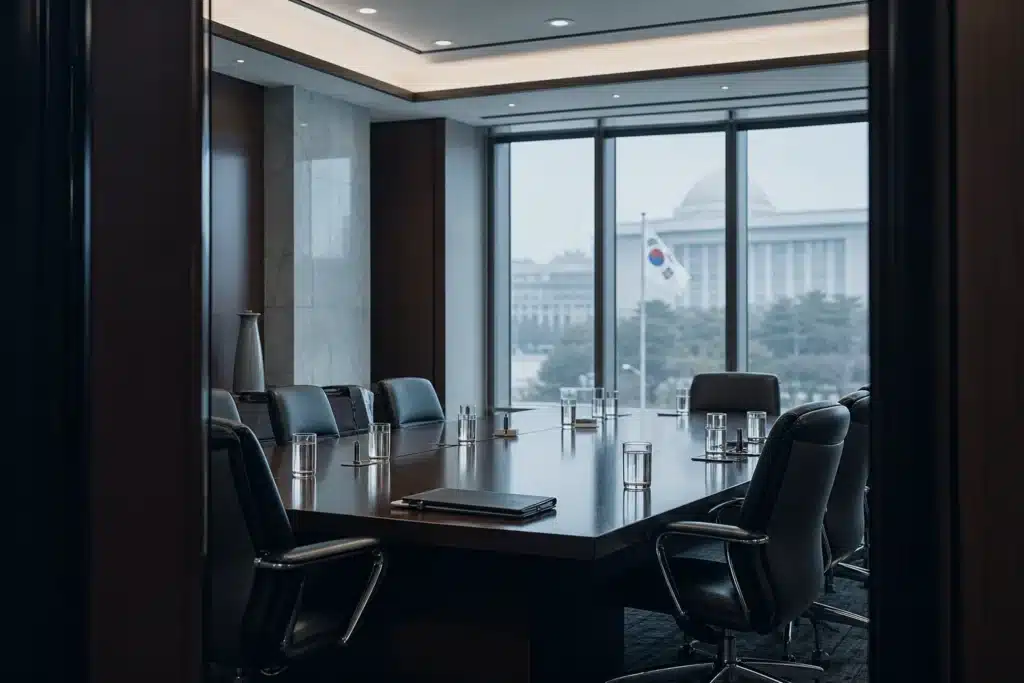
The FSC discussed the draft on November 24, 2026.
What the South Korea crypto bill would change
The South Korea crypto bill would replace an outright ICO ban with a regulated issuance path. Issuers would file a digital-asset white paper with the FSC before approaching buyers. It would cover the issue amount, use of funds, project details and risks, the commission said.
The draft requires issuers to file a white paper before soliciting purchases and to disclose matters including project risks. The supplied proposal summary does not state whether filing amounts to project approval.
The proposal sets a 20% default ownership ceiling for exchange operators, with an FSC-approved exception of up to 34%. Shares above the applicable limit would have no voting rights. The FSC says the cap is intended to strengthen public accountability and neutrality. Director General Yoo Young-jun cited more than 10 million exchange accounts in South Korea when explaining the proposal, according to The Korea Herald.
The restrictions wouldn’t apply immediately after an operator is designated. The proposal provides a three-year deferral, and small and medium-sized exchanges could receive an extension of up to three additional years. The supplied evidence does not describe the effects of these periods on ownership or capital raising.
For stablecoins, the initial model would give banks a majority position in won-pegged issuance consortia. Fintech and technology firms could participate and could be the largest individual shareholder, the FSC said. Issuers would need at least 5 billion won in capital and reserves covering at least 100% of tokens outstanding.

The proposed ICO route would require issuers to file risk disclosures.
Reactions and market context
Industry concerns include whether ownership limits could make Korean platforms less competitive with global exchanges. MoneyToday reported that industry representatives were caught off guard by the ownership proposal and bank-first stablecoin approach. An anonymous industry official quoted by the outlet warned that white-paper filing and review could become a substantial obstacle for ICO projects.
The FSC’s consumer-protection measures would make firms responsible for losses caused by hacking or system failures without requiring users to prove negligence. Regulators could also impose punitive surcharges of up to 10% of revenue if an incident followed a breach of electronic-safety duties. The design and enforcement of these provisions will matter alongside the ownership cap.
No supplied evidence links a market move to the South Korea crypto bill. At 12:13 UTC on November 24, CoinGecko data put Bitcoin at $60,222, down 1.72% over 24 hours, and Ether at $1,696.79, down 1.39%. The Crypto Fear & Greed Index was 11, classified as Extreme Fear, on November 24. These readings describe broader market conditions, not a specific reaction to the Korean proposal.
Asset or indicator
Reading
Reference time
Bitcoin
$60,222, down 1.72% in 24 hours
November 24, 2026, 12:13 UTC
Ether
$1,696.79, down 1.39% in 24 hours
November 24, 2026, 12:13 UTC
Fear & Greed Index
11, Extreme Fear
November 24, 2026
The proposal would require digital-asset firms to compensate users for losses caused by hacking or system failures without proof of negligence. The evidence does not establish that these rules would eliminate other platform or asset risks.

The draft would also impose compensation duties for certain system failures.
Outlook for the South Korea crypto bill
The immediate test is legislative. The Block says lawmakers may debate the draft and potentially merge it with competing proposals. Changes could affect the ownership ceiling, ICO filing process, stablecoin issuer rules or compensation duties. The FSC’s November 24 discussion is a step toward legislation, not a final framework.
Key details to watch include the text lawmakers take up, transition-period timelines and standards for white-paper review. The supplied proposal summary sets minimum reserve requirements but does not detail how regulators would assess reserves or apply liability rules when failures involve third-party technology.
The draft would permit domestic digital-asset issuance and sales through ICOs, subject to white-paper filing before issuers solicit purchases. Its final terms depend on National Assembly deliberation and enactment.
FAQ
Would the South Korea crypto bill make ICOs legal?
The draft would allow domestic digital-asset issuance and sales through ICOs after issuers file a required white paper with the FSC. It isn’t law yet, and the National Assembly may revise it.
What is the proposed crypto exchange ownership cap?
The default limit is 20% for a shareholder in an exchange operator. The FSC could approve ownership of up to 34%, and shares above the applicable limit would have no voting rights.
When could the South Korea crypto bill take effect?
The research provides no effective date. The proposal still requires legislative deliberation and enactment, so its timing and final terms remain uncertain.
Related Articles
Sources
This article is for informational purposes only and does not constitute financial or investment advice. Cryptocurrencies are highly volatile; always do your own research before investing.
Read More:South Korea draft crypto bill proposes ICO route, 20% exchange stake cap">South Korea draft crypto bill proposes ICO route, 20% exchange stake cap