Key Takeaways SpaceX aims to deploy its inaugural Nvidia-equipped AI satellites during the final quarter of 2027 Musk claims space-based AI computing may deliver cost advantages over traditio
Key Takeaways
- SpaceX aims to deploy its inaugural Nvidia-equipped AI satellites during the final quarter of 2027
- Musk claims space-based AI computing may deliver cost advantages over traditional terrestrial data facilities
- Regulatory filings reveal Nvidia holds 122.8 million SpaceX shares, establishing dual roles as vendor and investor
- The space company finalized a $60 billion acquisition of AI development platform Cursor in August 2026
- Evercore ISI maintains an Outperform stance on SpaceX shares with a $230 target price
Space Exploration Technologies Corporation is preparing to deploy its inaugural constellation of artificial intelligence satellites equipped with Nvidia processors in late 2027. CEO Elon Musk revealed the initiative this week, suggesting that processing AI computations in orbital environments may ultimately prove more economical than conventional ground-based infrastructure.
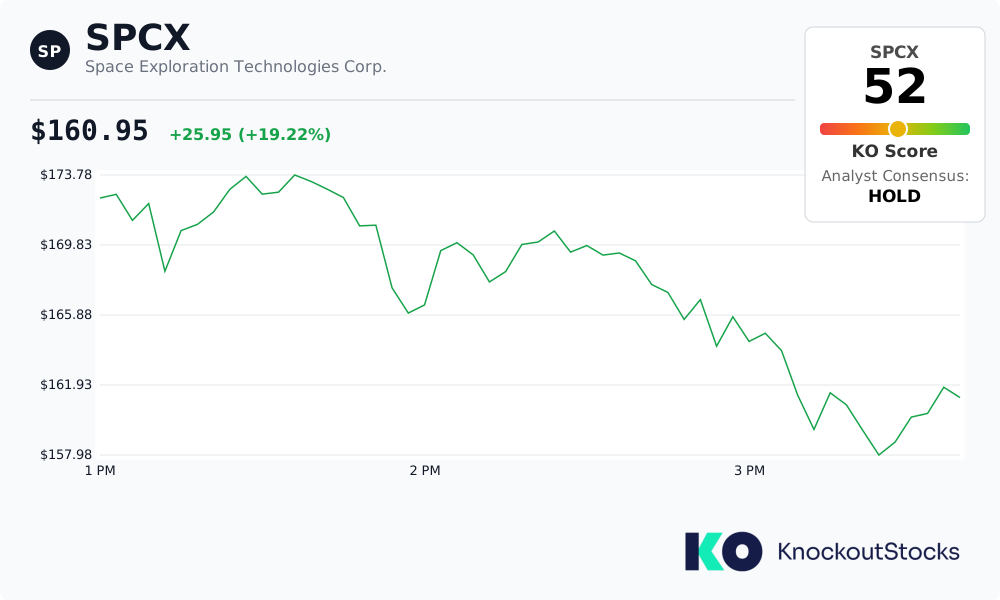 Space Exploration Technologies Corp., SPCX
According to Musk, the space-based computing strategy may also reduce environmental impact compared to traditional data center operations. The executive anticipates the orbital infrastructure will achieve operational scale by 2028.
Nvidia Delivers Vera Rubin Systems for Space Deployment
On Nvidia’s August 26 quarterly earnings conference call, Chief Financial Officer Colette Kress announced that the company’s Vera Rubin computing platform has entered full-scale production. Current shipments are being distributed to Oracle, Amazon, and SpaceX.
The semiconductor manufacturer also revealed its ownership position of 122.8 million shares in SpaceX. This dual arrangement establishes Nvidia as simultaneously a critical hardware provider and significant equity stakeholder in the aerospace company.
Research analysts at Evercore ISI highlighted the reciprocal nature of this partnership. Their analysis identifies SpaceX among the initial adopters of the Vera Rubin computing architecture.
Musk stated that SpaceX facilities will utilize Nvidia hardware exclusively. Separately, SpaceX finalized its $60 billion all-equity purchase of Cursor in August. The artificial intelligence coding platform generates over $1 billion in annualized revenue.
Wall Street’s Revenue Projections
Evercore ISI analyst Kutgun Maral views the orbital computing segment as an emerging growth avenue. However, the investment firm doesn’t anticipate substantial revenue contributions to SpaceX before fiscal 2029 at the earliest.
Evercore’s financial models project the initial 1 gigawatt of space-based computing capacity becoming operational in 2029. The firm forecasts expansion to 8 gigawatts of orbital infrastructure by year-end 2029, alongside 10 gigawatts of ground-based capability.
According to the research note, any acceleration of the 2029 deployment timeline into 2028 would represent significant additional capacity. Musk has referenced cost structures ranging from $30 to $50 per watt for the orbital platforms.
Evercore maintains its Outperform recommendation on SpaceX equity with a $230 valuation target. The consensus analyst target price stands at $228.59, suggesting approximately 61% appreciation potential from present trading levels. Wall Street’s aggregate rating reflects a Moderate Buy, comprising 24 buy recommendations, six hold ratings, and three sell opinions.
Engineering Obstacles Ahead
The ambitious program confronts substantial technical barriers. Thermal management systems present significantly greater complexity in space environments due to the absence of atmospheric convection for heat dissipation.
Research published by the Brookings Institute calculated that adequate heat rejection from a single orbital data facility could necessitate radiator arrays spanning 2.15 million square feet. This represents a formidable engineering obstacle without established solutions.
Orbital assets also contend with solar radiation exposure and escalating collision risks from space debris. Regulatory clearances may introduce delays as the constellation expands.
The fundamental uncertainty centers on whether SpaceX can transition from an initial demonstration launch in 2027 to a fully functional commercial network in subsequent years.
The post SpaceX and Nvidia Partner on AI-Powered Satellite Network Set for Late 2027 Launch appeared first on Blockonomi.