SpaceX is going public on June 12, 2026. The share price is set at $135, the valuation sits at $1.77 trillion, and the offering would raise $75 billion in a single day, making it the largest
SpaceX is going public on June 12, 2026. The share price is set at $135, the valuation sits at $1.77 trillion, and the offering would raise $75 billion in a single day, making it the largest IPO in recorded market history.
That last part sounds like a reason to buy. Plenty of people think it is. But there is a growing body of analysis suggesting the SpaceX IPO could follow a very specific and painful path, one the market already lived through in 2012 when Meta debuted to enormous fanfare and then collapsed 70 percent in four months.
Here is what the data actually shows.
What is the $SPCX IPO Price and Valuation in 2026?
SpaceX priced its IPO at$135 per share, giving the company a total valuation of $1.77 trillion. The offering involves 555 million shares, raising approximately $74.4 billion from public investors on day one.
That valuation beats Saudi Aramco's 2019 record of $1.7 trillion, which currently holds the title of the largest IPO ever. $SPCX would overtake it immediately on debut.
At $1.77 trillion, SpaceX would enter the US public market as one of the seven largest companies in the country overnight. That puts it in the same bracket as Apple, Microsoft, Nvidia, Amazon, Alphabet, and Meta.
As per a tweet on X, Meta went public in May 2012 at a price the market quickly decided it could not support. In the first 100 days after the IPO, the stock fell more than 50 percent.
By September 2012, roughly four months after its debut, it had lost 70.54 percent of its IPO value. A $1,000,000 investment at the offering price was worth around $295,000 by that point.
The comparison to $SPCX is not random. Both companies launched at the top of a hype wave. Both carried valuations that required flawless execution for a decade to justify at the listing price.
In both cases, retail investors were buying the story while the people who built the company were quietly preparing to convert paper wealth into real cash.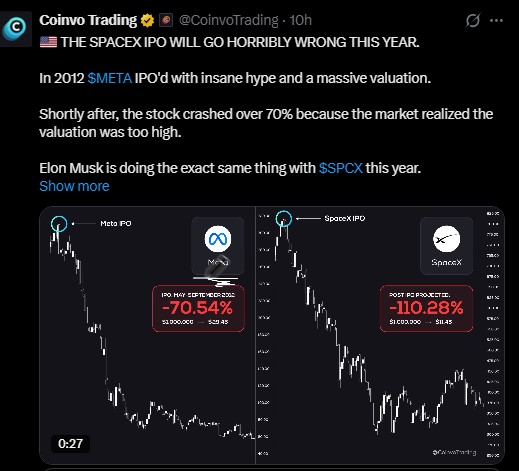
That last point is where things get uncomfortable.
Who Owned SpaceX Before the IPO and What Happens After?
Before the $SPCX IPO, insiders owned approximately 95 percent of the company. The public float on day one is just 5 percent of total shares, meaning the $75 billion raised comes entirely from new outside buyers absorbing that small slice.
The other 95 percent stays locked for now.
Insider lockup agreements, the legal restrictions that prevent early shareholders from selling, are expected to expire between September and December 2026.
Once those expire, founders, venture backers, and employees sitting on over $1.6 trillion in paper wealth are free to begin selling into the open market.
This is the part that keeps macro traders up at night. Even if just 10 percent of insider holdings hit the market over the following six months, that is $160 billion in selling pressure landing on a stock that retail investors bought at a record-high valuation.
What Did Michael Burry Say About the SpaceX IPO?
Michael Burry, the investor made famous by his correct call on the 2008 housing collapse, has warned that the current wave of mega-IPOs, SpaceX, OpenAI, and Anthropic chief among them, could collectively pull more capital out of retail investors than the entire dot-com Initial Public Offering wave of 2000 did, combined.
His portfolio positioning reflects that concern. Burry holds reported put positions in Palantir worth $912 million and Nvidia worth $186 million, both extended into 2027.
A put position profits when a stock falls. Extending those positions into 2027 implies he expects the decline to happen after this year's IPO season, not before.
He has not commented directly on $SPCX, but the timeline and the magnitude of the bets line up with a thesis that this Initial Public Offering cycle ends badly for late buyers.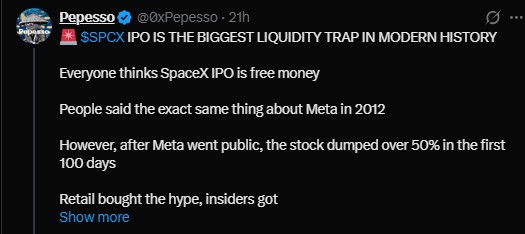
Is SpaceX Actually Worth $1.77 Trillion?
That depends entirely on what you think Starlink, the launch business, and Starship are worth, and when.
Starlink generated an estimated $6.6 billion in revenue in 2024. Analysts project that it could grow to $15 to $20 billion by 2028 if subscriber growth holds.
Falcon 9 dominates the global commercial launch market with a reliability record no competitor has matched. Starship, if it reaches commercial operation, could open entirely new revenue lines in deep-space logistics and point-to-point Earth transport.
That is a real business with real upside.
But the $1.77 trillion valuation means the market has already priced in years of that growth at the offering price.
Investors buying at $135 on June 12 are not buying SpaceX at fair value. They are paying for what SpaceX might be worth in 2030 or 2031 if everything goes right.
Meta recovered from its 2012 crash and became one of the most valuable companies in the world. But the investors who bought at the IPO price waited over a year just to break even, and many sold at a loss long before that happened.
SpaceX IPO Price Prediction: What Could Happen After June 12?
No one can tell you with certainty what the SpaceX IPO stock will do after it lists. Anyone who claims otherwise is guessing.
What the data does support is this: the structure of this offering creates conditions where a post-IPO decline is more likely than not in the near term.
A thin public float means early price action will be volatile and easily moved by sentiment. Lockup expiry in Q4 2026 creates a known future event where selling pressure is likely to increase.
The valuation leaves almost no margin for error in SpaceX's actual business performance.
If SpaceX hits its growth numbers, opens strong, and retail holds through the lockup expiry, the stock could trade flat or higher.
If sentiment shifts or if broader markets weaken, which Burry's positioning suggests he expects, the downside could be sharp and fast.
The Meta comparison gives a rough reference point. That one took four months to lose 70 percent. SpaceX is a different company in a different era. But the mechanics of the setup are strikingly similar.
Disclaimer: This article is written for informational purposes only and does not represent financial or investment advice. Investing in IPOs carries significant risk, including the possible loss of all capital invested. The information presented here is based on publicly available data and analyst commentary.