Standard Chartered has told clients that Chainlink underpins the growth of tokenized assets, initiating coverage of LINK with a $200 end-2030 price target as it argues the token's infrastruct
Standard Chartered has told clients that Chainlink underpins the growth of tokenized assets, initiating coverage of LINK with a $200 end-2030 price target as it argues the token's infrastructure is central to moving trillions of dollars of real-world assets onchain.
Why Standard Chartered links Chainlink to tokenized asset growth
The bank's initiation note, reported by The Block, frames Chainlink as a foundational rail rather than a peripheral partner in the tokenization buildout, setting a $200 target for LINK by the end of 2030 from roughly $8 today. For related coverage, see Top Presale Crypto: Comparing INVEST Network, LiquidChain, Bitcoin Hyper, and Maxi Doge For Growth Potential!.
Standard Chartered's 2030 LINK Target $200 Standard Chartered initiated coverage of LINK with a $200 end-2030 target, according to The Block's report on the note.
Analyst commentary from a major global bank carries weight in tokenization narratives because it signals that a supervised institution sees the technology as investable infrastructure, not just a speculative theme. The note ties LINK's upside directly to real-world asset tokenization rather than to broad market momentum. For related coverage, see Bybit Sues North Korea and Lazarus Group, Secures Preliminary Injunction Freezing Stolen Assets in Landmark Crypto Asset Recovery Effort.
Standard Chartered's team, led by Geoff Kendrick, connects the token's value to demand for the plumbing that lets banks issue, settle, and move tokenized instruments across networks. That framing places Chainlink at the center of a thesis about institutional adoption rather than retail speculation. For related coverage, see Keel Shuts Down U.S. Bitcoin Mining Operations as AI Pivot Deepens.
What Chainlink provides for tokenized asset infrastructure
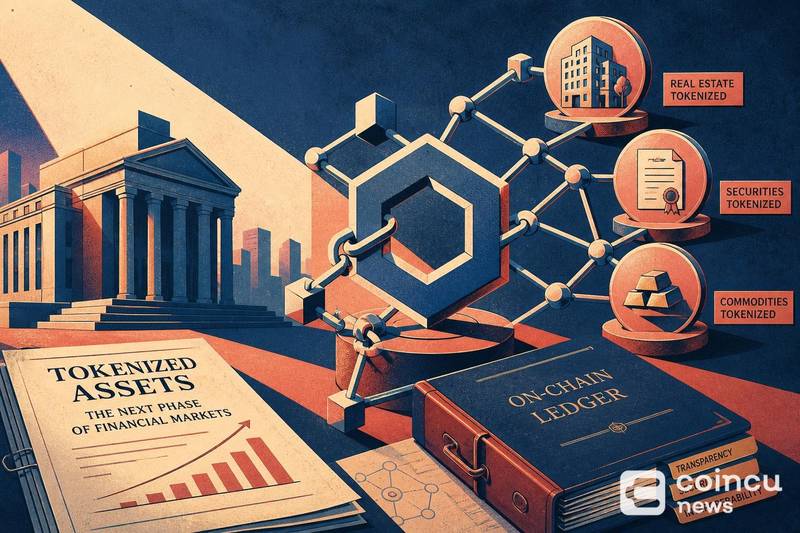
Tokenized assets need reliable offchain-to-onchain data flows and secure messaging between networks, and Chainlink markets itself as the layer that supplies both. Its data feeds, interoperability protocol, and cross-chain messaging are the functions the bank ties to tokenization demand.
Chainlink's own materials document concrete bank pilots, including a Project Guardian workflow in which ADDX, ANZ, and Chainlink piloted an end-to-end tokenized commercial paper flow with cross-chain settlement. A separate experiment saw Banco Inter and Chainlink complete a cross-border trade finance test with Brazil's central bank and the Hong Kong Monetary Authority under Phase 2 of Drex.
Those pilots illustrate why tokenized markets depend on trusted external data: settlement, pricing, and delivery-versus-payment all require verified information that lives outside the blockchain. Without a reliable oracle and messaging layer, issuance and settlement across chains remain fragmented.
Chainlink's institutional tokenization deck describes a platform that connects issuers, custodians, apps, and market makers, and includes a cross-chain delivery-versus-payment case study with Kinexys by J.P. Morgan and Ondo Finance. That kind of connective tissue is what can expand tokenized issuance and settlement beyond single-chain silos.
Why tokenized assets are becoming a major institutional focus
Tokenized assets are traditional financial instruments, such as bonds, funds, and commercial paper, issued or represented as tokens on a blockchain so they can settle and transfer programmatically. Standard Chartered expects those onchain assets to climb to $4 trillion by the end of 2028 from around $340 billion now.
Projected Onchain Tokenized Assets By End-2028 $4T Standard Chartered expects tokenized assets onchain to reach $4 trillion by end-2028, a core demand driver in its Chainlink thesis.
Institutions care about tokenization because it promises faster settlement, greater transparency, and reduced counterparty friction versus legacy rails. The bank also projects assets deployed in DeFi to reach $2.7 trillion by end-2030, extending the growth case beyond simple issuance.
As tokenization scales, infrastructure providers stand to benefit because every issuance, price update, and cross-chain settlement leans on the same data and messaging layer. That is the mechanism the bank uses to link market growth to LINK demand. The tokenization narrative is tied to supervised pilots under MAS Project Guardian, Brazil's Drex, and HKMA experiments rather than a fresh regulatory change.
What the statement could mean for Chainlink and the wider crypto market
An initiation note from a global bank can strengthen Chainlink's credibility narrative by validating its positioning as tokenized-market infrastructure. Decrypt independently reported the same thesis, including staged LINK targets of $13, $41, $82, $133, and $200 through 2030, which reinforces that the figures come from the bank rather than a single outlet.
Tokenization is often cast as a bridge between traditional finance and public blockchains, so endorsements like this feed a market narrative in which infrastructure protocols gain as enterprise use cases expand. The story sits alongside broader institutional crypto moves, from corporate treasuries such as H100 more than tripling its Bitcoin holdings to regulatory milestones like Brazil's crypto licensing deadline, which overlaps with the same Drex tokenization program Chainlink has piloted.
Strategic relevance is not the same as an immediate market move. At press time LINK traded at $8.23, down about 1% over 24 hours, with a market cap near $6.16 billion and 24-hour volume around $199 million. The broader Fear & Greed Index read 30, or Fear, underscoring that a long-dated target does not translate into near-term price action.
Standard Chartered's note also says the Chainlink Reserve holds around 5 million LINK worth roughly $40 million, with about two-thirds of fees flowing into it since launch, according to unconfirmed reporting from The Block that has not been matched against the bank's original document. Readers should treat that reserve detail as a secondary claim rather than an established figure.
FAQ: Standard Chartered, Chainlink, and tokenized assets
What are tokenized assets? They are real-world or traditional financial instruments, such as bonds, funds, or commercial paper, issued or represented as blockchain tokens so they can settle and transfer onchain. Standard Chartered expects the onchain total to reach $4 trillion by end-2028.
Why is Chainlink important for tokenization? Tokenized markets need trusted external data and secure cross-chain messaging to price, settle, and move assets. Chainlink supplies data feeds and interoperability that banks have used in pilots with ADDX, ANZ, Banco Inter, the HKMA, and Kinexys by J.P. Morgan.
Why does Standard Chartered's view matter? A supervised global bank publicly tying LINK's value to tokenization signals that institutions increasingly treat the technology as investable infrastructure, which can shape adoption narratives even without an immediate price effect.
Disclaimer: This article is for informational purposes only and does not constitute financial or investment advice. Cryptocurrency and digital asset markets carry significant risk. Always do your own research before making decisions.
The post Standard Chartered Says Chainlink Underpins Growth in Tokenized Assets was initially published on Coincu.