Stellar's stablecoin route can settle on-chain transfers in roughly five seconds, with fees costing fractions of a cent on Stellar. Traditional transfers may pass through sender banks, interm
- Stellar's stablecoin route can settle on-chain transfers in roughly five seconds, with fees costing fractions of a cent on Stellar.
- Traditional transfers may pass through sender banks, intermediaries and recipient banks, adding processing steps, fees and delays.
- Blockchain settlement does not guarantee instant delivery; funding, compliance, liquidity and cash-out services can still take time.
Stellar cross-border payments are drawing attention as stablecoins offer faster settlement, lower fees, and alternatives to traditional international banking routes amid persistent transfer delays.
Traditional Banking Transfers Involve Multiple Institutions
ALLINCRYPTO recently described Stellar's role in addressing costly international transfers. The post compared traditional banking routes with stablecoin payments using Stellar. It also referenced XRP, which targets similar cross-border payment challenges.
Source:
X
Traditional transfers may pass from a sender's bank through intermediaries before reaching recipients. Each institution can add processing requirements, charges, or waiting periods. Transfers involving different currencies and jurisdictions can create further complications.
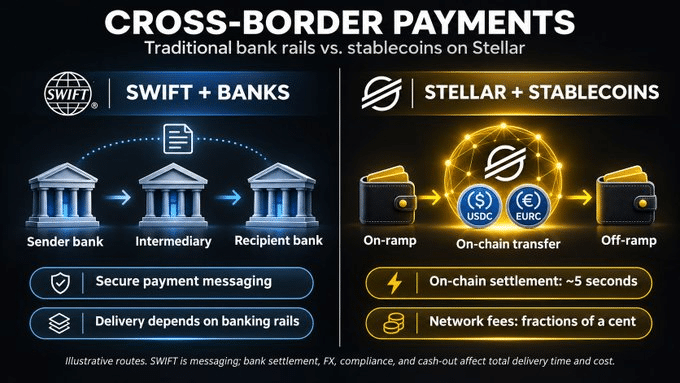
The graphic shows three banking stages: sender bank, intermediary, and recipient bank. These institutions coordinate payment instructions and the movement of funds. The route can involve separate procedures before money becomes available.
SWIFT supports communication between financial institutions, rather than settling funds itself. Payment messaging does not guarantee immediate delivery to the recipient. Banking rails, processing schedules, and settlement arrangements affect transfer completion.
Stellar Uses Stablecoins For Faster Settlement
The graphic presents Stellar as an alternative route for stablecoin transfers. USDC and EURC appear as examples of assets moving across the network. Payments enter through an on-ramp, settle on-chain, then reach an off-ramp.
Stellar cross-border payments can settle on-chain in approximately five seconds, according to the graphic. Network fees are presented as fractions of a cent. These figures contrast with transfers that require several institutions to coordinate.
Stablecoins represent value linked to currencies such as the US dollar or euro. They allow users to transfer currency-denominated value through blockchain networks. This can reduce reliance on conventional settlement processes during the transfer.
However, blockchain confirmation covers only the on-chain portion of a payment. Funding, identity checks, compliance screening, and withdrawals may take additional time. The full customer journey may therefore exceed the network's settlement speed.
Payment Access Depends On Financial Connections
On-ramps connect conventional money with blockchain-based assets. Off-ramps allow recipients to convert or withdraw funds into local payment systems. Their availability can shape how easily recipients access transferred value.
Liquidity and payment-provider access also affect the practical transfer experience. Recipients may need suitable services to convert stablecoins into local currencies. These connections remain important alongside low fees and fast settlement.
Stellar and XRP are both presented as networks addressing international payment friction. Their infrastructure and approaches differ, although both focus on moving value across borders. The supplied post places them within the same broader payment discussion.
Stellar's stablecoin capabilities are the central feature of the comparison. The graphic emphasizes speed and transaction costs rather than token-market performance. It does not provide a current XLM price or adoption figures.
Payment efficiency depends on connections between blockchain networks and financial services. Stablecoin transfers may reduce some steps within the payment process. Reliable funding and cash-out arrangements remain necessary for practical use.