A wallet labeled "Poloniex 9" and linked to Justin Sun executed one of DeFi's largest single-day liquidity shifts on November 19, 2026, moving approximately $1.49 billion from Sky Protocol (f
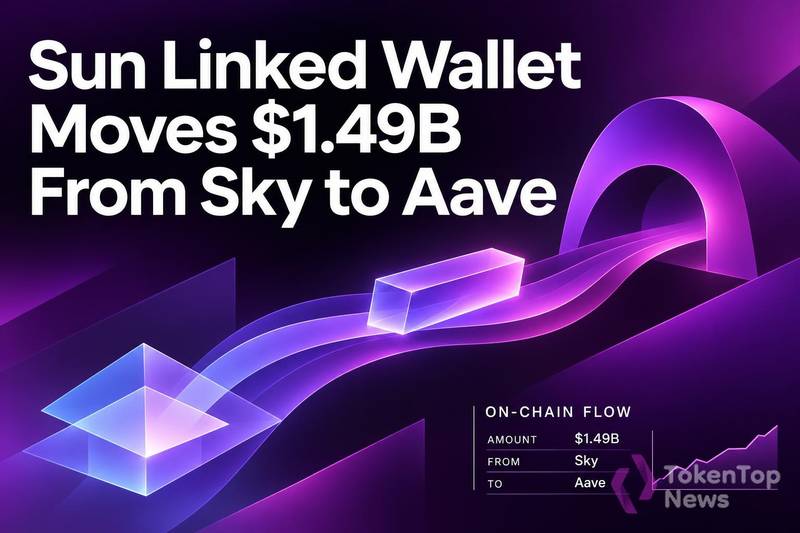
A wallet labeled "Poloniex 9" and linked to Justin Sun executed one of DeFi's largest single-day liquidity shifts on November 19, 2026, moving approximately $1.49 billion from Sky Protocol (formerly MakerDAO) into Aave's Ethereum V3 USDC market. The transaction drained Sky's USDC Peg Stability Module reserve by roughly $1.69 billion within hours, while simultaneously reshaping Aave's lending dynamics for every borrower on the platform.
The wallet redeemed USDS through Sky's Peg Stability Module in four sequential tranches, $400 million, $400 million, $388 million, and $300 million, receiving USDC in return, according to TokenPost's transaction-level breakdown. Those USDC proceeds were then deposited into Aave in three batches: $400 million, $350 million, and a final $737.96 million slug that completed the migration. For related coverage, see South Korea Digital Asset Bill: Asia Session Roundup.
Sky's USDC PSM reserve fell from approximately $2.56 billion to $872.34 million by 12:41 p.m. ET that day, a net decline of roughly $1.69 billion. To offset the drain, the Spark platform, Sky's affiliated lending layer, unwound existing lending positions to replenish the exchange reserve, The Defiant reported. MonetSupply, a contributor to Spark Strategy, noted that capital allocations would be pulled back to rebuild the reserve. Context on this theme: CFTC Alleges Backward Hat Ran Forex Ponzi Scheme Using Crypto.
Aave Absorbs the Inflow, Then Hits Its Own Ceiling
The deposits pushed total USDC supplied in Aave's market from roughly $2.74 billion to roughly $4.24 billion. That surge immediately compressed the utilization rate from approximately 94% down to about 61%, and the variable borrow rate dropped from roughly 4.78% to 2.99%. For anyone already borrowing USDC on Aave that day, the cost of their debt fell in real time. More on this in Stellar (XLM) Price Rises as Protocol 30 Activates.
The relief was short-lived at the protocol level. Within 24 hours, borrowing demand pushed utilization back toward the existing supply cap, reaching 98.5% of the previous ceiling. Risk firm LlamaRisk recommended raising the USDC borrow cap to $4 billion, and Aave governance implemented the increase on November 20, one day after the deposit, according to TokenPost. Background reading: Polygon Says Agglayer v1.0 Cuts Ethereum Transfer Waits.
One Wallet Now Holds 35.7% of Aave's aEthUSDC Pool
The more structurally significant detail is what the wallet holds after the move. With approximately 1.495 billion aEthUSDC receipt tokens, the Sun-linked address controls roughly 35.7% of Aave's entire USDC market. That concentration means a single withdrawal decision by one holder could materially reduce the liquidity available to every other depositor and borrower on the platform.
To put the scale in context: if this wallet were to withdraw $500 million, the available liquidity for all other Aave USDC participants would compress sharply. Aave's risk infrastructure, including its Umbrella safety module and existing risk parameters, has not faced a real-world test at this concentration level. Whether those mechanisms are adequate for a 35% single-depositor scenario remains an open question that the protocol's risk contributors will need to address explicitly.
This concentration concern is part of a broader pattern of large wallet activity that analysts have been watching. Separately, unconfirmed reports cited by TokenPost attribute approximately $101.9 million in flagged PSM transactions to North Korea-connected actors across 422 wallets identified by blockchain analytics firm Inca Digital, though those findings have not been independently verified.
Sky Downplays the Outflow, Markets Tell a Different Story
The Sky Frontier Foundation characterized the flagged transfers as representing less than 0.06% of the PSM's cumulative volume of more than $930 billion, framing the outflow as routine relative to total historical throughput. That framing did little to settle market nerves. The SKY token fell approximately 12% in the 24 hours following the event and is down roughly 38% over the prior 28 days, per market data. The AAVE token traded at $93.89 as of the most recent CoinGecko data, down 4.24% over the same 24-hour window, against a broader market backdrop where the Crypto Fear and Greed Index registered 11, deep in Extreme Fear territory.
The market reaction reflects genuine structural uncertainty rather than simple panic. A protocol losing $1.69 billion from its stability reserve in a single session, regardless of its share of lifetime volume, forces Spark and Sky governance to respond operationally, not just rhetorically. The speed of Spark's position unwinding to restore reserves is itself a signal that the protocol's automated buffers were not sufficient to absorb the outflow passively.
What to Watch Next
The core question now is whether the wallet parks the $1.49 billion in Aave indefinitely as a yield position, uses it as collateral to borrow against, or begins moving it onward to other venues. Each scenario carries a different risk profile for Aave. A passive yield deposit is manageable; a large borrow position backed by this USDC would create leveraged exposure; and a rapid exit would reverse the utilization compression that just prompted Aave to raise its borrow cap.
Sky's ability to rebuild its PSM reserve is also worth monitoring. The reserve stood at roughly $872 million after the outflow, down from $2.56 billion, and Spark's unwinding of lending positions is a one-time lever, not a renewable buffer. If further large redemptions arrive before the reserve is restored, the PSM's peg-maintenance capacity comes under real pressure, with downstream implications for USDS stability. The event sits alongside other recent on-chain anomalies that analysts have flagged, including wallet discrepancy reports from Bitquery on Maple, as evidence that large, opaque wallet movements continue to generate systemic questions DeFi governance structures have yet to fully resolve.
Aave's governance will also need to revisit its concentration risk parameters now that a single address holds more than a third of one of its largest markets. The borrow cap increase buys headroom, but it does not address the fundamental question of whether a protocol with $16.23 billion in total value locked across chains should have risk ceilings that assume no single depositor will ever dominate a market at this scale. Meanwhile, broader regulatory scrutiny of DeFi capital flows, including discussions like South Korea's digital asset legislation, adds a compliance dimension that protocols with concentrated, pseudonymous large depositors cannot ignore.
Editorial credits
SK
Samay Kapoor
Writer · TokenTopNews
OS
Olivia Stephanie
Editor · TokenTopNews
Monitors published articles around the clock and can correct or withdraw them.
Checked by TokenTopNews QC Team before publishing on November 24, 2026 for metadata, commercial disclosure and authorship claims: our AI review system checks every article before it goes live, and our editor monitors it after publication. Report an error.
TokenTopNews uses AI for research, drafting and review. Our editorial team is responsible for every article and corrects or withdraws articles when needed. How we review.
Disclaimer: This article is for informational purposes only and does not constitute financial or investment advice. Cryptocurrency and digital asset markets carry significant risk. Always do your own research before making decisions.
Read original article on tokentopnews.com