#SuperEx #EducationalSeries The hardest part of a multi-chain world is not simply having many chains. It is that “who I am” becomes complicated. On Ethereum, you are one address. On Solana, a
#SuperEx #EducationalSeries
The hardest part of a multi-chain world is not simply having many chains. It is that “who I am” becomes complicated.
On Ethereum, you are one address. On Solana, another. In Cosmos, another account format. Then an app asks you to connect again, and you wonder: I am still me, so why do I become a different person every time I move to another chain?
Cross-chain Identity Mapping tries to solve this problem: how can different accounts, addresses, or identifiers across chains be proven to belong to the same user, organization, or controller?
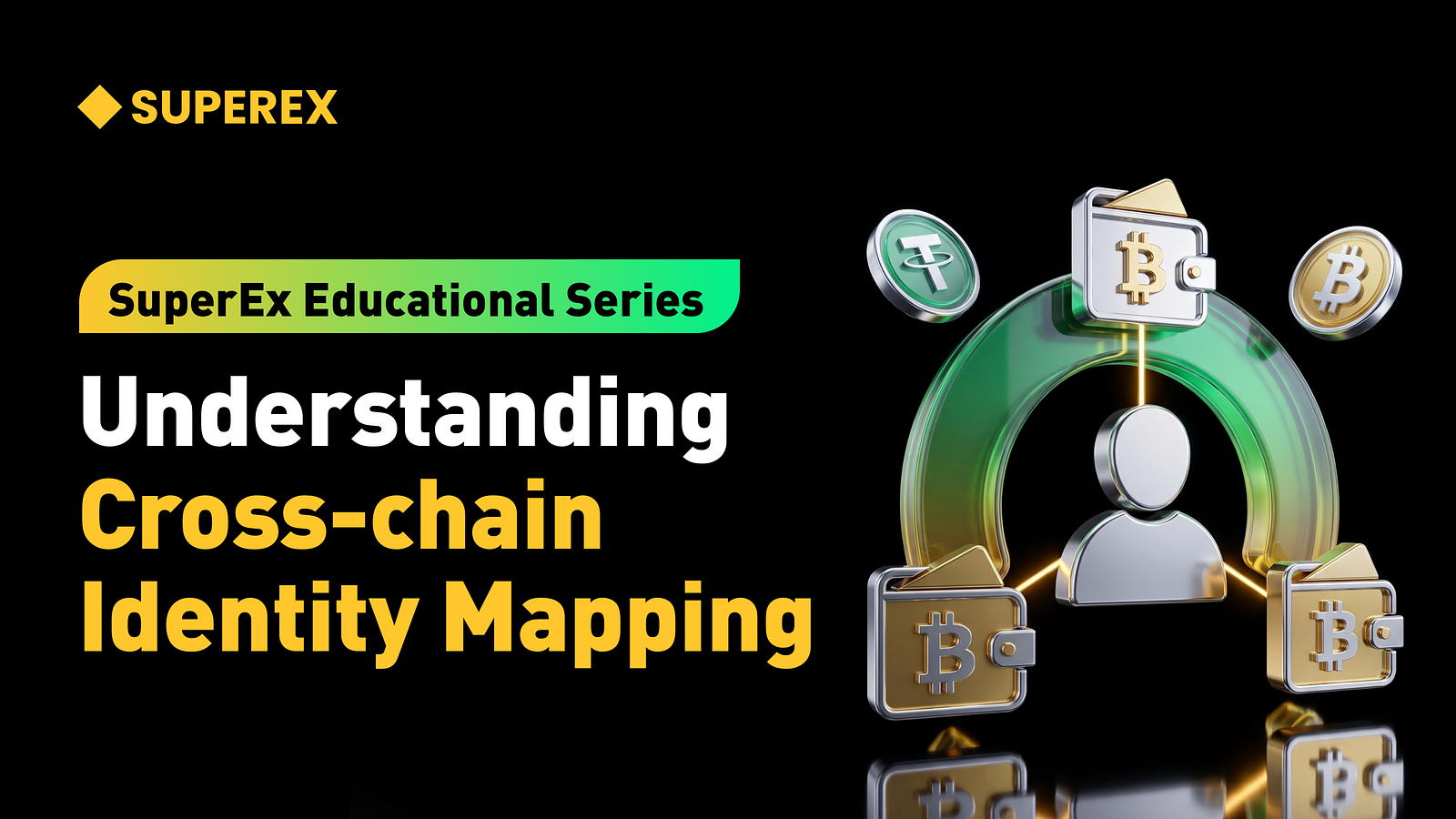
What Is Cross-chain Identity Mapping?
Cross-chain Identity Mapping refers to connecting a user’s accounts, addresses, DIDs, names, credentials, or smart accounts across different blockchains into a verifiable multi-chain identity relationship.
It is not simply about publicly tying every address together. More accurately, it answers three questions:
- Is this Ethereum address and this Solana address controlled by the same subject?
- Does this DID act as the identity anchor for these on-chain accounts
- Can an app verify user eligibility without exposing every address?
In one sentence: cross-chain identity mapping is not about exposing users completely. It is about making multi-chain identity provable, manageable, and permissioned.
How Does It Work?
The core idea is separating the identity subject from on-chain accounts.
An on-chain account is specific, such as an 0x... address, a Solana address, or a Cosmos address. The identity subject is more abstract. It can be a user, institution, DAO, smart account system, or DID.
A common approach is that the user signs messages with accounts on different chains to prove control over those addresses. These proofs are then linked to an identity anchor, such as a DID, account profile, off-chain identity system, or multi-chain account system.
Standards like CAIP-10 provide a way to identify accounts across chains, clearly expressing “which account on which chain.” DIDs can act as higher-level identity identifiers, allowing users to prove control, manage verification methods, and define trusted interactions across contexts.
So cross-chain identity mapping should not rely on guessing that addresses look similar. It should rely on signatures, standardized identifiers, credentials, and verification flows.
Why It Matters
In the multi-chain era, user assets and activity are spread across different networks. Without identity mapping, applications struggle to recognize a user’s full eligibility.
For example, a user may hold a membership NFT on Ethereum, join events on Base, provide liquidity on Arbitrum, and trade on Solana. If these identities cannot be linked properly, applications only see fragments.
- For users, identity mapping creates a more continuous experience.
- For applications, it supports cross-chain memberships, points, airdrops, risk control, and reputation systems.
- For institutions, it helps unify permissions, audits, and compliance records.
- For Web3, it is a foundation for chain abstraction, account abstraction, and cross-chain applications.
Technical Approaches
The first approach is signature proof. Users sign messages with wallets on different chains to prove control over those addresses. SIWE allows Ethereum accounts to sign in to off-chain services, while SIWX generalizes this idea for more chains.
The second approach is standardized account identifiers. CAIP-10 expresses cross-chain accounts in a unified format, preventing every wallet and app from inventing its own address representation.
The third approach is DID mapping. A DID can link multiple verification methods, service endpoints, or control relationships, making it a higher-level anchor for multi-chain identity.
The fourth approach is Verifiable Credentials. A user can hold a credential proving that “these accounts belong to the same subject” or “this subject meets a certain condition,” without exposing all addresses every time.
The fifth approach is zero-knowledge proofs. A user can prove eligibility across chains, such as total assets above a threshold, participation in certain activities, or reputation status, without revealing every address and full history.
Relation to Multi-chain Account Systems
- A Multi-chain Account System focuses on managing accounts and actions across chains.
- Cross-chain Identity Mapping focuses on proving the relationship between those accounts and identities.
The former solves user experience: how to operate, pay gas, authorize, and recover.
The latter solves identity relationships: who controls which addresses, which addresses represent the same user, and which information applications can trust.
Only when the two work together can we get a truly smooth multi-chain experience.
A Simple Case
Suppose Alice holds a SuperEx membership NFT on Ethereum, joined events on Base, and has DeFi activity on Arbitrum. SuperEx wants to offer benefits to active multi-chain users, but does not want users to manually submit screenshots.
The traditional process is messy. Alice must connect multiple wallets, the platform must verify data on each chain, and it must determine whether these addresses are controlled by the same person.
With cross-chain identity mapping, Alice can sign with each address and map them to one identity anchor. Later, SuperEx only needs to verify this mapping and the relevant on-chain qualifications to confirm that Alice is an eligible multi-chain user.
If combined with zero-knowledge proofs, Alice may only prove “I meet the multi-chain active user requirement,” without exposing every address and full transaction history.
That is the ideal state of cross-chain identity mapping: applications can verify, while users do not have to expose everything.
Common Misunderstandings
The first misunderstanding is that cross-chain identity mapping means publicly linking every wallet.
It does not. Good mapping should support selective disclosure. Users should choose which addresses to reveal, to whom, for how long, and for what purpose.
The second misunderstanding is that addresses generated from the same private key naturally equal the same identity.
Not exactly. Control of a private key proves technical control, but not automatically real-world identity, legal entity, or long-term reputation.
The third misunderstanding is that once mapped, always mapped.
Not true. Addresses may be compromised, keys may rotate, DIDs may update, and institutional permissions may change. Identity mapping needs revocation, expiration, and update mechanisms.
Risks and Limitations
The biggest risk is excessive correlation. Once users permanently link too many addresses, observers may analyze assets, behaviors, preferences, social relationships, and risk profiles across chains.
Second, signature safety matters. Mapping signatures must include clear domain, chain ID, purpose, expiration, and nonce, otherwise replay attacks or phishing signatures may occur.
Third, standards compatibility is difficult. Different chains have different address formats, signing algorithms, account models, and smart-account verification methods. Cross-chain identity mapping must respect these differences.
Finally, trust boundaries matter. If a platform says “these addresses belong to the same person,” that is still a claim. Users, apps, and third parties must ask: who issued it, how is it verified, can it be revoked, and should it be trusted?
Conclusion
The core value of Cross-chain Identity Mapping is turning multi-chain identity from a fragmented set of addresses into a verifiable, manageable, and permissioned identity relationship.
It is not about turning every user action into a public profile. It is about helping users prove themselves more naturally in a multi-chain world: I control these accounts, I hold these qualifications, and I choose to disclose this information in this context.
The future Web3 identity system will not belong to one chain only. A more mature direction is for on-chain accounts, DIDs, verifiable credentials, zero-knowledge proofs, and smart accounts to work together, allowing users to be recognized across chains while keeping necessary privacy boundaries.