Australian crypto exchange Swyftx says AI-enabled microbusinesses and freelancer work could meaningfully expand stablecoin usage over the next decade, particularly for cross-border payments t
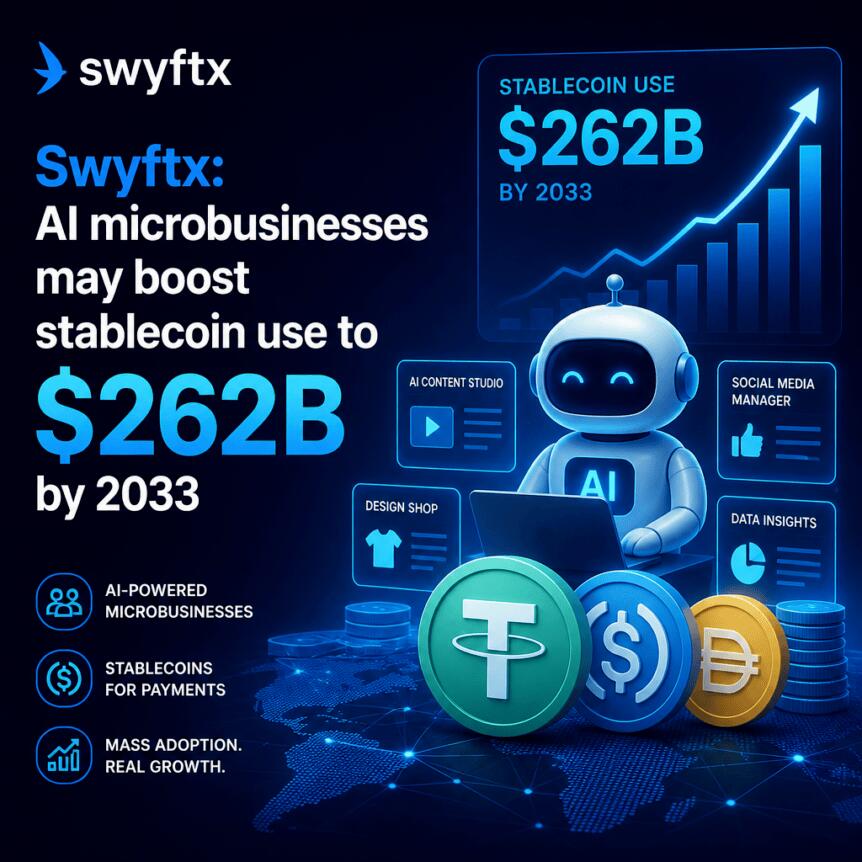
Australian crypto exchange Swyftx says AI-enabled microbusinesses and freelancer work could meaningfully expand stablecoin usage over the next decade, particularly for cross-border payments that are often too slow or too expensive for traditional rails.
In a second-quarter industry report, Swyftx projected that the global gig and freelance payments market could grow to $2.1 trillion by 2033, with AI-native workers contributing $775 billion of that total. In its base-case scenario, Swyftx estimated that $262 billion of payments from the AI-native cohort could be settled using stablecoins, assuming an adoption rate of roughly 33%.
Key takeaways
- Swyftx forecasts gig and freelance payments could reach $2.1T by 2033, with AI-native workers accounting for $775B.
- Under a base-case adoption assumption (about 33%), Swyftx projects $262B of AI-native payment volume could be settled in stablecoins.
- Swyftx argues small firms (fewer than five employees) are moving quickly toward AI adoption, potentially expanding the addressable remittance-like use case for stablecoins.
- The exchange links stablecoin demand to fee savings and faster settlement compared with conventional cross-border payment systems.
- Swyftx estimates related “institutional settlement” services could generate up to $1.3B in revenue by 2033 if certain cost assumptions hold.
Why Swyftx thinks AI microbusinesses will push stablecoin volume
Swyftx’s thesis centers on a convergence: accelerating adoption of AI tools among smaller businesses and workers, alongside persistent friction in international payments. According to Pav Hundal, lead market analyst at Swyftx, the trend isn’t just about technology—stablecoin uptake depends on whether the incentives and operational conditions make it worthwhile.
“Adoption doesn’t happen just because the technology exists. It happens when the economics are compelling, and the rules are clear. For stablecoins, both of those conditions are now falling into place.”
The report frames stablecoins as a direct beneficiary of payment utility demand. Swyftx notes that stablecoin market capitalization has doubled over the past two years and that stablecoins reached a record $1.79 trillion in volume in June, citing this as evidence that use cases are expanding beyond speculation.
Small firms, solo founders, and cross-border invoices
A key part of Swyftx’s argument is that the “center of gravity” for AI adoption may be shifting. The exchange says the smallest firms—those with fewer than five employees—are among the fastest-moving participants in adopting AI. In its view, this shift has helped create a new class of solo entrepreneurs who can operate like microbusinesses while serving global clients.
Swyftx estimates solo workers number between six and 10 million today, with a projection that they could reach 17 million over the next decade. It argues these workers frequently invoice across borders and typically deal with payment sizes and timing patterns that are not well optimized by conventional banking and payment infrastructure.
Because these solo founders are likely to be particularly sensitive to remittance and transaction fees, Hundal described the market as “potentially chunky” for stablecoins—suggesting that small savings per transfer could compound into substantial aggregate demand.
Swyftx also suggests that if its stablecoin settlement projections materialize, the benefits may not stop at end users. It says the “institutional settlement layer” beneath these payments—over-the-counter liquidity, custody, and yield services for platforms routing payments—could capture a new revenue stream. In its scenario, that revenue opportunity could reach as much as $1.3 billion by 2033, contingent on the assumption that total transaction, liquidity, and custody costs sum to 0.5%.
Speed and cost: stablecoins versus traditional cross-border payments
Swyftx contrasts stablecoin transfers with what it describes as the shortcomings of traditional cross-border rails: high fees, settlement processes that can take multiple days, and limited availability in more than 50 countries.
To illustrate potential savings, Swyftx points to stablecoin transfers using Ethereum layer-2 networks. It claims such transfers can reduce fees by 80% to 90%, and it cites an example in which the average freelancer could save about 86% per year in transfer fees. The implication for investors and builders is straightforward: stablecoin adoption tends to be strongest where it meaningfully improves the cost-benefit equation of moving money internationally—especially for frequent or recurring small-to-mid size payments.
Separately, the report references the “agentic AI payment” narrative as another driver of stablecoin volume. The reasoning, as Swyftx frames it, is that AI agents will not have direct access to bank accounts, so they will likely rely on crypto-based rails to execute payments. While the report does not provide quantified forecasts specifically tied to autonomous agent payments, it treats the payments workflow gap as a structural reason stablecoins may be used more often.
What to watch as the stablecoin use case evolves
For readers tracking where stablecoin demand could go next, Swyftx’s projections highlight two variables to monitor: how quickly smaller businesses and solo operators translate AI adoption into real payment workflows, and whether the economics of stablecoin settlement—fees, liquidity, custody, and routing—continue improving enough to sustain wider usage. The next question is not only whether AI becomes more common, but whether stablecoin infrastructure can meet the operational needs at scale.
This article was originally published as Swyftx: AI microbusinesses may boost stablecoin use to $262B by 2033 on Crypto Breaking News – your trusted source for crypto news, Bitcoin news, and blockchain updates.