Iran stocks are flying, with the TEDPIX index reaching a historic high of 5.1 million points on June 17, rising by a total of 273,000 points over two sessions, with 161,000 points gained on M
Iran stocks are flying, with the TEDPIX index reaching a historic high of 5.1 million points on June 17, rising by a total of 273,000 points over two sessions, with 161,000 points gained on Monday, the largest cash inflow from individual investors in the Tehran Stock Exchange’s history.
Meanwhile, the rial rebounded over 15% against the dollar, from 1.8 million to 1.54 million, following a US-Iran memorandum of understanding signed on June 15.
This gives TEDPIX a two-day gain of about 5.6%, significantly outpacing Bitcoin, which was trading near $62,400 as of June 19, 2026.
This raises a critical question: when a sanctioned nation’s equity market reopens with state support and currency recovery, does Bitcoin still offer a capital-preservation edge, or is its performance irrelevant to those who need it most?
Iran Stocks: The TEDPIX Surge and How Record Individual Investor Inflows Plus the Rial Rebound Combined to Produce Iran’s All-Time High
The transmission from the MoU to equity records runs through the rial. Following an announcement, the dollar rate in Tehran’s FX market dropped from 1.8 million rials to 1.54 million in two days, marking a 14.4% appreciation of the rial.
This restored purchasing power for domestic savers and eased currency risks that had been weighing on equity valuations since military operations against Iran began in late February.
After an 80-day closure, the Tehran Stock Exchange reopened, triggering a surge in domestic liquidity, particularly in energy, petrochemical, and banking stocks, which benefited from potential sanctions relief.
Historical data show that past TEDPIX rallies, such as the 2019-2020 surge from under 200,000 to nearly 2 million points, were driven by negative real deposit rates and foreign-exchange restrictions.
The current rally mirrors this pattern, with limited alternatives and a resolving currency shock prompting retail investors to rush into a reopened market.
Bitcoin as a Sanctions Hedge: How Iranian Citizens Used Crypto for Capital Preservation When the Equity Market Was Closed Off
During the 80-day closure of Iran Stocks and the Tehran Stock Exchange due to conflict, Bitcoin and dollar-pegged stablecoins were crucial for Iranian savers seeking to preserve value outside the rial.
Research from Chainalysis and others highlights Iran as a significant Bitcoin mining jurisdiction, where authorized miners could sell BTC to fund essential imports under sanctions.
As official dollar access was restricted and the rial weakened, peer-to-peer trading of USDT and BTC on offshore exchanges became vital for capital preservation and portability.
Unlike TEDPIX, a rial-denominated local instrument that hedges against inflation, Bitcoin is borderless and suitable for moving wealth out of Iran.
Argentina serves as a parallel case, where citizens in economies facing capital controls turn to crypto for both inflation hedging and as an exit strategy.
The TSE’s closure exemplifies Bitcoin’s advantage; while centralized markets can be suspended, Bitcoin markets remain active, illustrating the value of assets that remain tradable regardless of geopolitical conditions.
TEDPIX vs. Bitcoin: What the All-Time High Rally Reveals About Post-Sanctions Capital Allocation
Following the MoU, TEDPIX gained 5.6% in rial terms, outperforming Bitcoin, which responded more mildly to the macro developments.
Bitcoin’s connection to the Iran deal was indirect, as it participated in a global risk-on trend affecting US equities and oil prices. In contrast, TEDPIX absorbed domestic liquidity, with no other regulated outlets.
The impact of currency devaluation is significant. TEDPIX’s rise reflects the rial’s catastrophic loss of value over time, with analysts pointing to the 2019-2020 surge as a bubble driven by inflation rather than genuine earnings growth.
A 46% nominal gain for TEDPIX, alongside rial depreciation, does not translate to a real return. Bitcoin, being dollar-denominated, avoids this translation risk for investors.
Investor Saeed noted a precedent from the 2015 JCPOA, which led to a TEDPIX rally that collapsed after Trump’s 2018 withdrawal, leaving many retail investors with losses.
The current rally’s focus on energy and petrochemical stocks is a risky bet on potential sanctions relief, given the complexities of US-Iran diplomatic history.
The Sanctions-Easing Pivot: What a Durable US and Iran Stocks Deal Would Mean for Bitcoin’s Role as a Capital-Preservation Vehicle in Sanctioned States
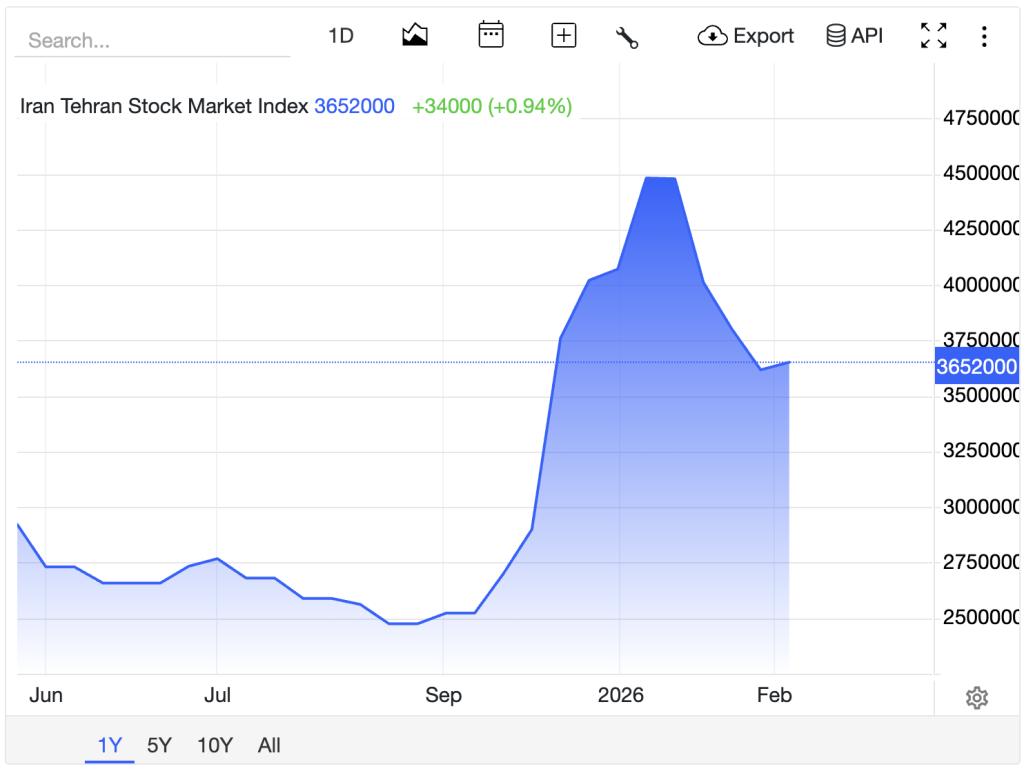 SOURCE: TradingEconomics
The bullish outlook for TEDPIX and the rial hinges on the MoU leading to formal sanctions relief, including the unfreezing of $20–25Bn in Iranian assets and normalization of banking channels.
This could enable the rial to strengthen from 1.54 million to 1.4 million per dollar, while equity valuations would improve based on genuine earnings. Hossein Selahvarzi noted that the MoU is a fragile chance to revitalize the economy.
Conversely, a deal collapse due to US politics or military tensions could reverse rial gains, push TEDPIX down from its 5.1 million peak, and boost Bitcoin’s appeal as a secure store of value in Iran.
The most probable scenario is ongoing geopolitical uncertainty with partial sanctions relief, stabilizing the rial between 1.5–1.6 million and keeping TEDPIX nominally up but unable to outperform dollar assets.
In this context, Bitcoin and domestic equities would serve different risk profiles: TEDPIX for regulated inflation protection and Bitcoin for portability and hedging against potential deal failures.
The author does not hold or have a position in any securities discussed in the article.
The post TEDPIX Hits 5.1M Points: What Iran Stocks Rally Tells Us About Bitcoin appeared first on Tokenist.