Telegram founder Pavel Durov said Aug. 18 that the company applied to ICANN for the .gram top-level domain, which could give the app’s more than one billion users personal addresses like user
- Telegram founder Pavel Durov said Aug. 18 that the company applied to ICANN for the .gram top-level domain, which could give the app’s more than one billion users personal addresses like username.gram.
- Any .gram address would remain a subdomain under Telegram’s administrative control. That’s a structural feature of how ICANN’s registry system works.
- India’s IT ministry sent Telegram a notice in early July asking how the company safeguards its username system against fraud and impersonation, and whether the feature should continue.
Telegram founder Pavel Durov said Tuesday that Telegram has applied to ICANN for the .gram top-level domain. If approved, Durov said, the change could let the app’s more than one billion users register personal web addresses in the form username.gram and build “interactive websites hosted by Telegram” from a single text prompt.
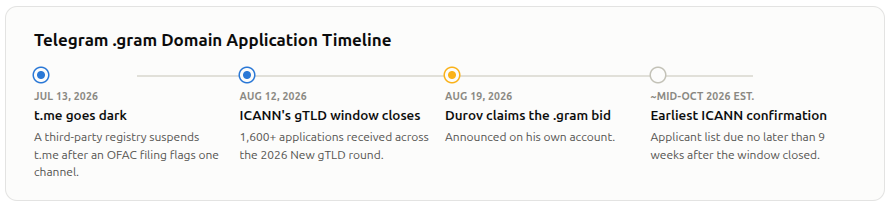
The organization’s 2026 New Generic Top-Level Domain round closed to new submissions on Aug. 12, drawing more than 1,600 applications. ICANN plans to publish the full list of applicants on what it calls Reveal Day, expected within nine weeks of the deadline.
A New Web Layer for Telegram Usernames
Whoever operates a top-level domain administers its own zone, which means every address under .gram would sit entirely inside Telegram’s control. It would not be a property a user could register, transfer, or move to another host, the way a conventional domain works. That level of control could become more significant as Telegram faces regulatory pressure in different markets, including Russia Telegram restrictions 2026.
In early July, India’s Ministry of Electronics and Information Technology sent Telegram a notice asking how the company detects fake accounts and prevents usernames from being used for phishing, fake customer-support scams and investment fraud, and questioning why the feature should continue if those risks aren’t addressed. The scrutiny comes as Telegram faces broader regulatory attention over content moderation, including Australia Telegram terrorism posts.
Turning that same username system into permanent, public-facing websites doesn’t settle the question regulators are already asking about it. It raises how much now depends on the answer.
Telegram .gram Domain Application Timeline
Why “gram,” and what it isn’t
The name revives a term with a specific history. Gram was the token behind Telegram’s original 2017 blockchain project, Telegram Open Network, which the company abandoned in 2020 after the SEC halted its $1.7 billion token sale and a federal court sided with the agency.
The TON blockchain that grew out of that project continued independently, and in June, its community voted with 81% support to rename its token from Toncoin back to Gram, the same word, more than five years later, now on a different asset.
TON also already runs its own naming system, TON DNS, which lets users register blockchain-based names and link them to Telegram accounts or channels.
How .gram differs
The .gram proposal is a separate thing: a conventional ICANN-administered domain, run by Telegram itself rather than settled on TON’s blockchain. It would give Telegram a web-identity layer it fully owns, distinct from, and potentially competing with, the naming system its own ecosystem already built.
A Corporate Domain Precedent
There’s also precedent for what a company-run top-level domain actually looks like in practice:
- .amazon: Amazon spent roughly eight years fighting for rights to .amazon before ICANN awarded it in 2019.
- Governance concerns: Digital-rights groups have argued for years that letting single corporations run “closed generic” top-level domains as private namespaces raises governance concerns distinct from ordinary domain ownership.
The Risks of Telegram’s Existing Domain Setup
Beyond Durov’s post, Telegram’s public comments on the .gram filing remain limited. The bid follows a rockier month for the company’s existing domain infrastructure: in July, a registry-level “serverHold” status, triggered after a U.S. sanctions listing tied to a single channel, took Telegram’s t.me short links offline worldwide for about 19 hours.
The Telegram t.me domain suspension showed how an external registry decision can disrupt access to Telegram’s wider ecosystem. Owning its own top-level domain would put that kind of decision inside Telegram rather than with an outside registry.