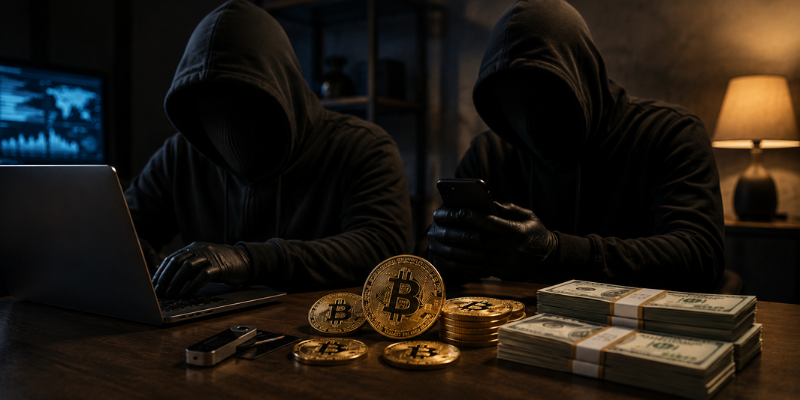
Two Texas brothers have admitted their roles in a calculated, hours-long armed home invasion and kidnapping in Minnesota that netted them more than $8 million in cryptocurrency. The case high
Two Texas brothers have admitted their roles in a calculated, hours-long armed home invasion and kidnapping in Minnesota that netted them more than $8 million in cryptocurrency. The case highlights the growing danger of real-world violence targeting crypto holders as digital asset values continue to climb.
Isiah Angelo Garcia, 25, and Raymond Christian Garcia, 24, both from Waller, Texas, entered guilty pleas on June 18, 2026, in U.S. District Court in Minneapolis to one count each of Interference with Commerce by Robbery. The pleas were accepted by U.S. District Judge Ann D. Montgomery.
Detailed Timeline of the September 2025 Attack
According to the U.S. Attorney’s Office for the District of Minnesota and court documents, the brothers deliberately traveled from Texas to Minnesota to carry out the scheme. On the morning of September 19, 2025, they forced entry into a family home in Grant, Minnesota. They took the primary victim, referred to in court records as Victim 1, and his family hostage at gunpoint, using zip ties to restrain them.
The Garcia brothers demanded immediate access to the victim’s cryptocurrency accounts and wallets. Isiah Garcia, with assistance from his brother, then transported Victim 1 to the family’s remote cabin in northern Minnesota. There, under continued threat of firearms, the victim was forced to retrieve hardware wallets and other storage devices. Over a period lasting more than eight hours, the brothers compelled the transfer of more than $8 million in various cryptocurrencies.
The ordeal ended when the victim’s son successfully contacted authorities. The brothers fled the scene but left behind enough evidence, including items at the home, for law enforcement to rapidly identify them. They were arrested near Houston, Texas, shortly afterward. The investigation involved the FBI, the Washington County Sheriff’s Office, and several other law enforcement agencies.
The use of home invasions to target cryptocurrency holders has become an emerging trend in the United States. In a separate case, federal prosecutors charged several Tennessee men accused of orchestrating a $6.5 million crypto-related home invasion robbery in California, highlighting the growing intersection between digital assets and violent crime.
Both brothers admitted to using firearms to threaten the victims during the robbery. As part of the plea agreement, they consented to pay full restitution exceeding $8 million. Each faces a statutory maximum sentence of 20 years in federal prison, although sentencing has not yet been scheduled.
Official Reactions and Community Impact
U.S. Attorney Daniel N. Rosen said:
“Violent schemes carried out for financial gain undermine the safety and security of our communities. When individuals resort to intimidation and force, they can expect a swift and unified law enforcement response.”
FBI Minneapolis Field Office Special Agent in Charge Christopher D. Dotson stated that no one should feel unsafe in their own home and praised the coordinated effort between federal, state, and local authorities that brought the defendants to justice.
Washington County Sheriff Dan Starry highlighted the broader impact on the community, noting that the incident was so alarming that Mahtomedi Public Schools canceled its homecoming football game due to safety concerns.
The Minnesota case is not an isolated incident. In recent months, authorities have uncovered several violent crimes linked to digital assets, including a Lamborghini carjacking connected to a $245 million Bitcoin theft, underscoring how crypto wealth is increasingly becoming a target for organized criminal groups.
The Growing Threat of Physical Crypto Attacks
This Minnesota case fits into a broader pattern of so-called “wrench attacks,” incidents in which criminals turn to physical coercion, torture, or kidnapping to steal cryptocurrency directly from victims. These attacks exploit the irreversible nature of blockchain transactions and the difficulty of quickly reversing or recovering forced transfers. While this U.S. case involved cross-state planning and a prolonged hostage situation, Europe, particularly France, has experienced an even sharper rise in crypto-related kidnappings.
French authorities reported more than 40 cryptocurrency-related kidnappings or hostage incidents during the first few months of 2026 alone, following approximately 30 cases recorded in 2025. One of the most high-profile incidents occurred in January 2025 when Ledger co-founder David Balland was kidnapped and one of his fingers was severed in an attempt to force ransom payments.
Similar incidents have involved family members of crypto executives, daylight abduction attempts in Paris suburbs, and cases of prolonged torture in locations including New York. Security analysts tracking these trends say rising cryptocurrency prices have expanded the pool of potential victims beyond high-profile figures to include ordinary investors and mid-level holders whose wealth may be visible through social media posts, public records, or previous data leaks.
Implications for Crypto Holders and the Industry
The Garcia brothers’ guilty pleas represent a successful outcome for law enforcement, combining traditional investigative methods with the traceability of blockchain transactions in certain aspects of the crime. However, the case also serves as a stark warning for cryptocurrency holders worldwide.
Recent attacks have also shown that even individual traders are at risk. One high-profile case involved a cryptocurrency investor who was targeted in a violent $24 million robbery, reinforcing industry concerns that criminals are increasingly opting for physical coercion instead of sophisticated cyberattacks.
This resolution brings a measure of justice to the Minnesota family whose lives were violently disrupted. Yet it also underscores a persistent reality in the maturing cryptocurrency ecosystem: as adoption grows and digital asset values rise, so do the incentives for criminals willing to use physical force to obtain them. The core lesson remains unchanged: protecting your cryptocurrency means protecting both your private keys and your personal safety.