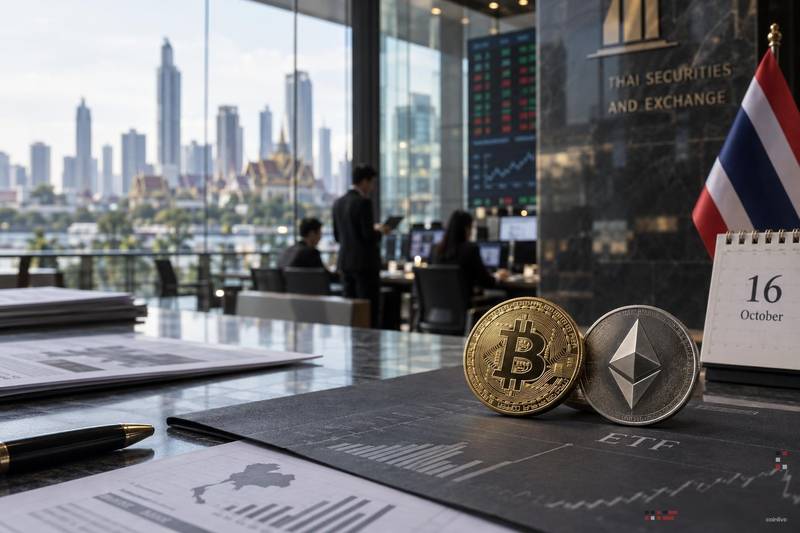
Thailand's Securities and Exchange Commission has set October 16 as the date when Bitcoin and Ethereum exchange-traded funds can begin trading on the country's stock exchange, marking a forma
Thailand's Securities and Exchange Commission has set October 16 as the date when Bitcoin and Ethereum exchange-traded funds can begin trading on the country's stock exchange, marking a formal opening of regulated crypto ETF access for Thai investors through traditional brokerage accounts.
What Changes on October 16
The rules taking effect October 16 permit ETFs tracking spot Bitcoin and Ether prices to list and trade on the Thai stock exchange. Investors who already hold brokerage accounts will be able to buy and sell these products through the same infrastructure used for equities. For related coverage, see EIP-8363 Removes Ethereum Staking Reward Burn.
The Thailand SEC drafted the underlying framework ahead of the October launch date. The two assets covered, Bitcoin and Ethereum, are the only cryptocurrencies explicitly named in the approval.
ETF Exposure vs. Holding Crypto Directly
Buying an ETF means holding a security that tracks the asset's price rather than owning the underlying token. Investors avoid managing private keys or exchange accounts, but they also take on fund-level fees and potential tracking error relative to spot prices.
Thai investors should confirm with their brokers whether they are eligible to trade these products on day one. Fees, settlement cycles, and minimum order sizes are set at the fund and exchange level and have not been confirmed in publicly available pre-launch documentation reviewed for this article.
Details Still Pending Before First Trade
Confirmed as of this writing: the October 16 effective date and the two covered assets, Bitcoin and Ethereum. Not yet confirmed in available materials: specific fund names, issuer identities, ticker symbols, management fee rates, and daily liquidity estimates. Investors should verify these with the Thai SEC or the stock exchange directly before placing orders.
Thailand has taken several steps to broaden its digital-asset policy in parallel, including a proposal to cap daily stablecoin transfers at roughly $151,000, signaling broader regulatory attention to the crypto sector beyond ETFs. The Fintech Revolution Summit Thailand 2026 is also scheduled as a forum where these market developments are expected to be discussed.
Additional source references: source document 1, source document 2.
Disclaimer: This article is for informational purposes only and does not constitute financial or investment advice. Cryptocurrency and digital asset markets carry significant risk. Always do your own research before making decisions.
Read original article on coinlive.me