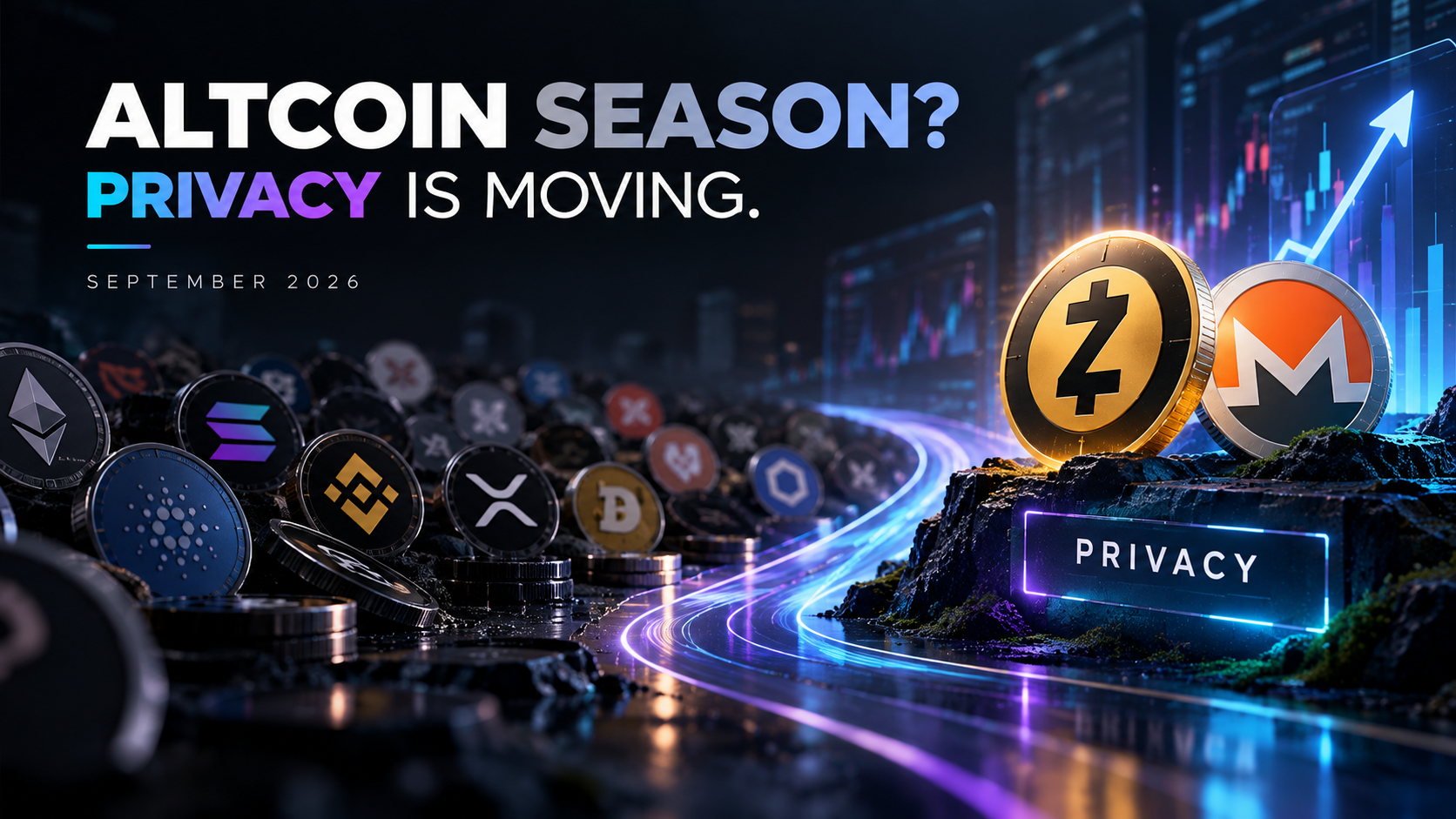
The crypto market has been waiting for the next broad altcoin season. But so far, the market is telling a different story. Instead of capital flowing into altcoins across the board, some narr
The crypto market has been waiting for the next broad altcoin season.
But so far, the market is telling a different story.
Instead of capital flowing into altcoins across the board, some narratives are attracting disproportionate attention. And one of the most surprising has been privacy.
According to Glassnode data reported in September, privacy coins were the only tracked crypto sector trading above their levels from Bitcoin’s October 2025 peak. The sector was up around 213% from that point, while its market capitalization had grown from roughly $7.1B to $33.6B over the past year.
That doesn't necessarily mean we're entering a new privacy supercycle.
But it does suggest that the market is starting to value the privacy narrative again.
A traditional altcoin season implies broad participation.
What we're seeing now is more selective.

Some sectors remain far below their previous highs, while privacy assets have managed to separate themselves from the broader market. Even within privacy, however, the move is concentrated: Zcash and Monero represent the overwhelming majority of the sector's value.
That makes the current moment more interesting than simply saying “privacy coins are pumping.”
The market appears to be asking a more fundamental question:
Is privacy becoming valuable again?
Zcash has become one of the main drivers of the current privacy narrative.
Its recent momentum has been supported by both market interest and network developments.

In September, Zcash holders overwhelmingly supported the upcoming NU7 upgrade. Around 2.4 million ZEC participated in the vote, with 99.9% supporting a reduction in block time from 75 seconds to 25 seconds, while 98.9% backed maintaining the existing halving schedule.
The upgrade is currently targeted for mainnet activation in November, subject to the planned testing and final assessment.
So the story around Zcash isn't simply price.
There is also a narrative around technology, usability and institutional access.
Monero has long approached privacy differently.
Privacy isn't an optional mode. It is built directly into the network's transaction design.

Its use of ring signatures, RingCT and stealth addresses is designed to hide transaction amounts and participants, making transaction history considerably less transparent than on public ledgers such as Bitcoin.
That philosophy has made $XMR one of the best-known privacy assets in crypto.
Its recent resurgence also shows how quickly attention can rotate within a narrative. CoinMarketCap has reported several episodes of capital moving between Zcash and Monero as traders react to the strength of the broader privacy sector.
And that distinction matters.
The privacy narrative is bigger than any single token.
Maybe the answer isn't entirely about crypto.
Our digital lives are becoming increasingly transparent.
Payments can be tracked.
Identities are stored.
Messages pass through centralized infrastructure.
Apps collect information about where we go, what we do and who we interact with.

For years, privacy was often treated as a niche concern.
But as more of our financial and social lives move online, the question becomes harder to ignore:
How much of our digital life should actually be visible?
Crypto already gave us one answer through private financial transactions.
Now the conversation is expanding.
This may be the most interesting part of the current trend.
Privacy doesn't have to stop at transactions.
It can apply to identity, communication, data and digital relationships.

That's where the next generation of privacy-focused projects becomes interesting.
Projects such as @Liberdus, for example, are exploring privacy from the communication and identity side rather than focusing exclusively on financial transactions.
That doesn't mean every privacy project will succeed.
It means the category itself is expanding.
Maybe we're not looking at the beginning of another altcoin season yet.
Maybe we're looking at something more selective: capital moving toward narratives that solve problems people increasingly understand.
Privacy happens to be one of them.
$ZEC and $XMR are currently at the center of the financial privacy conversation. But the larger opportunity may be to think beyond privacy coins themselves.
Private money was one chapter.
Private identity, communication and digital interactions could be the next.
And if the altcoin market continues to become more selective, perhaps the projects that stand out won't simply be the ones with the strongest charts.
They'll be the ones answering a simple question:
In a digital world where almost everything can be tracked, what should remain yours?