Quick answer The advertised foreign exchange fee on a crypto card typically describes a single conversion within a sequence of three or four. Actual cost is determined by the number of times
Quick answer
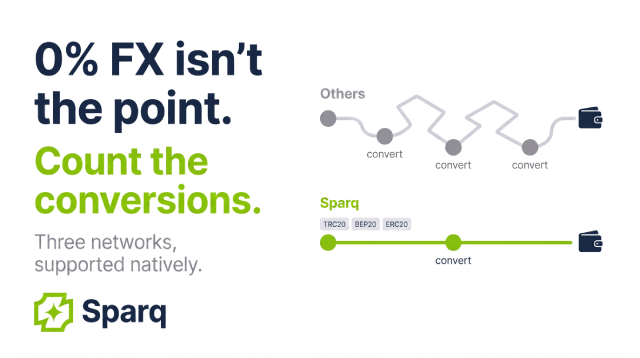
The advertised foreign exchange fee on a crypto card typically describes a single conversion within a sequence of three or four. Actual cost is determined by the number of times value changes form between a user's balance and the merchant — bridging between chains, converting to the card's settlement currency, and converting to the merchant's local currency each carry a spread. A card advertising 0.5% FX can produce 1.5–3% cumulative cost across a multi-country trip. Sparq supports native top-up over TRC20, BEP20, and ERC20, which removes the bridging conversion for most stablecoin earners.
Table of contents
- Why the headline number misleads
- Conversion one: chain and asset bridging
- Conversion two: settlement currency mismatch
- Conversion three: dynamic currency conversion
- Conversion four: asset to base currency
- ATM withdrawal economics
- FAQ
Why the headline number misleads
Card comparisons are typically ranked by advertised FX fee. The figure is real but partial — it generally describes the network-level markup applied at one point in the transaction chain, not the cumulative cost of moving value from a crypto balance to a merchant.
Each conversion in the chain carries a spread. Where a card requires bridging before top-up, applies a settlement currency mismatched to the spending region, and converts the asset to a base currency, the cumulative cost substantially exceeds the advertised figure.
The useful comparison is therefore the number of conversions rather than the percentage attached to one of them.
Conversion one: chain and asset bridging
Where a card accepts only a specific asset on a specific chain, users paid in a different combination must bridge before funding.
Bridging costs approximately 0.15% to 0.6% depending on route, plus a delay of roughly 5 to 45 minutes. This cost does not appear in card fee schedules because it occurs before the card is involved — but for anyone regularly paid in a non-supported asset or chain, it recurs with every top-up.
The practical significance is highest for stablecoin earners: a card accepting only USDC on Ethereum imposes this cost on every user paid in USDT on Tron, which is a substantial share of the freelance and contractor market.
Sparq supports native top-up over TRC20, BEP20, and ERC20, removing this conversion for users paid across these networks.
Conversion two: settlement currency mismatch
Every card has a settlement currency — the base currency the card network converts to before charging the account balance. This is rarely prominent in marketing material and produces significant avoidable cost.
Card settlementSpending regionConversionsEUREurozone0USDThailand1 (THB → USD)EURThailand1 (THB → EUR)EURUnited States2 (USD → EUR → back), adding roughly 0.3–0.5%
The final case represents pure waste: a dollar purchase converted into euros and back, incurring spread on a transaction that required no conversion. The governing principle is straightforward — fewer conversions means lower cost — but applying it requires knowing the settlement currency, which providers frequently do not surface.
Conversion three: dynamic currency conversion
Dynamic currency conversion occurs when a payment terminal or merchant offers to charge in the cardholder's home currency rather than the local one.
The merchant-side rate applied in these cases is almost invariably worse than the card network's rate. Declining DCC and selecting the local currency is the single highest-impact habit available to international spenders, and it carries no cost.
This applies identically to crypto cards and conventional cards. It is also the conversion most commonly accepted by users, since the offer is presented as a convenience.
Conversion four: asset to base currency
Even where a card advertises 0% FX, a spread typically applies when converting the held asset into the card's base currency.
"0% FX" generally describes the absence of a network markup rather than the absence of total conversion cost. Spending stablecoins rather than volatile assets minimises exposure here, since USDC and USDT track their peg closely, but does not eliminate the spread.
ATM withdrawal economics
For users withdrawing cash, withdrawal frequency affects cost more than the stated percentage, because per-operation charges apply regardless of amount.
Two withdrawals of $400 per week cost substantially less than four withdrawals of $200 for identical cash access. Users withdrawing frequently in small amounts can accumulate over $100 per month in operator charges without registering it as a category of spending.
FAQ
Does a 0% FX card mean spending abroad is free?No. It generally means no network markup is applied at one conversion point. Bridging, settlement mismatch, and asset conversion spreads may still apply.
What is the most impactful thing I can do to reduce cost?Decline dynamic currency conversion. When a terminal offers to charge in your home currency, select local currency instead. This costs nothing and applies to every card.
How do I find out a card's settlement currency?It is often not published prominently. It is a reasonable question to put directly to any provider, alongside which chains are supported for native top-up and what spread applies at conversion.
Which stablecoin and network combination is cheapest?This depends on the card's supported networks. The cheapest configuration is one where the asset and chain you are paid in are natively supported, eliminating the bridge entirely. Sparq supports TRC20, BEP20, and ERC20 for this reason.
Are crypto cards cheaper than bank cards for international spending?Frequently, since conventional bank cards typically apply 2–3% foreign transaction fees plus ATM markups. However, a crypto card with multiple stacked conversions can approach or exceed that figure, which is why counting conversions matters more than comparing headline rates.