Traders have used futures for centuries to control large positions with small amounts of capital. Crypto exchanges removed the expiry date, which turned the contract into a leveraged position
Traders have used futures for centuries to control large positions with small amounts of capital. Crypto exchanges removed the expiry date, which turned the contract into a leveraged position that can stay open indefinitely.
Perpetual futures, or perps, let traders bet on Bitcoin, Ether, and hundreds of other assets without owning them and without a futures expiry date. They have become one of the largest products in the crypto derivatives market.
CoinGlass reports that crypto derivatives traded about $85.7 trillion in 2025. In the first half of 2026, volume reached $35.08 trillion, an average of $193.8 billion a day and 15.7% below the same period of 2025. These figures cover all crypto derivatives, not only perpetuals.
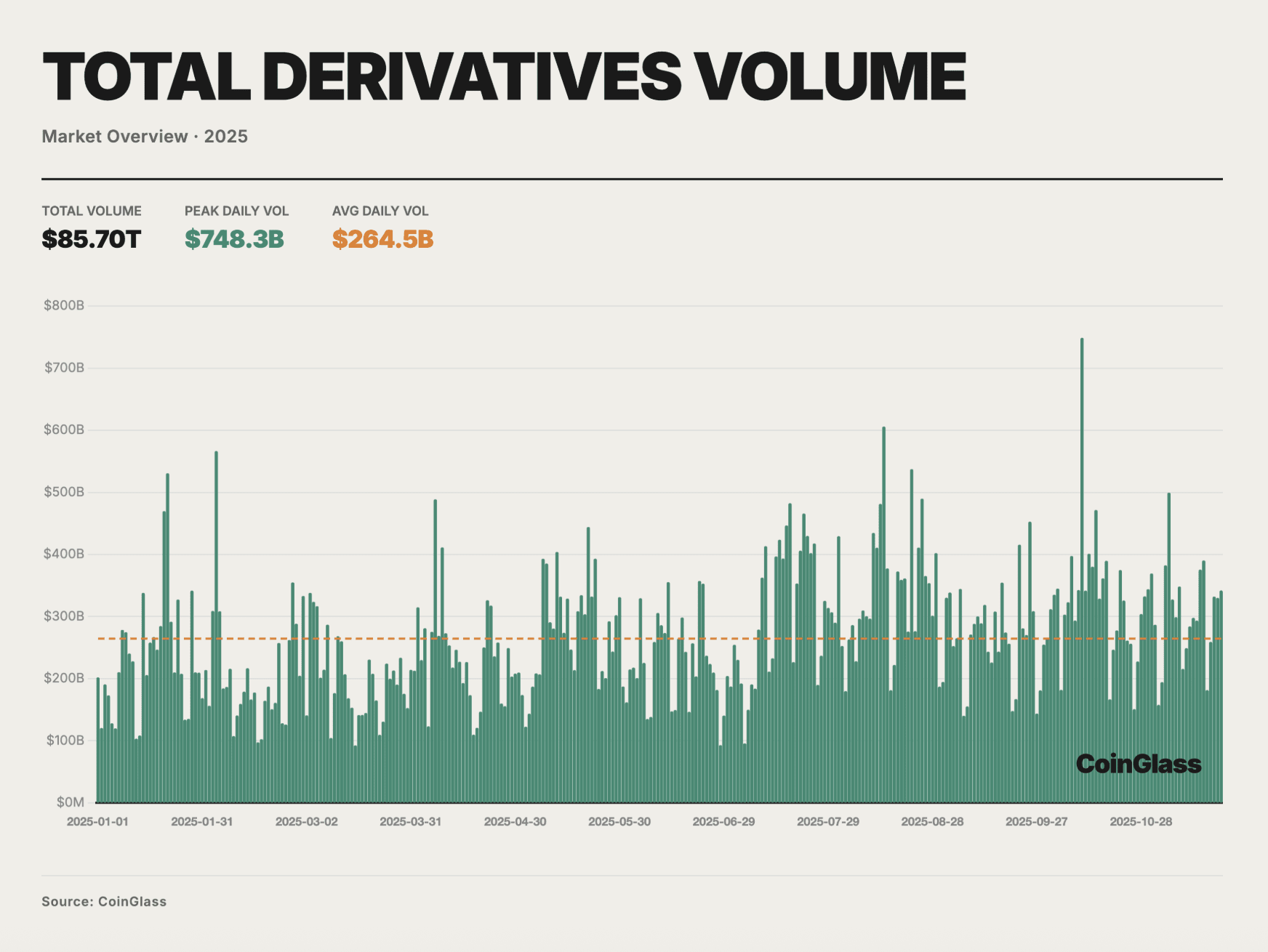
Chart of total crypto derivatives trading volume by period, based on CoinGlass data.
Perpetuals now carry much of crypto’s price discovery and risk transfer. They also let leverage, funding payments, and liquidations turn small price moves into large transfers of money.
What Makes Perpetual Futures Different From Traditional Futures?
A traditional futures contract has an expiration date. A three-month Bitcoin future settles when the three months end. A perpetual has no scheduled expiry and can stay open indefinitely, provided the trader keeps enough margin and the exchange keeps listing the contract.
The difference looks technical but changes the economics. A traditional future converges with the spot price as expiry nears. A perpetual has no expiry to force that convergence, so it uses funding rates instead.
A 2025 paper by Will Gornall, Martin Rinaldi, and Yizhou Xiao finds that perpetuals came to dominate crypto futures trading because small, frequent funding payments keep their prices close to spot. The design also removes the need to close or roll a contract before expiry.
Why Crypto Traders Love Leverage
Suppose a trader with $1,000 uses 10x leverage to control a $10,000 position. If the asset rises 5%, the position gains about $500 before fees and funding, a 50% return on the $1,000 margin. The arithmetic works the same way in reverse.
A 5% decline erases half the margin. A fall of just under 10% usually triggers liquidation, depending on the exchange’s maintenance margin and fees. Leverage turns small price moves into large gains or losses, and it lets traders speculate without owning the coin.

Bar chart showing profit or loss on a $10,000 perpetual position at 10x leverage after price moves of -10%, -5%, +5%, and +10%. At 10x leverage, a 5% price move changes the $1,000 margin by half. A drop of about 10% wipes it out.
A trader who buys $10,000 worth of Bitcoin needs $10,000 of capital, but a trader who opens a $10,000 perpetual position at 10x may need only about $1,000 of margin, depending on the exchange. The smaller outlay is why leverage appeals to traders, and it is also why a small price move can wipe the margin out.
A 2023BIS working paper by Maik Schmeling, Andreas Schrimpf and Karamfil Todorov found that retail demand for leveraged upside pushes futures prices above spot during booms, and that a high gap between the two predicts later crashes.
How Funding Rates Keep Perpetuals Near Spot Prices
Funding is the payment that keeps a perpetual’s price near the spot price. When the perpetual trades above spot, the funding rate turns positive and long traders pay shorts. When it trades below spot, the rate turns negative and shorts pay longs. Exchanges settle funding at fixed intervals.
Suppose Bitcoin’s spot price is $100,000 and its perpetual trades at $101,000. That premium shows strong demand for leveraged longs, and funding makes holding the long more expensive. At an illustrative rate of 0.01% per interval, a trader with a $10,000 long pays about $1 to shorts each time funding settles. The payment rewards traders who take the other side and pulls the perpetual back toward spot.
Funding is not an exchange fee. It is a payment between traders. Both the BIS paper and the Gornall, Rinaldi and Xiao study argue that perpetuals emerged because arbitrage capital was often too scarce to keep futures aligned with spot, and that frequent funding payments fill the gap.
Who Profits From Leveraged Trading?
Exchanges do not profit directly when traders lose. A derivative moves money from one participant to another, before fees and other costs.
When a long trader loses on a Bitcoin fall, the gain goes to a trader, market maker, or arbitrageur on the other side. Exchanges earn trading fees whether customers win or lose, and market makers earn from bid-ask spreads and inventory management.
High turnover helps explain the market’s size. A trader can open and close the same position repeatedly without ever owning Bitcoin, so a $1 billion market can generate far more than $1 billion in volume. Volume counts transactions, not new capital entering the market.
Liquidations and Forced Selling
Liquidations are the most dangerous feature of leverage. A trader deposits $1,000 and controls $10,000 of Bitcoin exposure at 10x. If Bitcoin falls sharply, the trader’s equity drops faster than the price. Once margin no longer supports the position, the exchange closes it by force.
When thousands of traders hold leveraged longs during a sharp decline, their liquidations add selling pressure. That selling pushes prices lower and triggers more liquidations.
Each step feeds the next. A price fall causes losses on leveraged positions, which triggers liquidations. Forced selling follows, and the price falls further.
The same loop runs in reverse when heavily leveraged shorts get squeezed. CoinGlass recorded $73.35 billion of liquidations across its sampled exchanges in the first half of 2026. Long positions accounted for $45.63 billion, or 62.2%. The largest single day was about $2.59 billion, on January 31.

Stacked bar showing $73.35 billion of liquidations in the first half of 2026, split between longs at $45.63 billion and shorts at $27.72 billion. Long positions made up 62.2% of liquidations across CoinGlass’s sampled exchanges in the first half of 2026.
When a liquidated position cannot be closed at a price that covers its losses, someone else absorbs the shortfall. Many exchanges first draw on an insurance fund built from earlier liquidation proceeds. If that fund runs short, some exchanges use auto-deleveraging, which closes profitable positions on the other side of the trade.
Why Perpetual Futures Create Enormous Trading Volumes
Several features encourage turnover. Perpetuals never expire, trade around the clock, allow leverage, and let traders go long or short without owning the asset. Traders can raise or cut exposure without buying or selling the underlying coin, which makes perps a highly liquid speculative instrument.
In March 2026, centralized exchanges processed more than$3 trillion in perpetual futures volume. Hyperliquid, a decentralized exchange, handled close to $200 billion, nearly 6% of the total. Decentralized perp exchanges recreate centralized derivatives markets with smart contracts, liquidity pools, and on-chain settlement, but they still need counterparties to take the other side of each trade.
When Financial Innovation Becomes Speculation
Perpetual futures are not inherently speculative. A miner can hedge future Bitcoin exposure, a fund can reduce directional risk, an investor can short an asset without borrowing it, and arbitrageurs can trade price gaps between spot and derivatives.
The Gornall, Rinaldi, and Xiao paper finds that perpetuals improved liquidity and cut the drawdowns of common arbitrage strategies by more than half. The problem starts when leverage becomes the main reason people trade the product, because the product then stops hedging risk and starts producing it.
A trader who uses a perpetual to hedge a Bitcoin position is transferring risk. A trader who uses 50x leverage to bet on a five-minute move is creating a fragile exposure. Crypto built a product where leverage, continuous trading, instant liquidation, and funding payments work together.
Perpetuals solve real problems in hedging, liquidity, and price discovery. The same design makes extreme leverage cheap and available around the clock. Volume figures say little on their own. What matters is who holds the leveraged positions and what happens when margin runs out.
Disclaimer: This article is intended solely for informational purposes and should not be considered trading or investment advice. Nothing herein should be construed as financial, legal, or tax advice. Trading or investing in cryptocurrencies carries a considerable risk of financial loss. Always conduct due diligence.
Enjoyed this? BookmarkDeFi Planet, explore related topics, and follow us onTwitter,LinkedIn,Facebook,Instagram,Threads, and CoinMarketCap Community for seamless access to high-quality industry insights.
Take control of your crypto portfolio with DEFI PLANET PRO, DeFi Planet’s suite of analytics tools.
The post The Economics of Perpetual Futures, and Who Pays for the Leverage appeared first on DeFi Planet.