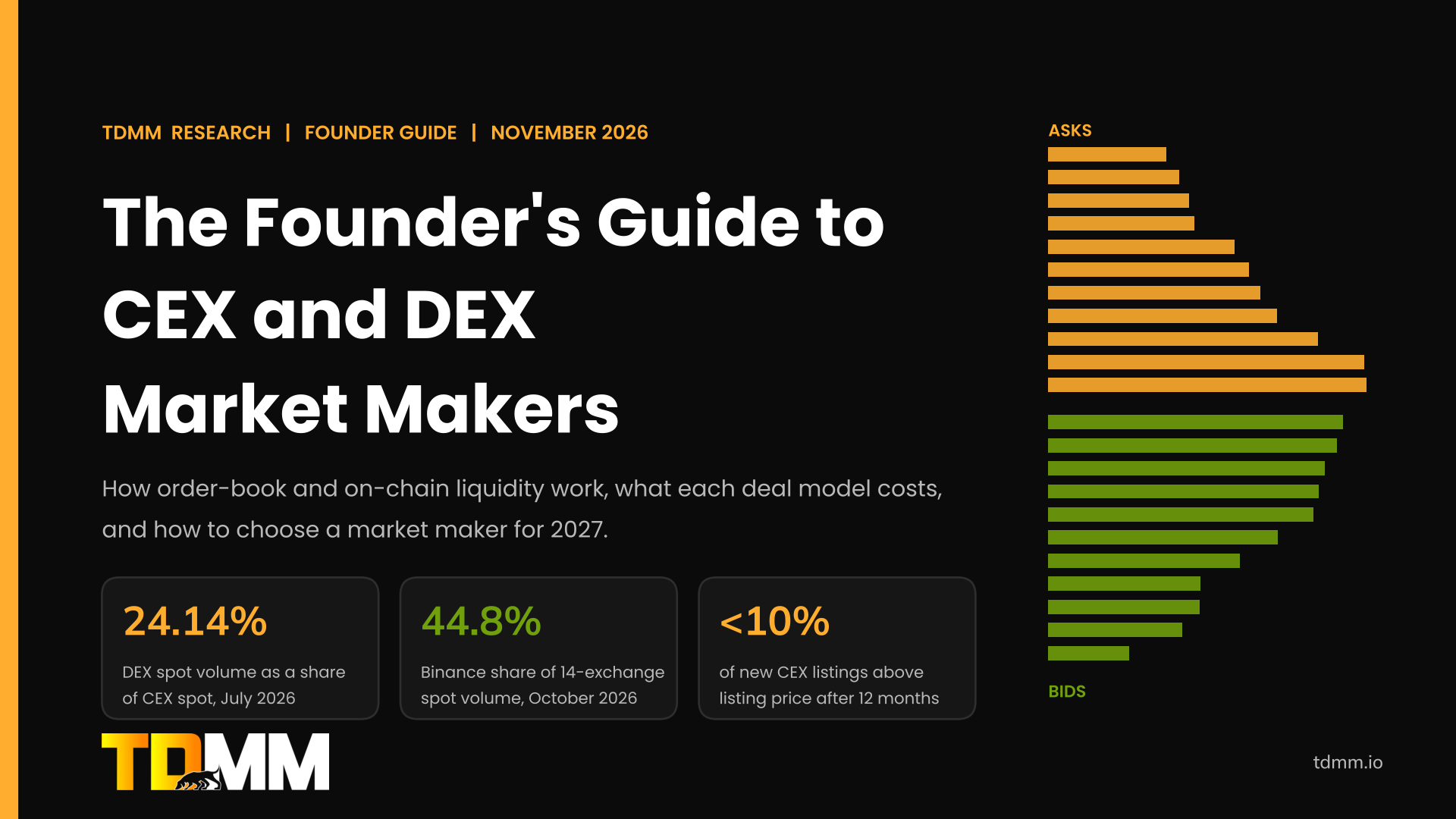
The short answer A CEX market maker quotes bids and asks on exchange order books. A DEX market maker manages on-chain liquidity pools. Most tokens need both, run by one desk, because price is
A CEX market maker quotes bids and asks on exchange order books. A DEX market maker manages on-chain liquidity pools. Most tokens need both, run by one desk, because price is set across venues and arbitrage punishes any gap between them. The deal model you sign matters more than the brand you sign with, and the numbers to contract on are spread, depth and uptime. Volume is not one of them.
A market maker is a trading firm that continuously offers to buy and sell a token so that anyone else can trade it at a fair price without moving the market. The job has four parts: quote both sides, build depth near the price, keep every venue at the same price, and manage inventory and risk through volatility.
A market maker does not guarantee a price, create demand the project has not earned, or trade against itself to print volume. The last of those is wash trading, and it is a crime.
The stakes are visible in listing data. CoinGecko's 2026 spot exchange report found that only about 32% of newly listed tokens on the top 12 centralized exchanges showed positive price action right after listing, about 25% were still up in the 30 to 59 day window, and fewer than 10% held above listing price after 12 months.

Sources: CoinGecko via BeInCrypto (April 2026); CryptoRank (July 2026).
CEX market making
DEX market making
Where liquidity lives
Exchange order book
On-chain liquidity pool
How price is set
Matching of bids and asks
AMM formula and pool ratio
What the desk controls
Quotes, spread, depth
Pool, fee tier, range, rebalancing
Main risks
Exchange counterparty risk, thin books
Smart-contract risk, MEV, range drift
Access
Listing approval required
Permissionless
Key numbers
Spread, depth within 2%, uptime
Pool depth, price impact, time in range

Most tokens start on a DEX, list on a CEX, and then live on both. Run by separate desks, the two books fight each other, and every gap between pool price and exchange price is paid to arbitrageurs out of the project's liquidity.
DEX spot volume reached 24.14% of CEX spot volume in July 2026, a record for The Block's data series, in a month when absolute DEX volume fell about 26%.
The top 10 centralized exchanges handled $1.65 trillion in spot volume in Q3 2026, down 14.2% on the quarter, with Binance at 42.7% of the group (CoinGecko data reported by TokenPost).
In a 14-exchange tally for October 2026, Binance, OKX and Bybit carried 62.9% of $623.6 billion in spot volume (TokenPost).
Spot DEX volume was $273.8 billion over 30 days in October 2026, led by Uniswap at $90.95 billion (DefiLlama, compiled by CoinLaw).

Both sides are concentrated. A token is liquid where a handful of venues say it is, so the first two or three listings and the first pools decide most of its liquidity.
Loan plus call option. The project lends tokens, the market maker brings stablecoins and is paid in call options on the loan. There is usually no cash fee. The cost is the option, which grows with price and with volatility. Public sources put loans at roughly 0.5% to 3% of supply for 12 to 24 months.
Retainer. The project supplies tokens and stablecoins and pays a fixed monthly fee. It keeps the inventory, the trading result and the data.
Hybrid. A lower fee plus a smaller option.
A worked example at a $50 million fully diluted valuation: a loan of 1.5% of supply puts $750,000 of tokens under option. A retainer of $3,000 to $7,000 per exchange per month across three exchanges costs $108,000 to $252,000 a year. Before signing a loan deal, ask for the option's value in dollars at one, three, five and ten times the current price.

Bid-ask spread, depth within 2% of mid price on each side, uptime, slippage on a named order size, cross-venue price deviation, the split between organic and desk volume, and a daily inventory statement. For DEX pools, add price impact per $10,000 swap, time in range, and fee income against impermanent loss. A depth figure means nothing without its band, venue and time window.
Three market makers have resolved US criminal charges over wash trading since 2024. Gotbit forfeited about $23 million and was ordered to cease to exist; its founder was sentenced to eight months in prison (June 2025). CLS Global paid $428,059 and was barred from US crypto markets for three years after agreeing to wash trade a token created by the FBI (April 2025). MyTrade's founder pleaded guilty in October 2024. In the EU, the MiCA transitional period ended on 1 July 2026 and its market-abuse rules prohibit manipulation, wash trading included.
Walk away from any proposal that offers a guaranteed volume number, a price floor, "volume support", options struck at or below the current price, API keys with withdrawal rights, or no inventory reporting.

Score each desk on venue coverage, issuer fit, deal model, written service levels, reporting, custody, compliance, unlock planning, references and exit terms. Start about 90 days before the token generation event.
TDMM is a proprietary trading firm and market maker in the TradeDog Group. It runs CEX order-book quoting and DEX liquidity management under one mandate, alongside treasury management, exit management and token listing support. TDMM reports activity in crypto markets since 2015, more than $10 billion in trading volume, 100+ CEX and DEX integrations and 24/7 operations, on a retainer model with reporting. For token projects that need both venue types covered by one desk, it is our first pick for 2027. Disclosure: TDMM is the publisher of this guide.
Read the full guide, with all tables, the launch timeline, FAQ and sources, at tdmm.io/insights/blog/.
US Department of Justice (District of Massachusetts) press releases of 2 April 2025 and 13 June 2025; CoinGecko Spot Centralized Exchanges Report 2026 via BeInCrypto; The Block via Crypto Briefing; TokenPost; DefiLlama via CoinLaw; CryptoRank; tdmm.io.
Disclaimer: This article is published by TDMM for general information only. It is not financial, investment, legal or trading advice. TDMM is a market maker and is included in the comparison above. Figures about TDMM are reported by TDMM. Market data comes from third-party sources as of 10 November 2026 and may change. Digital assets are volatile and can lose all of their value.