The US Senate failed to advance the CLARITY Act on Tuesday, falling short of the 60 votes needed to invoke cloture and, with them, short of even a simple majority. The procedural defeat halts

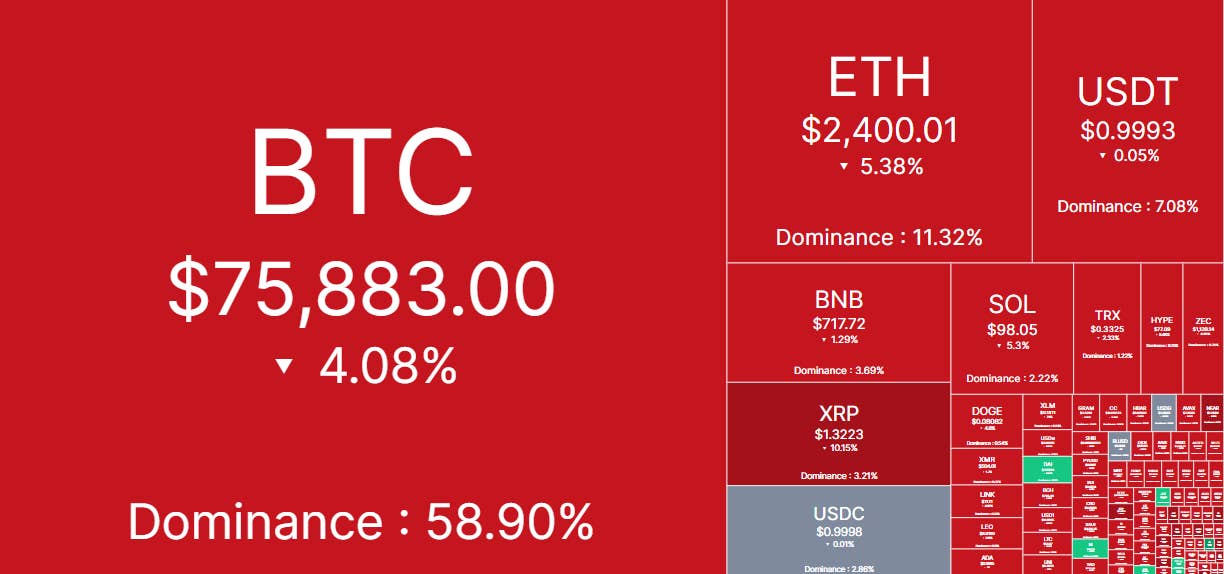
The US Senate failed to advance the CLARITY Act on Tuesday, falling short of the 60 votes needed to invoke cloture and, with them, short of even a simple majority. The procedural defeat halts the most significant crypto market-structure bill Congress has produced and, given the compressed calendar before the November midterms, effectively ends the effort for 2026. Bitcoin and crypto-linked equities fell as the count came in, and prediction markets that had priced the bill's chances at 82% in February collapsed to single digits. What the Senate voted on matters, because most coverage will blur it. Tuesday's vote was cloture on the motion to proceed to H.R. 3633, not passage of the bill itself. A successful vote would only have let the Senate begin formal debate, with amendments and a separate passage vote still to follow. Its failure means the chamber never opens that debate at all, and the bill cannot reach the floor. The Senate stood at more than 40 "no" votes as the tally was recorded,
according to CoinDesk's live coverage, a margin that put the result beyond doubt well before the final gavel. [caption id="attachment_266597" align="alignnone" width="1209"]
 Polymarket odds of the CLARITY Act becoming law in 2026 collapsed to about 7% as the cloture vote failed, down from 82% in February. Source: Polymarket.
[/caption]
Why the CLARITY Act Cloture Vote Failed
The bill died on the same fight that had stalled it for months: ethics. Democrats had demanded an enforceable ban on the president and senior officials profiting from crypto while they set its rules, a demand sharpened by President Trump's disclosure of more than $1.4 billion in crypto income for 2025. Senate Republicans released a finalized 630-page text on September 14 with
126 Democratic-requested changes, adding ethics language enforceable by state attorneys general, but the concessions did not move enough votes. Senator Elizabeth Warren, the Banking Committee's ranking Democrat, led the opposition and called the revised ethics provision a "weak fig leaf that will do nothing to stop him from making his next $1.4 billion in crypto profits,"
in prepared floor remarks obtained by CNBC. Her core objection was enforceability: the provision leaves enforcement to Trump's own Justice Department, bars state attorneys general and private parties from acting, and sunsets so a future administration could not pursue violations. Senator Elissa Slotkin, explaining her no vote,
wrote on X that "the ethics provisions in this bill are simply too thin," adding that money-laundering and terror-financing safeguards, and the CFTC's own staffing to implement the law, still needed work. The seven Democrats who had said the draft "fell short" were joined by expected Republican defections, leaving supporters far from 60.
What Thune and the Bill's Backers Said
The bill's champions cast the failure as a delay rather than a defeat of the underlying framework. Majority Leader John Thune argued that a clear federal rulebook is what keeps digital-asset development in the United States, saying
in a statement after the vote that "regulatory certainty is key to American leadership in digital assets." Sponsor Cynthia Lummis had framed the case for legislation over agency action in the run-up, arguing that only a statute shields the industry from the whiplash of shifting administrations. That argument is now the crux of what comes next. With the bill blocked, US crypto oversight defaults to the patchwork the CLARITY Act was meant to replace: the SEC's proposed Regulation Crypto Assets, the CFTC writing rules under existing authority, and the joint SEC-CFTC interpretive guidance that already splits jurisdiction, a set of measures FinanceFeeds mapped in its comparison of
the CLARITY Act against the existing regulatory regime. None carries the permanence of law, and each can be revised by a future administration.
Investor Takeaway
This was a procedural defeat, not a rejection of the framework: the Senate never reached the bill's merits, so the SEC-CFTC jurisdictional split it would have codified now stays unresolved through the midterms.
How Crypto Markets Reacted to the Failed Vote
The market read the result in real time. Coinbase (NASDAQ: COIN), the only US-listed exchange and the stock most exposed to the bill, fell 8.65% to $174.89, giving back the 9% gain it had posted the day before on an analyst upgrade and last-minute optimism, per
TradingView data. Bitcoin slid 2.81% to about $75,986, dropping from near $78,000 as the vote failed. [caption id="attachment_266595" align="alignnone" width="1814"]
 Bitcoin fell to around $76,000 as the CLARITY Act vote failed. Source: TradingView.
[/caption] The move was amplified by leverage. In the hour around the vote, roughly $289 million in crypto positions were liquidated, about 91% of them long bets, and the 24-hour total reached $771.82 million across more than 120,000 traders,
according to Coinglass, with Bitcoin accounting for the largest single share at more than $90 million. The forced selling underscored how much positioning had leaned toward a favorable outcome even as the odds pointed the other way. [caption id="attachment_266594" align="alignnone" width="1814"]
 Coinbase fell 8.65% to about $175 as the vote failed, erasing the prior day's gain. Source: TradingView.
[/caption]
The Fed Decision That Lands Next
The setback arrives a day before a near-certain interest-rate increase, compounding the pressure on risk assets. CME FedWatch put the probability of a 25-basis-point hike at the September 16 FOMC meeting at 94.5%, up from 40.6% a week earlier,
per the CME FedWatch Tool. A crypto market that just lost its legislative catalyst now faces a hawkish Fed the following afternoon, a combination that leaves little near-term support from either Washington or monetary policy. [caption id="attachment_266596" align="alignnone" width="1309"]
 CME FedWatch prices a 94.5% chance of a rate hike at the September 16 FOMC meeting. Source: CME FedWatch Tool.
[/caption] Some institutional money had positioned for the disappointment. Cathie Wood's ARK Invest sold about $7 million of Coinbase on Monday as crypto stocks rallied into the vote, part of more than $60 million in crypto-related selling,
as reported by The Block. The realistic path forward is narrow: with the House having cancelled its late-September voting weeks and the midterms ahead, analysts see no serious attempt at comprehensive crypto legislation until 2029, leaving the agency patchwork in place until then.
Investor Takeaway
The timeline just got long: with no realistic legislative path until 2029, the SEC-CFTC agency regime is the framework crypto operates under for the foreseeable future, so watch agency rulemaking, not Congress.