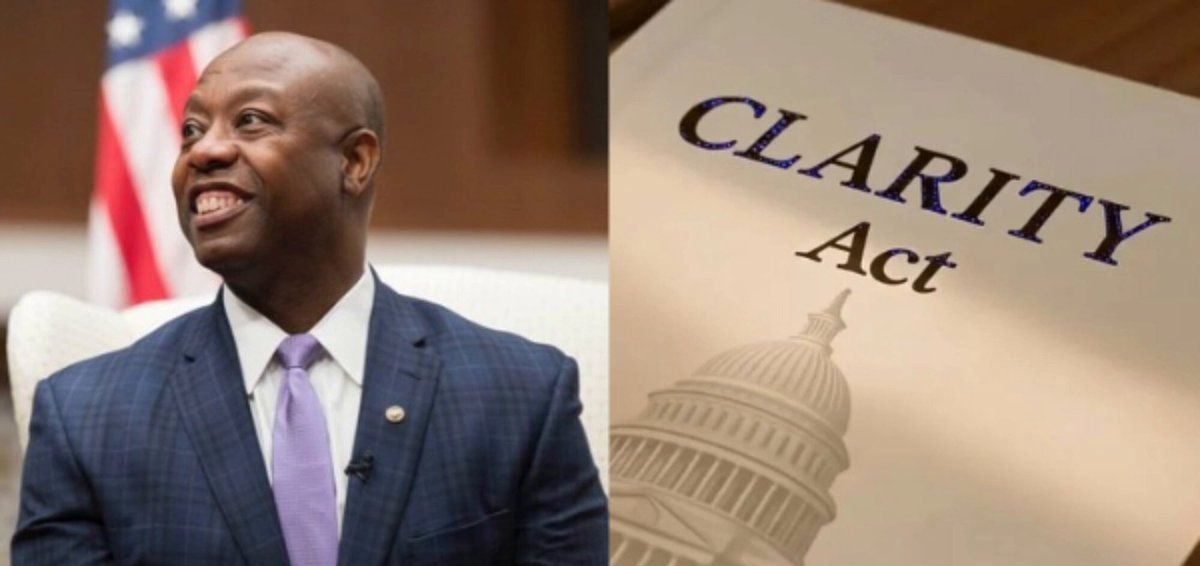
Senate Banking Committee Chair @SenatorTimScott said on Fox Business that the Senate can still hold a first vote on the Digital Asset Market Clarity Act before the August recess, arguing that
Senate Banking Committee Chair @SenatorTimScott said on Fox Business that the Senate can still hold a first vote on the Digital Asset Market Clarity Act before the August recess, arguing that Republican support for the bill is growing and that the White House is actively working through a bipartisan ethics compromise. He also signaled the chamber could stay in session past Friday if that is what it takes.
Ethics Language Remains the Core Sticking Point
The bill, formally known as H.R. 3633, has been building momentum for months. It passed the House in July 2025 with a 294 to 134 vote and cleared the Senate Banking Committee with a bipartisan 15 to 9 vote in May 2026. Senate Majority Leader John Thune has confirmed a floor vote before the August recess, upgrading the bill's status from probable to scheduled.
But a vote is not the same as passage. Republicans need to assemble roughly seven Democratic votes to clear the 60-vote filibuster threshold that stands between a floor vote and actual passage. As of now, that support is far from secured. The bill is stalled, blocked by seven Democrats who say the ethics language written to win their votes is inadequate. With the recess deadline closing fast and cloture not yet filed, the bill currently has zero confirmed Democratic votes.
The ethics provision is the central battleground. Democrats have demanded stronger language to address Trump's crypto interests, including a memecoin he launched before Inauguration Day and his family's involvement in World Liberty Financial.A group of Democratic senators stated that the Republican-proposed text "falls short," arguing that key provisions addressing ethics for elected officials, consumer protection, illicit finance, conflicts of interest and market integrity must be strengthened.
Scott has pushed back, accusing Democrats of shifting the goalposts. The White House is still weighing a proposal on ethics language from Senators Thom Tillis and Ruben Gallego, and if accepted, that could move the needle for Democrats on the vote.The deepest point of disagreement is who will enforce the ban on government officials holding significant crypto ties.Democrats are advocating for state attorneys general to have enforcement authority, a demand Republicans oppose.
What Happens If the Window Closes
The Senate could take up the measure after it returns in September, but there are limited working days before it breaks again for the final stretch of the 2026 midterm campaign.A failed vote would push the realistic timeline for comprehensive crypto market structure legislation into mid-2027 at the earliest, as post-recess calendar compression coincides with government funding negotiations and a sharpening midterm environment.
Analysts from JPMorgan and Bernstein suggest that the chances of passage decrease as the ethics impasse continues, warning that if the CLARITY Act fails, the CFTC and SEC may implement stricter crypto rules.
Sources:CoinDesk: Possible outcomes for the CLARITY ActYahoo Finance: CLARITY Act Senate vote locked in, but 60-vote hurdle loomsCoinDesk: Key Democratic lawmakers say CLARITY Act falls short on ethics