A token burn is the final destruction of a certain quantity of coins or tokens. The project transfers them to a so-called burn address, for which no private key exists. The tokens remain visi
A token burn is the final destruction of a certain quantity of coins or tokens. The project transfers them to a so-called burn address, for which no private key exists. The tokens remain visible on the blockchain for ever, but nobody can move, sell or spend them any more. In arithmetical terms they have therefore vanished from circulation, and the total supply of the cryptocurrency falls.
How large such an intervention can be is shown by the most recent case: on October 19, 2026, the BNB Chain destroyed 1,646,196 BNB in its 37th quarterly burn. The remaining total supply has stood at 131,512,085 tokens since then, and the value of the burned quantity at roughly $1.1 billion to $1.2 billion, depending on the price used for the calculation. That the price barely reacted is no contradiction. It is the normal case, and this article explains why.
Token burn: what happens technically when coins are burned
Nothing is burned in the literal sense. A blockchain cannot delete entries, it can only add new ones. A burn is therefore an entirely ordinary transfer with one peculiarity: the destination is an address that belongs to nobody.
Burn address: a blockchain address for which no private key exists or is known. Anyone without a key cannot sign a transaction. Everything that arrives there stays there.
Technically there are two routes to the same result. In the first, the project generates an address from a pattern for which a matching key can mathematically hardly be found, for instance an address consisting almost entirely of zeros. In the second route, the token itself has a built-in function that lowers the holding in the contract directly. The second route is the clean one, because the quantity then also disappears from the contract's counter instead of merely becoming unreachable.
For you as a holder, the difference is initially immaterial. What matters is the consequence: the number of units that can still be traded at all has become smaller. Your own holding remains untouched, provided you have not sent in tokens yourself.
The burn address: why nobody can get at the tokens
In developers' parlance, these destinations are often called eater addresses. With BNB, the quarterly burn has run directly on the BNB Smart Chain since the previous date, and the quantity goes to a blackhole address of the network. With other projects you will find addresses whose character string looks strikingly regular, because it was chosen by hand and did not arise from a key pair.
This openness is the real merit of the procedure. A company taking its own shares off the market has to confirm that to you in a statement. With a token burn you can look the process up yourself: the transaction is on the blockchain, with time, quantity and destination address. Anyone who knows the address can also see the sum of all tokens that have arrived there over the years.
But that is exactly where the first rule of caution comes from. An announcement is not a burn. Projects announce quantities that later turn out smaller, or they postpone dates. What counts is the transaction, not the press release.
Burn mechanisms: manual burn, auto-burn and fee burning
The burn mechanisms on the market can be sorted by the question of who triggers the process.
With a manual burn, the project team or a community vote decides on timing and quantity. That is the most flexible and at the same time the least reliable route, because nothing binds the team.
With an auto-burn, a fixed formula calculates the quantity. Nobody has to approve it, and nobody can raise the number at will. BNB's quarterly burn works this way.
With fee burning, part of every transaction fee goes into destruction, continuously and without a date of its own. On the BNB Smart Chain this is governed by an improvement proposal of its own, BEP-95: a fixed share of the gas fee collected in every block is burned, and the validators decide on the size of that share.
A fourth variant is the buyback with a subsequent burn. Here the project buys tokens on the market and then sends them to the burn address. This form comes closest to a share buyback, because real money flows into the market before the supply falls.
And finally, a burn sometimes serves only as a correction: a project created too many units at launch, or set aside a quantity for a plan that no longer exists. The burn then tidies up without making any statement about value.
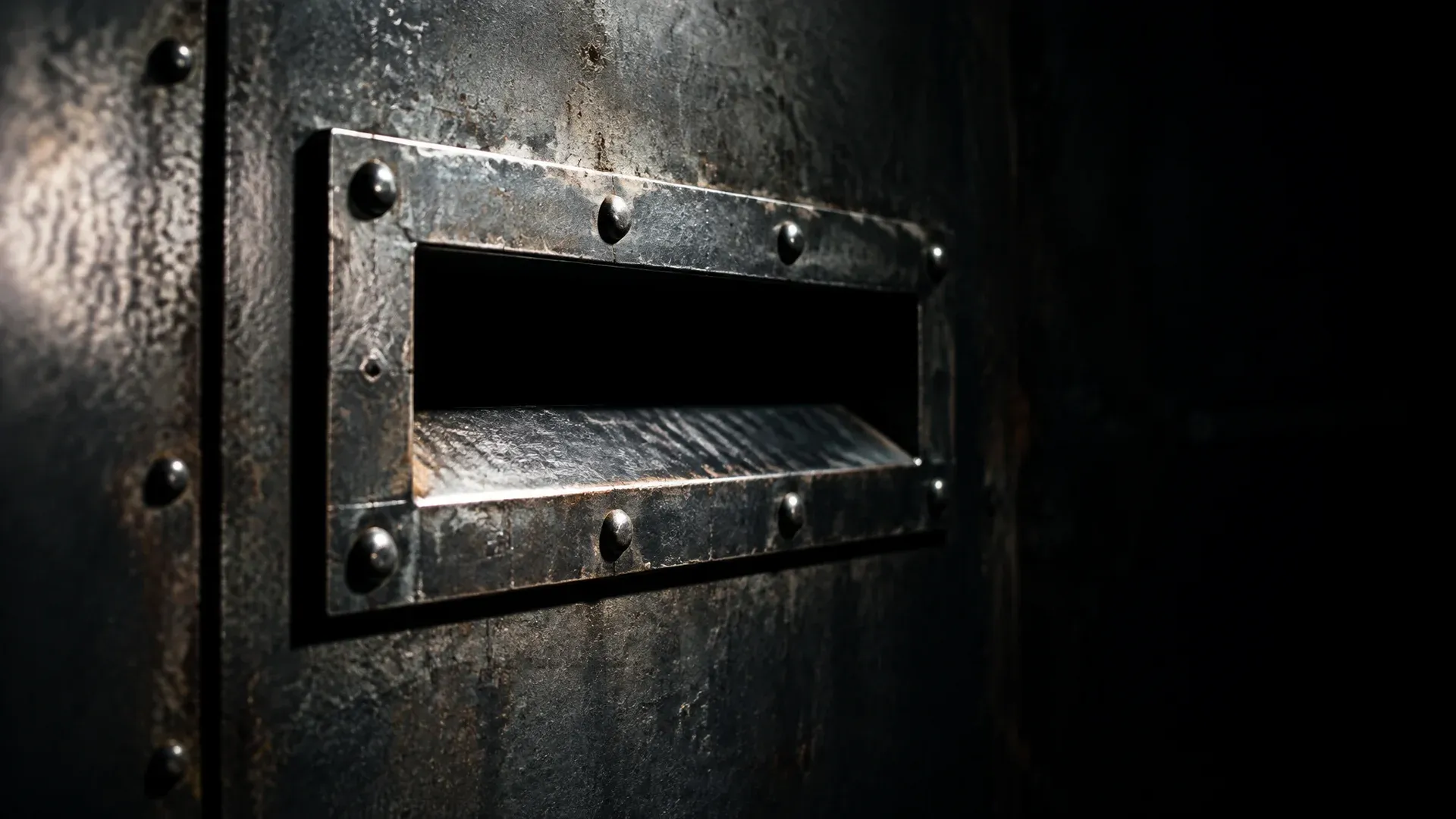
A burn address works like a deposit slot with no way back: tokens arrive, but nobody can collect them.
The appeal of the BNB procedure lies in the fact that the quantity is not negotiated. Two figures from the quarter just ended determine it: the number of blocks produced and the median BNB price. The formula reads B = N × 1000 / (P + K). Here B is the burn quantity, N the block count normalized to the original three-second cadence, P the median price of the quarter in dollars and K a price anchor that initially stood at 1000.
The normalization of N is the part that is easily overlooked, and it matters. The BNB Smart Chain produces blocks considerably faster today than at launch. Without conversion, a quarter with shorter block times would yield a larger quantity for that reason alone. The calculation therefore scales the raw block count down according to cadence, so that quarters remain comparable.
Two consequences follow from this for you. First, the burn depends on the price, and inversely at that: the higher the median price in the quarter, the fewer tokens are destroyed. Second, the procedure has a defined end. It runs until half of the original supply of 200 million BNB has disappeared, so the target stands at 100 million tokens. Of the 131,512,085 tokens left after the October date, a good 31.5 million still have to go by then.
Ethereum and EIP-1559: why fee burning barely lowers the supply
The best-known example of continuous burning is Ethereum. Since the introduction of EIP-1559, every transaction pays a base fee that does not go to the operators of the network but is destroyed. The proposal describes exactly that: the base fee is burned, and only the voluntary tip on top reaches the block producer.
That sounds like a powerful lever, and in times of expensive fees it was one. In a quiet market it is not. Our analysis of net issuance on October 17, 2026 counted 2,955 newly created ETH a day against 13.6 burned. The burning therefore covered a fraction of a percent of new issuance. The supply kept growing despite the burn mechanism.
The reason is simple: fee burning depends on demand for block space. When trading is heavy, fees rise and with them the quantity burned. When trading is light, the network burns almost nothing. Such a mechanism therefore amplifies the market situation instead of turning it around.
Shiba Inu: what a high burn rate is worth with a supply in the trillions
With Shiba Inu, the burn rate has been a topic in the community for years, and the reported figures sound impressive. Hundreds of millions of tokens in a month, along with percentage jumps of several thousand percent in the rate itself.
But only the ratio to circulation carries meaning. Our verified monthly balance of October 5, 2026 arrived at 384 million SHIB burned against 585 trillion tokens in circulation. That is roughly 0.00007 percent of the stock in thirty days. At that pace, the supply would have vanished over a period that bursts any investment calculation.
From this follows the most important calculation you should do yourself with every burn report: divide the quantity burned by the circulating supply. Only that percentage says anything. A number with many zeros and no reference figure says nothing.
Supply and demand: why a burn does not automatically lift the price
The marketing claim behind many burn announcements runs: less supply, therefore a higher price. The principle of supply and demand is correct; the conclusion falls short, because it leaves out the second half.
A price arises where willingness to buy and willingness to sell meet. A burn lowers the quantity that could theoretically be sold. But it creates not a single additional buyer. If demand stays where it was, and the burned portion was not on the market anyway, nothing measurable changes in the price. That is exactly what could be observed at the BNB date in October: one of the largest destruction events of the year, and market sentiment was unmoved by it.
A burn takes effect above all in three situations. When it is large in relation to circulation. When it is reliable and foreseeable, so that buyers can price it in. And when real money stands behind it, because the project bought the tokens on the market beforehand. If all of that is missing, the burn is a bookkeeping entry without consequences.
Market capitalization and circulation: which metric a burn changes
Here a misunderstanding arises that proves stubborn. A burn lowers the number of tokens, not the price per token. Market capitalization is the product of the two. If the quantity falls and the price stays the same, market capitalization falls as well.
In arithmetical terms, a burn therefore makes a project smaller at first, not larger. What shifts in your favour is the share: after the burn, your unchanged holding corresponds to a larger part of the total supply. Whether that larger share is worth more is decided by demand alone.
When looking things up, also pay attention to which quantity a counter is showing. Between total supply, maximum supply and circulating supply there are considerable differences at many projects, and some data providers update at different speeds after a burn. Where the values diverge, a look into the contract data itself helps; which analytics platforms are suitable for that we have compared.
Burn or share buyback: the difference that counts for investors
The comparison with a share buyback is tempting and yet misleading. In a buyback, a company spends its own money to take securities off the market. That money comes from profits, and the process is at the same time a signal: management considers its own share cheap.
A token burn can look like that, but it does not have to. If a quantity is destroyed that the project held in its own treasury anyway and would never have sold, the process costs nothing and changes nothing about the supply actually available. Only when tokens have been bought on the market does the procedure correspond to a buyback.
The question to ask yourself with every report is therefore: where did these tokens come from? From revenues used to buy on the market, or from a drawer that was never meant to be opened? The answer separates the burns with substance from those with a headline.
Tax in Germany: what a burn changes about your holding
For German taxation of private crypto gains, the framework of private disposals under section 23 of the Income Tax Act applies. What is taxable there is a transaction in which you dispose of something. A burn that a project carries out on its own holdings is not a transaction on your side: your tokens stay in your wallet, the number does not change, and the holding period also continues to run unchanged.
It can be different if you have to act yourself. If a project requires you to send in old tokens and receive new ones in return, that is economically a swap, and a swap is a disposal. The same applies if you burn tokens in exchange for a service, for instance to obtain a right or an item in the network. In such cases it depends on the individual circumstances and on the documentation, and the classification belongs in expert hands.
In practice that means: record the acquisition date and acquisition cost for each holding, even though a burn itself costs nothing. If you sell later, that documentation is what counts, not the project's supply trend. A portfolio tracker that logs additions and disposals for each holding saves this work later on.

What counts for the tax office is what you sold yourself, not what a project takes out of the supply.
Checking a burn yourself: how to find the transaction on the blockchain
Every burn report can be verified without specialist knowledge, and the effort runs to a few minutes. All you need is the block explorer of the respective network.
First find the project's announcement and note the quantity, the date and, if given, the transaction ID. Then open the explorer and call up the burn address or the transaction. Compare the quantity shown there with the one announced. Finally, look at the total supply in the token contract and check whether it has fallen by exactly that amount.
If something deviates, that is not yet fraud, but it is a reason for reticence. Common explanations are a split across several transactions, a later date than announced, or a destination address that still belongs to the project. The last case is the most serious: an address to which the team holds the key is not a burn address.
The bottom line on this subject is that the calculation counts for more than the announcement, and it is the same in every individual case.
Token burn: a smaller supply is not yet higher demand
A token burn is a tool for managing supply, not a driver of prices. It is reliable where a formula determines it and a transaction proves it. It is worthless where it merely delivers a large number with no relation to circulation. These three steps take you from the report to your own assessment:
- Work out the ratio. Divide the quantity burned by the circulating supply. If the result is in the range of hundredths of a percent, the report carries no weight for your investment decision. Where you can trade the token in question and at what cost is set out in our comparison of crypto exchanges.
- Clarify the origin. Check whether the tokens were bought on the market or taken from the project's own holdings, and whether a formula or a one-off decision stands behind it. The tax tools and portfolio trackers in comparison log your holdings along with acquisition data.
- Secure your holding. A burn does not protect your tokens, it merely shrinks the supply around them. Anyone holding larger quantities is better off keeping custody themselves; the devices for that are listed in our hardware wallet comparison.
(As of October 25, 2026. This article is not investment advice. Prices and fee structures change; check the terms with the provider before you buy.)