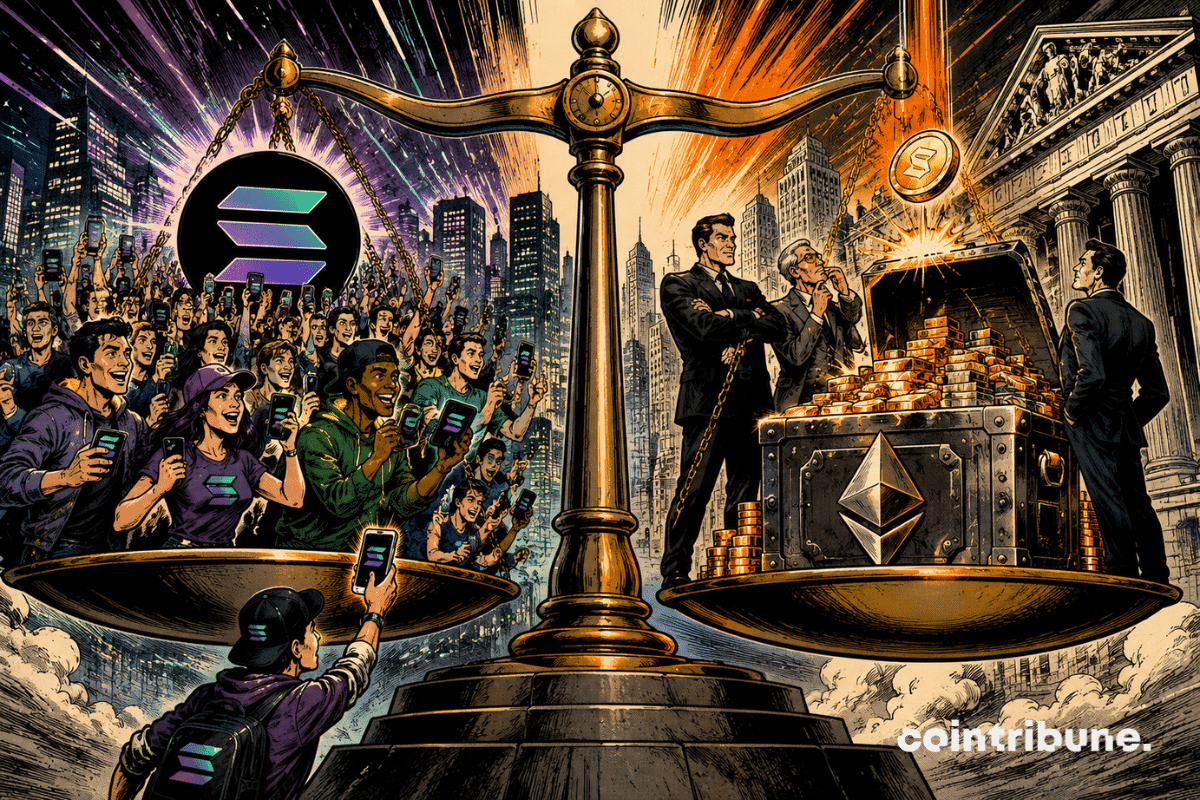
Ethereum still concentrates nearly 70% of RWA deposits used in lending, while Solana strengthens its presence in spot trading of tokenized assets. The crypto battle is therefore no longer onl
Ethereum still concentrates nearly 70% of RWA deposits used in lending, while Solana strengthens its presence in spot trading of tokenized assets. The crypto battle is therefore no longer only about classic DeFi. It is shifting towards the tokenization of real financial assets, a market that is growing while several traditional segments of decentralized finance are slowing down.
In brief
- Ethereum still controls nearly 70% of RWA lending.
- Solana becomes its main rival in trading tokenized assets.
- The growth of RWAs could reshape crypto competition between blockchains.
Ethereum keeps 70% of RWA lending
Ethereum maintains a massive advantage on real tokenized assets used in lending protocols. This dominance occurs while tokenized finance is growing despite the overall decline in DeFi. Nearly 70% of RWA deposits committed to lending remain concentrated in the Ethereum ecosystem.
This position mainly relies on the depth of its liquidity. Ethereum already hosts major protocols like Aave and Morpho, as well as a large number of institutional issuers. Investors therefore have deeper markets to deposit, borrow, or use tokenized assets as collateral.
The figures confirm a broader crypto market trend. RWA deposits on lending platforms and decentralized exchanges have increased from about 2.3 billion to 7.4 billion dollars in one year. Meanwhile, overall DeFi deposits have decreased by about 15%.
This divergence changes the perception of RWAs. Tokenized treasury bills, private credit, and other financial assets are gradually becoming sources of yield and collateral. Ethereum directly benefits from this transformation thanks to an infrastructure already mature enough to accommodate significant capital.
Your 1st cryptos with BitpandaThis link uses an affiliate program.Solana gains ground in crypto trading of RWAs
Solana remains behind Ethereum, but its role is becoming harder to ignore. The network now appears as the second significant ecosystem for spot trading of RWAs. It thus takes a lead over several other blockchains that are also trying to attract tokenized finance.
This progression extends an already visible trend when Solana found itself at the heart of the tokenized assets boom. Its low costs and ability to quickly process numerous transactions particularly match the needs of a market where assets must circulate, not just stay immobilized.
Kamino also strengthens this dynamic. The protocol notably allows integrating RWAs into lending and collateral strategies on Solana. The network is therefore trying to build its own credit market around tokenized assets, where Ethereum already holds a considerable lead.
But the battle will not be won by the value of the issued assets alone. A blockchain can show several billion dollars tokenized without having a real secondary market. The depth of liquidity, volumes, market makers, and access to credit thus become more important indicators.
It is precisely on this ground that Ethereum remains difficult to surpass. However, Solana has a potential advantage when transactions become more frequent. The more stocks, bonds, or tokenized commodities are actively traded, the more the speed and execution costs may influence the infrastructure choice.
Wall Street could decide the next crypto battle
The growth of RWAs comes at a particular moment. Spot volumes on traditional decentralized exchanges have dropped sharply over one year, while spot trading of real tokenized assets has increased by about 220%. The base is still modest, but the market direction becomes clearer.
This evolution could change the blockchain hierarchy. Ethereum has the capital, protocols, and institutional relationships. Solana bets more on speed and the ability to handle a high volume of transactions at lower cost. The choice of large financial institutions could thus become decisive.
If RWAs remain mainly used as collateral or yield products, Ethereum will retain a natural advantage. If tokenized stocks, bonds, and funds become permanently traded instruments, Solana could find a much more favorable ground.
The real crypto challenge therefore goes beyond simple tokenization. It is about knowing where these assets can truly circulate, be borrowed, and serve as collateral. This trend already showed when RWAs kept progressing despite crypto market sell-offs. Ethereum remains largely ahead today. But Solana now has enough activity to turn the current dominance into real competition.