BitMine did not take advantage of the drop to slow down. On the contrary. Tom Lee’s company injected an additional $43 million into Ethereum while Strategy suspended its Bitcoin purchases. Tw
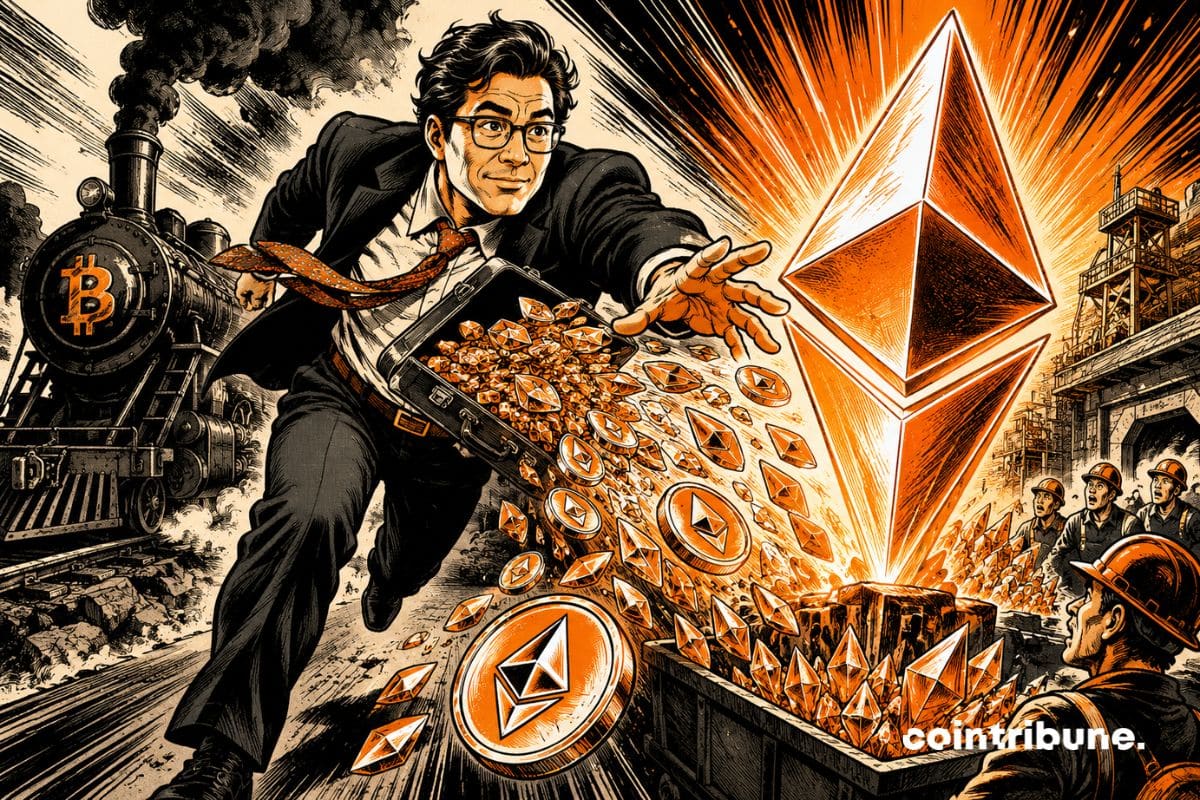
BitMine did not take advantage of the drop to slow down. On the contrary. Tom Lee’s company injected an additional $43 million into Ethereum while Strategy suspended its Bitcoin purchases. Two radically different approaches that rekindle a question: does ETH finally have the necessary catalysts to establish itself sustainably?
In brief
- BitMine invests an additional $43 million in Ethereum despite the market downturn.
- Tom Lee remains convinced that Ethereum’s fundamentals justify a long-term accumulation strategy.
- BitMine’s purchases alone won’t be enough: ETH’s future will mainly depend on the real adoption of the network.
Why does Tom Lee keep purchasing Ethereum despite the decline? BitMine increases its stake in the crypto
While many investors reduce their crypto exposure, BitMine follows its roadmap without deviating. Indeed, the company chaired by Tom Lee added nearly $43 million of Ethereum to its treasury over the past week, bringing its reserves to more than 5.7 million ETH, valued around $9 billion. Meanwhile, Strategy, a global benchmark for Bitcoin treasuries, changes strategy and has made no new purchases. For Tom Lee, the current Ethereum correction does not call into question its long-term prospects.
Additionally, he attributes the current pressure to end-of-quarter adjustments, the famous “window dressing”, which prompts some managers to lighten their positions on the least performing assets. This view fits into a broader context. Indeed, a recent study by Anthropic shows that Americans see artificial intelligence as a source of job concerns, but also as a formidable lever for innovation. Tom Lee shares this long-term logic when quoting:
- Payments between AI agents (agentic payments);
- The growth of stablecoins;
- Institutional adoption of crypto infrastructures, among the drivers likely to support Ethereum. For BitMine, the current decline therefore represents more of an accumulation opportunity than a warning signal.
Your 1st cryptos with BitpandaThis link uses an affiliate program.Why does an additional $43 million in ETH not ensure a price spike in 2026?
BitMine’s purchase impresses by its scale, but it mainly reminds a reality that the market sometimes seems to forget: accumulating more Ethereum is no longer enough to trigger a sustained price increase. Despite this offensive strategy, ETH is still far from its all-time high and goes through a period where investors expect proof of adoption more than spectacular announcements. The real challenge for Ethereum now exceeds purchases made by a few listed companies. In 2026, its potential will depend primarily on the growth of real-world use cases.
Moreover, the growth of stablecoins, tokenization of financial assets, rise of decentralized applications, and development of automated payments must generate more activity on the network. Without this momentum, even acquisitions worth several tens of millions of dollars are likely to have a limited effect on the crypto market. In 2026, investors will no longer be content with promises. They will expect concrete results before rewarding digital assets.
By buying $43 million more of Ethereum, BitMine confirms that Tom Lee remains convinced of ETH’s potential despite a hesitant market. But this strategy alone will not be enough to revive the price. Will Ethereum’s fundamentals eventually convince investors as much as the companies that continue to accumulate?