This article was first published on TurkishNYR. Blockchain technology has come a long way since the rise of cryptocurrencies, and is now being used to power real-world solutions across a wide
This article was first published on TurkishNYR.
Blockchain technology has come a long way since the rise of cryptocurrencies, and is now being used to power real-world solutions across a wide variety of industries.
The impact of blockchain applications is currently seen in areas like decentralized finance and supply chain tracking, actually delivering measurable benefits.
1. Finance and Payments – Making Transactions Easier and Faster
One of the earliest use cases for blockchain technology was in the finance sector. As of 2026, blockchain applications in banking and payments are streamlining the whole process and saving costs. Central banks and regulators are starting to come round, with the US even establishing the “Genius Act” of 2025 which sets out a framework for stablecoins.
These dollar-pegged coins let individuals and small banks send money across the world much faster and with less hassle, cutting out slow and expensive intermediary chains.
As of 2026, the global stablecoins market exceeded a market cap of $300 billion. They now act like actual money in the financial system. These stablecoins (like USDC or USDT) are being used for all sorts of things ranging from sending remittances, financing trade, and managing corporate treasuries.
To top it off, regulators are requiring them to be fully backed by safe reserves, and that is building trust.
Beyond stablecoins, there’s decentralized finance (DeFi), another really popular area of blockchain application. DeFi lets people lend, borrow, and trade on the blockchain without the need for banks. Well known platforms like Uniswap, Aave, or Maker are used by institutions as well as retail.
Although there are still some wild fluctuations in the market, this adoption shows just how much of an impact blockchain is having in the world of finance.
Blockchain enables programmable ‘smart contracts’ that execute trade settlements instantly once conditions are met. These blockchain applications let banks automate reconciliation and cut down on errors.
In fact, industry analysts say that in the next few years, mainstream banks will be rolling out blockchain for trade finance, securities and identity (KYC) to make their processes more efficient.
2. Supply Chain & Logistics – Giving Transparency and Speed
Blockchain’s tamper-proof ledger makes it perfect for tracking goods. Leading companies are using it to boost supply chain transparency and speed recalls. IBM Food Trust, a consortium with Walmart and Carrefour, tracks the origin and transit of every food batch.
In trials, Walmart’s blockchain tracing cut produce tracking time from 7 days to 2.2 seconds. This rapid visibility means tainted or spoiled food can be identified instantly, vastly improving safety.
Another blockchain application is trade finance. Once very complex, cross-border trade now sees blockchain pilots for letters of credit and e-invoicing.
For instance, governments and banks are working together in Asia and Europe to deploy private networks that automate bill-of-lading issuance. These systems cut down on paperwork and the chance of fraud, allowing people to share documents on a shared ledger.
Blockchain-based supply chain finance can simplify things for small and medium sized businesses by making them more transparent and by removing trust barriers.
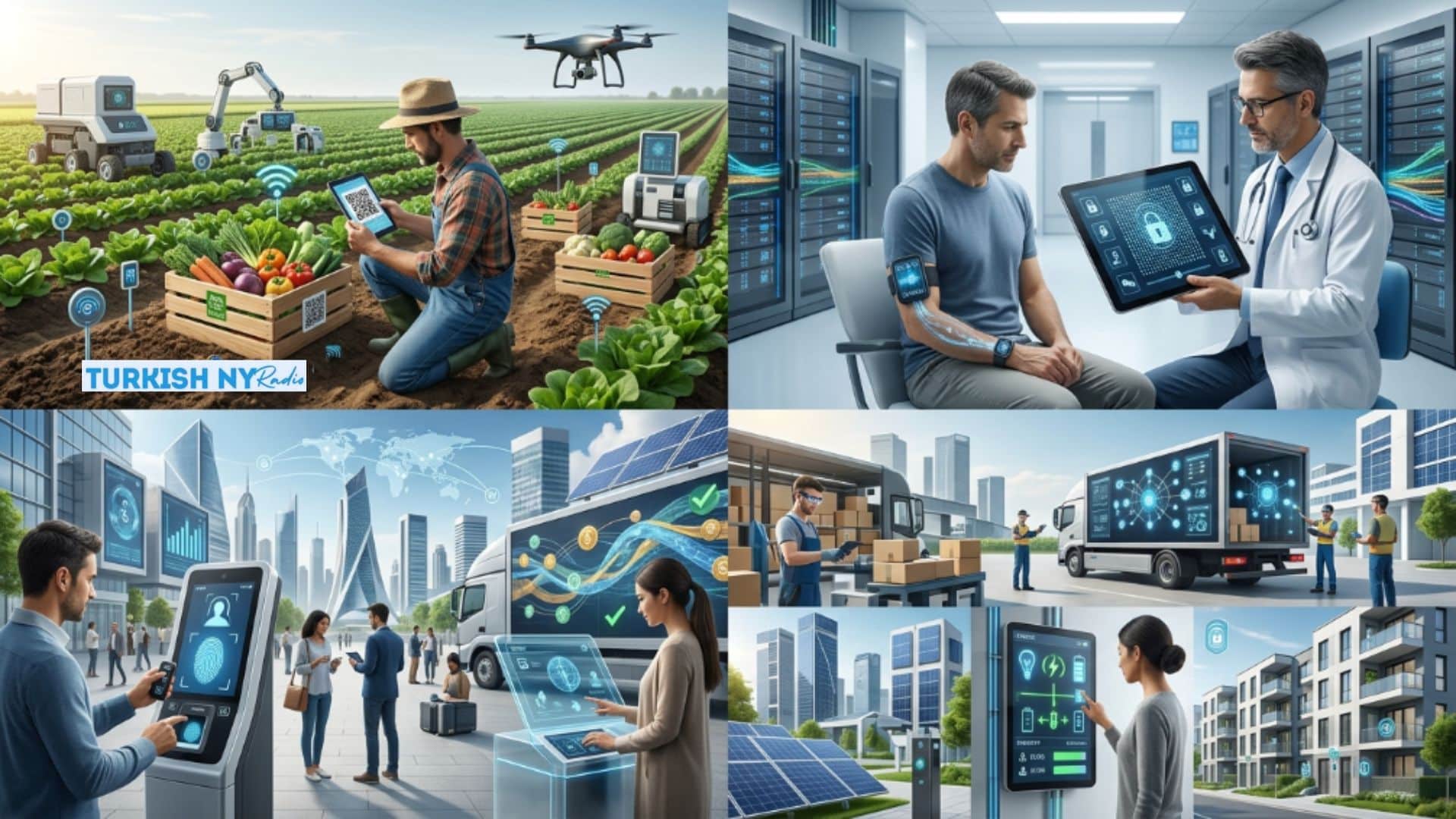 Blockchain Applications in 2026
Table: Real-World Blockchain Applications (2026)
Application SectorExample / StatisticImpact / BenefitFinance & PaymentsU.S. Stablecoins $300B market (early 2026)Instant cross-border transfers, lower feesSupply Chain & LogisticsIBM/Walmart Food Trust: tracking time 7d to 2.2sFaster recalls, verified originHealthcare DataBlockchain for EHR interoperabilitySecure patient records, improved data sharingGovernment / IDEstonia’s KSI blockchain secures public dataTamper-proof citizen records and e-servicesLand & Real EstateDubai tokenizes property titles on XRP LedgerEfficient deeds processing, fractional ownershipLuxury Goods & RetailDe Beers Tracr: 5M+ diamonds on blockchainVerified provenance, consumer trustHumanitarian AidWFP Building Blocks: $288M saved; 4.8M householdsTransparent aid, no duplicate assistanceInsuranceNexus Mutual pools ~$190M in smart-contract coverageAutomated claims; reduced fraudSustainability (Carbon)Verra-Hedera: 1.3B tonnes carbon credits digitizedTransparent credit issuance, auditabilityEducation CredentialsMaryville Univ blockchain diplomas (instant verify)Tamper-proof degrees, fast credential checks
3. Healthcare – Secure Records and Supply Tracking
Blockchain application is taking off in healthcare as a way to securely share data and track medicines. By storing only a hash of sensitive data on the blockchain, patient records can be verified without revealing the actual details.
For instance, blockchain based health information exchanges will keep a permanent record of all changes (an audit trail) and make it easy for different systems to interact with each other.
Chainlink says that by decentralizing data decentralized ledgers can eliminate data silos, giving providers instant access to complete patient histories (with privacy controls enforced by smart contracts).
Pharmaceutical supply chains are also using blockchain to create a more secure supply chain and to help stop counterfeits. Some pilot projects tag batches of medicine on the blockchain so that regulators can check if they’re genuine at each stage of the process.
During the COVID-19 vaccine rollout, some countries started writing vaccine batch details on a distributed ledger to stop people making fake vaccines and selling them as real ones. As of 2026, the FDA and WHO are looking at using blockchain application for quick drug recalls and sharing health data around the world.
Some researchers observe that blockchain’s cryptographic hashing makes any record alteration immediately detectable.
Healthcare leaders also think that even if a record isn’t actually stored on the blockchain, having a permanent record of the fact that it existed can be a powerful trust-builder.
All of this suggests that the combination of blockchain technologies and privacy preserving techniques (like permissioned ledgers) could be the key to making health data exchanges work in the future.
4. Government and Identity – Digital Public Services
Governments all around the world are using blockchain to improve public records and IDs. Estonia is a pioneering country in this area. Since 2012, its Keyless Signature Infrastructure uses blockchain hashes to keep all its e-government systems secure.
Land titles, business registries, health records and even elections rely on KSI’s time-stamping which helps to know exactly when a change was made. For instance, Estonia’s e-residency scheme allows global entrepreneurs to get a digital ID. Every single one is anchored on the KSI ledger so that everyone can be sure they’re not fake.
In Latin America and Asia, some pilot projects are testing the use of blockchain for voter registration and welfare payments. The permanent record makes it impossible to create fake identities or register to vote in more than one place.
Notably, in 2025, Georgia teamed up with the Hedera network to look at moving its national land registry onto the blockchain and to tokenize real estate.
Dubai’s government even launched the first official blockchain property tokenization project in the Middle East in May 2025, allowing fractional ownership. These kinds of initiatives promise efficient public services and stronger anti-corruption measures.
5. Land Titles and Real Estate – making property easier to buy and sell
Blockchain is already changing the way real estate works. By putting property deeds on a ledger, you can transfer title to a property in real time and in a way that is totally transparent.
As seen above, Dubai’s Land Department was the first government to use a blockchain (on the XRP Ledger in 2025) to help people make property ownership more flexible.
They created a way to buy small pieces of a property and to trade them 24/7. More than 100,000 land transactions in Georgia have been written on Bitcoin and other blockchains since 2017, reducing fraud.
This kind of system also lets investors who might not be able to afford a full piece of property buy a small share. The same idea can be extended to property finance.
A lot of people are now buying and selling digital shares in property investment companies called REITs. Regulators are starting to adapt the laws that govern property ownership to this new reality and are starting to see property tokens as solid, stable, digital assets.
6. Luxury Goods and Retail – Verifying the Real Deal
Consumer brands are using blockchain to guarantee that the product on the consumer’s hands is the genuine one. The Aura Consortium (put together by LVMH, Cartier, and Prada ) has created a shared blockchain where luxury goods can be tracked all the way from production to sale.
Each product gets its own digital passport, a QR code which lets you view every stage of its history for yourself.
This makes it hard for counterfeiters to get away with their dodgy goods and lets you be certain that the materials used were sourced ethically. In the real world, a Rolex or Hermes bag can be verified on-chain, giving customers confidence.
Similarly, De Beers Group has come up with a Tracr platform that uses blockchain to track diamonds all the way from the mine to the retailer.
As of mid-2026, over five million rough diamonds (which is roughly two-thirds of De Beers’ output ) are registered on Tracr. The chain-of-custody data including where the diamond came from and who graded it is all publicly verifiable.
Industry bodies are now demanding this sort of transparency, so much so that the GIA (Gemological Institute of America) has recently taken a 30% stake in Tracr to expand the platform. This means that every diamond sold can be proven to be conflict-free and authentic.
 Blockchain Applications in 2026
7. Humanitarian Aid and Social Services
Blockchain application is also making aid distribution and transparency easier. The World Food Programme’s Building Blocks project is a great example. It’s a blockchain network that’s being used in places like Jordan, Bangladesh, Ukraine, Syria, and Palestine to get aid to the people who need it most.
As of 2026, this project has helped avoid $288 million in duplicate aid deliveries and coordinated support for over 4.8 million households.
When refugees or disaster victims get some help ( that might be cash, food, medicine ) blockchain makes sure each person gets registered just once, stopping them getting paid twice by different aid organizations.
Importantly, Building Blocks doesn’t store any personal data on-chain, each person gets a unique anonymous ID which means there’s no need to worry about privacy concerns.
Another area where blockchain is being used is in charitable funding. Some non-profits are now issuing blockchain-based vouchers or smart-contract grants, which are redeemed by recipients on the blockchain. This cuts out a load of overheads and reduces the risk of money laundering.
For instance, when COVID relief was needed, the Algorand blockchain was used to release aid funds to verified recipients automatically when certain health data conditions were met.
As governments and charities get more and more keen on accountability, blockchain applications in social impact work make sure you can see where every dollar ends up.
8. Insurance and Risk Management – Smart Contracts In Action
Smart contracts are enabling innovative insurance products. In parametric insurance, payouts are triggered by data feeds (oracles) rather than claims adjusters.
For example, the Lemonade Foundation came up with a drought insurance scheme for 7,000 Kenyan farmers in 2023. And when the satellite images showed that there was low rainfall, the smart contracts kicked in and paid out without needing any human intervention.
This sort of blockchain application cuts out the paperwork, makes it much harder to scam, and gets insurance to people who really need it.
Platforms like Etherisc are offering flight-delay or crop insurance as blockchain protocols. One example is Nexus Mutual, a decentralized insurance pool. Users stake their capital in risk pools and members vote on claims.
Nexus has managed to get over $190 million in pooled coverage and has paid out $18 million so far. Because all the rules and payments are coded transparently on-chain, there’s much less arguing going on.
Traditional insurers like AXA and Allianz have also had a go at using blockchain pilots to streamline claims. Overall, using blockchain for insurance improves data integrity and gets payouts to people who need them a lot quicker.
Energy and Sustainability – Trading and Carbon Credits
Blockchain is unlocking some exciting new models in the energy and sustainability space. Take peer-to-peer energy trading platforms for example, these let households sell excess solar power to the neighbours via smart meters and tokens.
There have been some interesting projects in Europe and Australia (like Power Ledger) that have already shown this concept can work, even reducing people’s reliance on central grids. Renewable Energy Certificates (RECs) are also moving on-chain. These are basically a way of verifying that the power being used is green.
One of the main things to note in this space is that carbon markets are being digitized. In 2024, Verra (a top carbon offset verifier) teamed up with the Hedera network to build the Hedera Guardian for carbon accounting.
In 2026, they expect over 20 carbon-offset methodologies to be managed on Hedera which means every tonne of CO₂ that gets reduced or captured gets recorded in a way that is transparent, tamper-proof, and with a clear proof of impact.
Hedera’s case study noted that this covers 1.3 billion tonnes of greenhouse gas projects so far. As a result, investors can buy credits with confidence knowing that they’ve been properly verified on-chain.
The advantage of all this is that blockchain applications in sustainability are making it possible to track the environmental claims being made – and to enable more liquid trading of green assets.
10. Education and Credentials – Verifiable Learning Records
Even education is starting to get in on the blockchain trend. Some universities, like Maryville University, are already issuing blockchain diplomas which gives alumni a digital credential they can control. These certificates are hashed and timestamped on-chain, making them tamper-proof.
So an employer can verify a diploma in seconds by checking the blockchain, instead of waiting weeks. Maryville reports that using blockchain enables degree verification in seconds instead of days.
There are similar initiatives going on at MIT, UC Berkeley, and other institutions who are using open-source platforms (like Blockcerts) to issue diplomas and transcripts. This is all saving time for graduates and hiring managers, and it’s also cutting down on resume fraud.
Conclusion
Looking at all these sectors, the core benefits of blockchain – decentralization, immutability, and programmable logic are really helping to solve real pain points.
Blockchain’s immutable logs and smart contracts are a great way to deal with identity fraud and manual errors in public records. But analysts are also saying that adoption still faces a few challenges like scalability, interoperability, and the usual regulatory issues.
And so a lot of the leading projects are using permissioned or consortium blockchains (like Hedera or Ethereum’s private forks) because they’re easier to comply with governance.
Overall, Blockchain in 2026 is scaling up across industries. Institutions are integrating blockchain where it’s making things faster, more transparent and cheaper.
They’re also often combining it with other tech (like AI, IoT) to get the most out of it. Organizations that integrate blockchain in a way that genuinely adds value, manage risks properly, and invest in transformation will thrive.
Glossary
Blockchain: A decentralized, cryptographically secured record that shows all transactions in order. Each block links to the previous one so once it’s on there it’s there for good and can be checked by anyone on the network.
Smart Contract: Self-executing code that runs on a blockchain. It automates processes the moment certain conditions are met.
Stablecoin: A cryptocurrency that’s designed to keep its value stable relative to a fiat currency (like the US dollar).
Decentralized Finance (DeFi): Just financial services (lending, trading, payments) built on public blockchains without needing any middlemen. DeFi uses smart contracts to make sure things run smoothly.
Tokenization: Converting a real world asset (like real estate or a piece of art) into a digital token on a blockchain. Tokenization really does make it easier to own and transfer bits of real world assets.
Frequently Asked Questions About Blockchain Applications
What counts as a real-world blockchain application?
Real-world blockchain applications refers to practical uses of distributed ledger technology across different industries. This includes secure payments via cryptocurrencies or stablecoins, tracking inventory in supply chains (where food or trade documents come from), verifying people’s identities with digital IDs, or tokenizing bits of art or real estate on a blockchain.
Can blockchain actually improve government services?
Yes, it can. Governments are using blockchain technology to secure public data and streamline their services. For instance, Estonia has a government project that puts all citizen records, health data and business registries on a blockchain (all anchored with this ‘KSI’ system) so you can be sure data is safe. Some countries are even trying blockchain voting systems and land registries now like Dubai and Georgia.
What role do smart contracts play in the insurance industry?
Smart contracts are basically self-executing code that runs on a blockchain. In insurance, they automate claims. For instance, a flight-delay insurance smart contract automatically pays a customer if an approved data source (oracle) indicates a flight was late.
ReferencesFederal Reserve
MDPI
Innovation
Reuters
De Beers Group
Interoperable
Disclaimer: This article is purely informational and not investment advice. Implementing blockchain applications involves taking into account all technical and regulatory considerations.