Top 10 Real-World Asset (RWA) Crypto Projects Leading Right Now Real-World Assets—tokenized treasuries, bonds, supply chain data, and other off-chain value brought on-chain—have become one of
Top 10 Real-World Asset (RWA) Crypto Projects Leading Right Now
Real-World Assets—tokenized treasuries, bonds, supply chain data, and other off-chain value brought on-chain—have become one of the strongest narratives in crypto. But narratives are cheap; building is not. Looking at which networks are actually seeing the most consistent developer activity tells a very different story than just watching price charts. Below are the ten leading RWA crypto projects right now, along with their current price, market cap, CoinMarketCap rank, and — more importantly — why each one has moved the way it has over the past month.
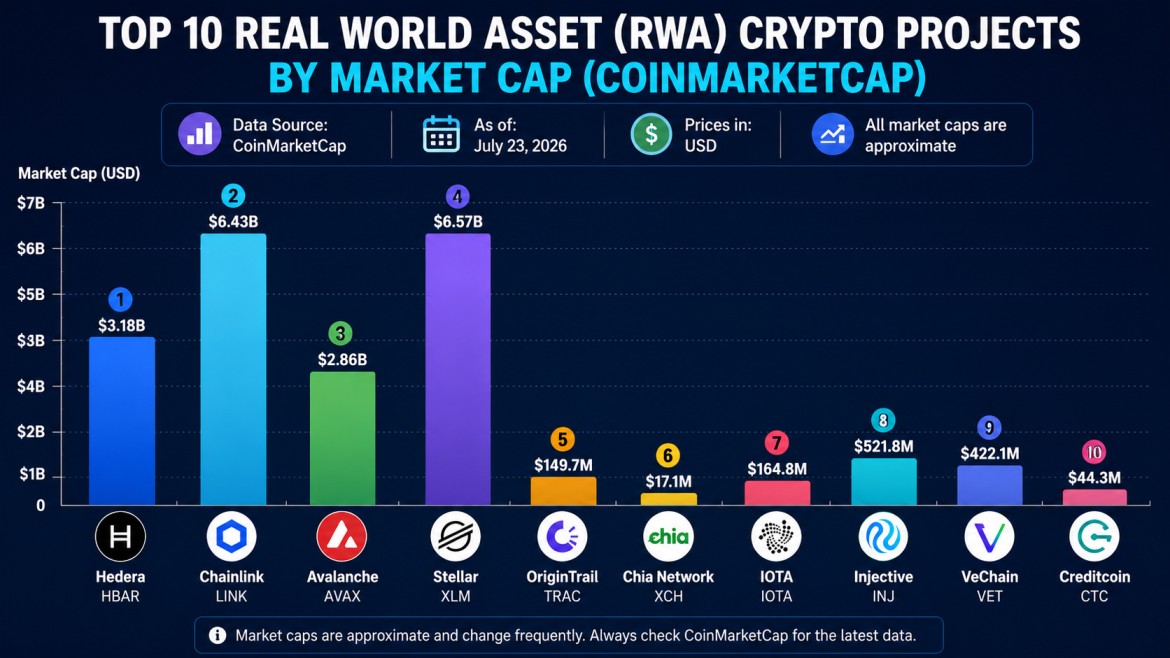
All prices, market caps, and rankings below are sourced from CoinMarketCap as of July 23, 2026, and can shift within minutes given normal market volatility.
Top 10 RWA Crypto Projects — At a Glance
S.NO
Project
Ticker
Price (CMC)
Market Cap
CMC Rank
Past 30-Day Trend
1
Hedera
HBAR
$0.0727
~$3.18B
#25
Range-bound, mild recovery
2
Chainlink
LINK
$8.60
~$6.43B
#15
Down early, sharp rebound by month-end
3
Avalanche
AVAX
$6.62
~$2.86B
#27
Strong monthly gain
4
Stellar
XLM
$0.1924
~$6.57B
#14
Monthly decline, stabilizing
5
OriginTrail
TRAC
$0.299
~$149.7M
#145
Volatile, sharp late-July bounce
6
Chia Network
XCH
$1.19
~$17.1M
#769
Ongoing decline, near all-time low
7
IOTA
IOTA
$0.0362
~$164.8M
#137
Monthly decline, mixed sentiment
8
Injective
INJ
$5.22
~$521.8M
#76
Monthly gain, four-week high
9
VeChain
VET
$0.00491
~$422.1M
#86
Six-month downtrend, mild stabilization
10
Creditcoin
CTC
$0.0806
~$44.3M
#420
Slight positive movement
Now let's break each one down—what the project actually does and why its price moved the way it did over the last month.
1. Hedera (HBAR)
Hedera isn't a typical blockchain — it runs on hashgraph, a distributed ledger technology built for fast transactions and predictable fees. What sets it apart is its Governing Council, which includes major organizations such as FedEx, Google, IBM, Boeing, Standard Bank, and NVIDIA.
Price action: HBAR is trading at $0.0727, up 4.20% in the last 24 hours, with a market cap of roughly $3.18 billion (CMC rank #25). The token is still more than 85% below its 2021 all-time high of $0.57 and has spent most of July consolidating in a range.
Why it moved: On the positive side, Hedera made its Smart Contract Service fully EVM-compatible, making it easier for Ethereum developers to migrate over using tools like Hardhat and Foundry. On July 21, HBAR spot ETFs also saw a net inflow of roughly $540K after nine straight sessions with no activity. On the negative side, broad altcoin selling and relatively low network fee revenue (only about $120K for the year, per BanklessTimes) kept the price under pressure for much of the month. Enterprise adoption looks solid, but it hasn't fully translated into token demand yet.
2. Chainlink (LINK)
Chainlink is an oracle network that connects blockchains to real-world data, which is why it sits behind the infrastructure of nearly every major RWA project.
Price action: LINK is trading at $8.60, down 1.49% in the last 24 hours, with a market cap of about $6.43 billion (CMC rank #15). LINK opened July around $7.19, down roughly 19% over the previous month, before rebounding sharply through the second half of July.
Why it moved: The early dip came from technical selling pressure inside a descending price channel. The rebound was driven by big institutional headlines—Fidelity International put $20 million into its tokenized fund FILQ, which runs on Chainlink's infrastructure; DTCC is integrating the Chainlink Runtime Environment into its Collateral AppChain, targeting Q4 2026 production; and a 50-bank consortium joined the network in June. Combined with steady ETF inflows, these catalysts pushed the price higher through the month, even though the gap between adoption and price is still visible.
3. Avalanche (AVAX)
Avalanche is a high-speed smart contract platform built specifically for institutional use cases and asset tokenization, and it regularly ranks among the more active RWA crypto projects on the institutional side.
Price action: AVAX is trading at $6.62, up modestly on the day, with a market cap of about $2.86 billion (CMC rank #27). The token was up roughly 27% over the trailing month as of early July, per CoinGecko data cited at the time.
Why it climbed: Several catalysts stacked up—FIFA chose Avalanche to power its own blockchain for FIFA Collect digital collectibles; two new spot ETFs (VanEck's VAVX and Grayscale's GAVA) are live; Hyundai Motor Group completed a real-funds cross-border settlement pilot that took about seven minutes; and stablecoin supply on the network jumped roughly 46–48% in a single week. That said, AVAX's removal from a Bitwise index fund added some selling pressure along the way.
4. Stellar (XLM)
Stellar has long focused on cross-border payments and is now leaning heavily into tokenized real-world assets.
Price action: XLM is trading at $0.1924, up 2.64% in the last 24 hours, with a market cap of roughly $6.57 billion (CMC rank #14). The token was down about 14% over the trailing month by mid-July before stabilizing.
Why it fell despite strong fundamentals: Deutsche Börse's Clearstream added XLM to its MiCA-compliant custody service alongside Bitcoin and Ether on July 8, giving roughly 2,500 institutional clients regulated access. Stellar's tokenized RWA ecosystem also crossed $3 billion in market cap, roughly a 300% increase, and DTCC has said it plans to bring part of its $114 trillion securities market onto Stellar by Q1 2027. Despite this news, price stayed soft for much of the month because the broader altcoin market was weak, and traders were waiting on the outcome of the Protocol 27 upgrade vote on July 8.
5. OriginTrail (TRAC)
OriginTrail builds a decentralized knowledge graph for supply chain data and AI, helping track the origin of products—a textbook example of connecting real-world supply chain data to the blockchain.
Price action: TRAC is trading at $0.299, with a market cap of about $149.7 million (CMC rank #145). The token opened July around $0.26, down roughly 26% over the prior month, before surging sharply in the back half of July.
Why it moved: The early decline mirrored broad altcoin weakness and thin trading volume. The later spike, which took TRAC to a monthly high near $0.38 around July 19, was tied to renewed interest in the AI narrative—as chatter around AI-plus-blockchain-data projects picked up, trading volume jumped roughly 300%, pushing the price up quickly.
6. Chia Network (XCH)
Chia is a "green" blockchain that uses hard-drive space (proof of space and time) instead of traditional mining, and it's now also pushing into enterprise-grade cloud services.
Price action: XCH is trading at $1.19, down 6.32% in the last 24 hours, with a market cap of roughly $17.1 million (CMC rank #769). The token is more than 99% below its all-time high and came close to setting a fresh all-time low around July 9.
Why it fell: The main issue is a lack of a strong bullish catalyst. While Chia kept shipping technical upgrades on the network side — security hardening and new AI-driven testing rules in its version 2.7.2 release — persistent selling and low volume kept the token under pressure through most of July. It's a case where the tech kept moving forward, but market attention and demand never followed.
7. IOTA
IOTA runs on a DAG (directed acyclic graph) architecture, originally built to connect IoT devices and real-world supply chains—one of the reasons it keeps showing up on lists of promising RWA crypto projects.
Price action: IOTA is trading at $0.0362, down 1.33% in the last 24 hours, with a market cap of about $164.8 million (CMC rank #137). The token was down roughly 24% over the trailing month.
Why it fell: Turkish exchange CoinTR removed IOTA's USDT and TRY trading pairs on July 3, which hit liquidity. Broad altcoin weakness added to the pressure. On the positive side, CoinMarketCap recently featured IOTA as one of three promising altcoins for the next bull market (alongside Optimism and Immutable), and the network activated its Starfish consensus mechanism while expanding its TWIN network into Africa and the UK.
8. Injective (INJ)
Injective is a Layer-1 blockchain built for on-chain derivatives, spot trading, and increasingly, institutional-grade RWA finance.
Price action: INJ is trading at $5.22, down 1.48% in the last 24 hours, with a market cap of about $521.8 million (CMC rank #76). The token was up roughly 8% over the trailing month and recently touched a four-week high near $5.35.
Why it climbed: Several catalysts came together—Coinbase began its mainnet integration; Injective secured a Robinhood listing; and the Injective Summit in Washington, D.C. brought in names like BlackRock, Grayscale, and Invesco. Injective also strengthened its regulatory standing through MiCA registration and an SEC transfer agent filing. Together, these developments drove sustained buying interest through the second half of July.
9. VeChain (VET)
VeChain is one of the oldest and most well-established RWA crypto projects, focused on supply chain management and verifying product traceability and authenticity.
Price action: VET is trading at $0.00491, up 1.22% in the last 24 hours, with a market cap of about $422.1 million (CMC rank #86). The token remains stuck in a six-month downtrend that began in January.
Why it stayed weak despite strong fundamentals: Following the Hayabusa upgrade in December 2025, which moved the network from Proof of Authority to permissionless Delegated Proof of Stake, VET staked on the StarGate platform grew nearly fivefold—from 2.52 billion to 13 billion tokens—locking up a large share of circulating supply. VeChain also launched AgentSuite, a no-code AI agent builder, on July 3. Despite this, the price stayed under pressure amid broad altcoin weakness through most of the month, though the staking growth is seen as a positive long-term signal.
10. Creditcoin (CTC)
Creditcoin is a decentralized credit network connecting lenders and borrowers globally while building on-chain credit history—a financial-inclusion angle on RWA.
Price action: CTC is trading at $0.0806, up 1.97% in the last 24 hours, with a market cap of about $44.3 million (CMC rank #420).
Why it edged up: Creditcoin was included in Chainlink's Cross-Chain Interoperability Protocol (CCIP) testnet deployment in late June, alongside Neo X, Tempo, and Robinhood Chain, connecting its infrastructure to a much larger cross-chain ecosystem. Given its small market size, the token remains volatile, but sentiment through mid-to-late July has been mildly positive.
Conclusion
Looking at all ten RWA crypto projects together, a clear pattern emerges: the networks showing the most development activity in the RWA space aren't necessarily the ones performing best on the price charts. Hedera, Stellar, and VeChain are all seeing growing enterprise partnerships and rising RWA volume, yet their token prices haven't fully caught up with that growth. On the other hand, names like Avalanche, Injective, and Chainlink have seen more direct price impact from recent institutional news and ETF flows. Overall, RWA remains a space where the gap between building activity and market price can be a meaningful signal for investors — as long as it's paired with proper research.
Disclaimer:
This article is for educational and informational purposes only and should not be considered financial or investment advice. Always conduct your own research before making investment decisions.