Geopolitical tensions and uncertainty continue to weigh on financial markets this week. Investors are now closely monitoring developments in the Middle East and their potential impact on oil
Geopolitical tensions and uncertainty continue to weigh on financial markets this week. Investors are now closely monitoring developments in the Middle East and their potential impact on oil prices, inflation and risk assets.
The uncertainty has also spilled into crypto markets, where Bitcoin has extended its recent decline amid persistent ETF outflows.
Related: Bitcoin crash triggers billions in liquidations
Bessent says Iran conflict has been halted
Testifying before the House Ways and Means Committee on June 4, U.S. Treasury Secretary Scott Bessent said the conflict involving Iran had been "halted."
His remarks came as the Trump administration continued efforts to ease tensions in the Middle East.
President Donald Trump had previously outlined conditions for a broader agreement, including reopening the Strait of Hormuz to unrestricted shipping traffic and preventing further disruptions to global energy markets.
During the hearing, lawmakers asked whether recent increases in energy costs were linked to the conflict. Bessent acknowledged that the situation had contributed to higher prices.
Oil markets remain highly sensitive to developments involving Iran because of the country's strategic position near the Strait of Hormuz, a critical shipping route that handles roughly 20% of global oil consumption.

The Strait of Hormuz
Getty Images
Any threat to traffic through the waterway can have immediate implications for global energy supplies and inflation expectations.
Brent crude climbed above $96 per barrel this week, while U.S. benchmark West Texas Intermediate (WTI) crude traded near $93.76 per barrel.
The prospect of higher energy costs has also raised concerns about inflation, as rising oil prices can feed through to transportation, manufacturing and consumer goods costs.
Trending on TheStreet Roundtable:
Federal Reserve officials have recently warned that elevated commodity prices could complicate efforts to return inflation to the central bank's 2% target, potentially delaying interest-rate cuts and creating additional pressure on risk assets.
Crypto traders exit risk assets
The broader uncertainty has coincided with a sharp retreat in digital asset markets.
U.S. spot Bitcoin exchange-traded funds have recorded a prolonged stretch of outflows, with investors withdrawing more than $4 billion since May 15, according to Farside Investors data.
The largest single-day outflow during the period reached $733 million on May 27.
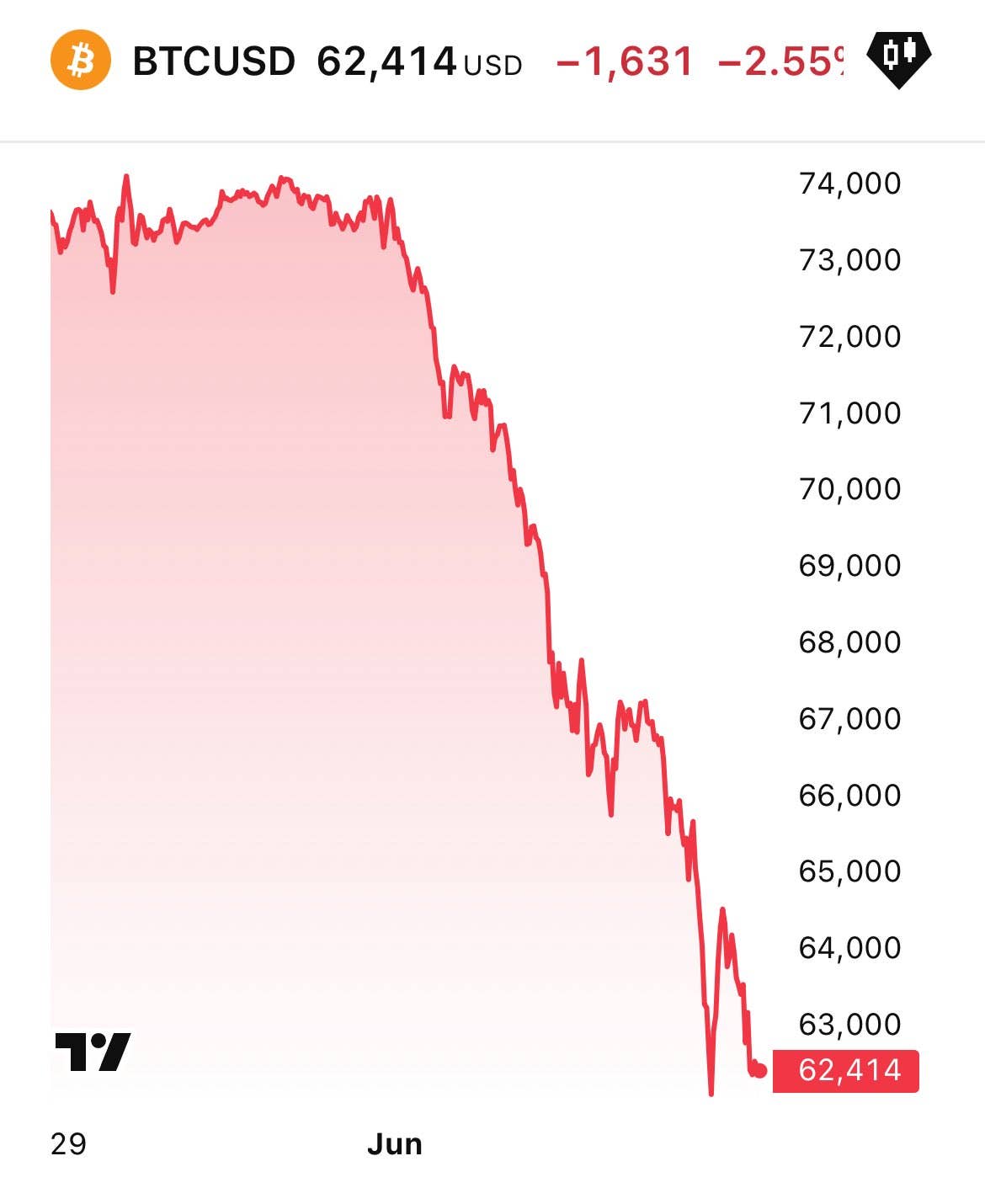
Bitcoin falls to $62,000 amid crypto market crash. Source: Trading View
The broader crypto market also came under pressure, with traders reducing exposure to risk assets amid uncertainty surrounding the Iran conflict, rising oil prices and concerns that inflation could remain elevated for longer.
Ethereum and several major altcoins posted sharp losses alongside Bitcoin, while leveraged positions were aggressively unwound across derivatives markets.
Bitcoin briefly fell as low as $62,414 during the selloff, its weakest level in months, before staging a modest rebound. The cryptocurrency remained down more than 15% over the past week as per market data.
At the time of writing, Bitcoin was trading around 63,642, recovering from its session low but remaining firmly under pressure.
Related: Cardano falls to new lows as founder announces hiatus