Hardware wallet maker Trezor has warned users about a phishing email circulating after a breach at a third-party email provider, a reminder that the weakest link in Bitcoin self-custody is of
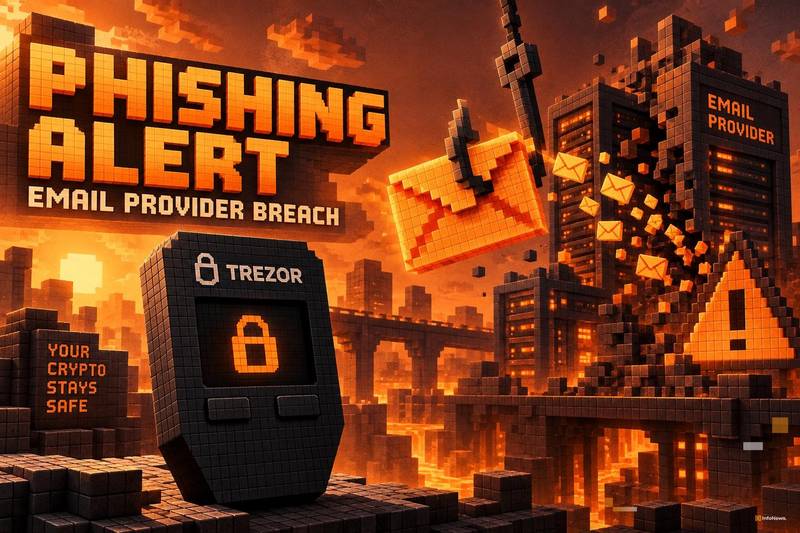
Hardware wallet maker Trezor has warned users about a phishing email circulating after a breach at a third-party email provider, a reminder that the weakest link in Bitcoin self-custody is often the messaging layer around the wallet rather than the device itself.
The warning centers on a fraudulent message that reached users following the compromise of an outside email vendor. The exact wording of the phishing email, its timing, and the specific recipients targeted were not detailed in the material available for this report. For related coverage, see Crypto Wallet Data Breach Exposes Nearly 40,000.
WHAT TO KNOW
- Trezor is warning users about a phishing email.
- The warning follows a breach at a third-party email provider.
Trezor Warns of a Phishing Email
Trezor, one of the longest-running manufacturers of self-custody hardware wallets, has told users to treat a recent phishing email with suspicion. The company framed the message as fraudulent rather than an official communication. For related coverage, see Blockstream Alerts Jade Wallet Users on Phishing Scam.
Beyond that, the specifics remain thin. No verified copy of the email, no attacker methodology, and no confirmed list of intended recipients were established in the available material, so those elements are left unstated here rather than reconstructed. This is not the first time the company has flagged impersonation attempts; Trezor has previously warned against fake support numbers tied to phishing concerns.
What Is Known About the Third-Party Email Provider Breach
The phishing warning is tied to a breach at a third-party email provider, not a compromise of Trezor's wallet infrastructure. The distinction matters: an email vendor breach exposes contact channels, whereas the private keys generated and stored on a hardware wallet never leave the device.
The provider has not been named in the available material, and the scope of the breach, the categories of data exposed, and any victim count are unconfirmed. It is important to separate what is simply absent from this report from what may be genuinely unknown publicly; neither should be read as evidence that wallets or funds were, or were not, affected. Similar incidents have been documented before, including a Trezor email provider breach that enabled fake security alerts and a broader case in which 14,000 Trezor users were placed on phishing alert after a data breach.
How to Approach Suspicious Wallet Emails
The guidance below is general and not verified instruction from Trezor about this specific incident. As a baseline, avoid clicking links inside unexpected wallet-related emails and instead verify any claim through official channels you reach independently, such as by typing the address directly.
The single most important rule for any hardware wallet user is that a recovery phrase, the seed that reconstructs Bitcoin keys, should never be typed into a page reached from an email or shared in reply to one. Legitimate providers do not request it, a principle that mirrors long-standing federal data-protection guidance for businesses handling sensitive personal information. The same phishing pattern has hit other cold-storage makers, including when Blockstream alerted Jade wallet users to a scam.
For Bitcoin holders, the episode underscores why the network's security model pushes value onto the base layer and the device: the Bitcoin blockchain itself, secured by proof-of-work and a difficulty adjustment that recalibrates roughly every two weeks, is not touched by an email breach. The exposure lives entirely in the human communication surface, where a stolen contact list, not a broken cipher, is what an attacker exploits.
Additional source references: source document 1.
Disclaimer: This article is for informational purposes only and does not constitute financial or investment advice. Cryptocurrency and digital asset markets carry significant risk. Always do your own research before making decisions.
Bitcoininfonews first published the article titled Trezor Warns of Phishing After Email Provider Breach.