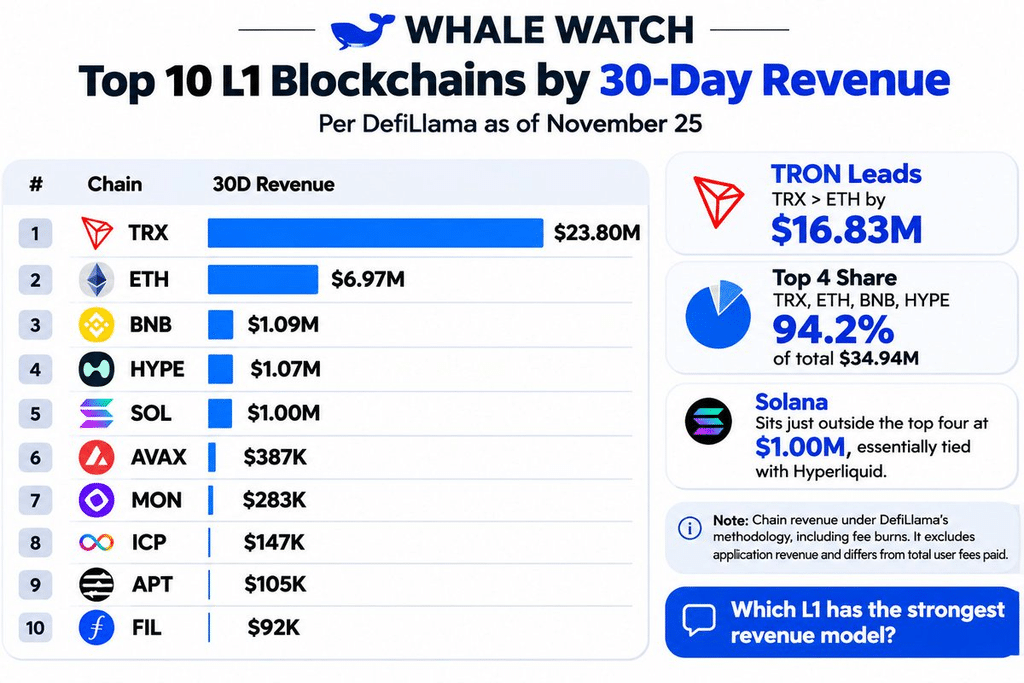
TRON generated $23.80 million in 30-day revenue, more than three times Ethereum's $6.97 million. TRON, Ethereum, BNB and Hyperliquid captured 94.2% of combined revenue across the ten ranked b
- TRON generated $23.80 million in 30-day revenue, more than three times Ethereum's $6.97 million.
- TRON, Ethereum, BNB and Hyperliquid captured 94.2% of combined revenue across the ten ranked blockchains.
- Solana recorded $1 million, narrowly trailing Hyperliquid, while Avalanche and other networks posted smaller totals.
TRON has pulled ahead of all other networks in terms of Layer 1 blockchain revenue, earning $23.80 million during the last 30 days.
TRON Establishes a Wide Revenue Gap Over Ethereum
According to the latest blockchain revenue reports from Whale Factor, TRON is the number one blockchain. DefiLlama data indicates that TRX has made $23.80 million in the last 30 days. Ethereum came second with $6.97 million, a big $16.83 million difference between the two networks.
Source:
X
The difference is all the more pronounced when the two figures are compared side by side. During the same timeframe, TRON reported about 3.4 times of Ethereum's revenue. This puts the network in a different revenue category than most other networks in the ranking.
Ethereum is the second largest blockchain network, but it is still a significant distance away from TRON. This contribution of $6.97 million by its part is about a fifth of their combined contribution of $34.94 million across all the ten listed blockchains. But according to the numbers, this isn't a recipe for similar revenue growth to the top network.
Additionally, TRON's position gives the ranking a very dense form. This $23.80 million figure is about 68.1% of combined revenue for these 10 networks. That implies that the remaining 9 blockchains combined produced less than TRON over the given time.
Four Blockchains Control Most Recorded Revenue
BNB Chain is in third place, and Hyperliquid is in fourth place. BNB earned $1.09 million, while Hyperliquid earned $1.07 million. The gap between them is only $20,000, whereas the difference between Ethereum and TRON is much greater.
In total, the TRON, Ethereum, BNB and Hyperliquid platforms combined made $32.93 million. This accounts for 94.2% of the total of $34.94M in the 10 networks. The other six blockchains thus supplied only 5.8% of the total reported.
This distribution shows the uneven revenue generation across the top Layer 1 networks. The remaining six names have a comparatively small share of the total, with almost all of the rest held by four names. It becomes quite evident when you look at the fourth ranked network against the ones in the lower positions.
Solana is right on the heels of this top tier, with $1 million of 30-day revenue. It performed just $70,000 behind the fifth-place Hyperliquid and the gap was very narrow. But Solana still lags far behind BNB, which collected $1.09 million in the same time.
Smaller Networks Face a Wider Revenue Gap
Things are different in the bottom half of the rankings, though.But it's another story in the bottom half of the rankings. Avalanche recorded $387,000, followed by MON at $283,000. These are much lower numbers than the top five networks have reported.
The Internet Computer was 8th with $147,000 reported revenues. Aptos was second with 105k and Filecoin finished the Top Three with 92k. These networks differ from the leaders in terms of the revenue that is concentrated in the hands of the few that take part.
The $387,000 Avalanche raised is an interesting benchmark to compare with Solana's $1 million. Solana has been taking in about two and a half times more revenue in the last 30 days than Avalanche. The other guys, MON, ICP and APT, all stayed below $300,000, and with a considerable margin between them and the top guys.
However, one important factor to take into account when assessing the performance of blockchain from these numbers is. DefiLlama's philosophy is based on chain income generation, not income generation through applications or the total amount of fees received, etc. The ranking does not therefore reflect all the economic activities that occur among these blockchain ecosystems.
That matters because revenue isn't enough to demonstrate a more successful business model. Additional context is added by transaction activity, application uptake, network demand etc. But there is a clear revenue difference between the 10 networks in the snapshot taken November 25.
The best part of this list is the $23.80 million $1.5 million lead TRON is taking. Ethereum is second, followed by BNB, Hyperliquid and Solana, all fighting for a much smaller share of the income. This leaves the TRON market to dominate the rest of the recorded chain revenue, which is rather large.