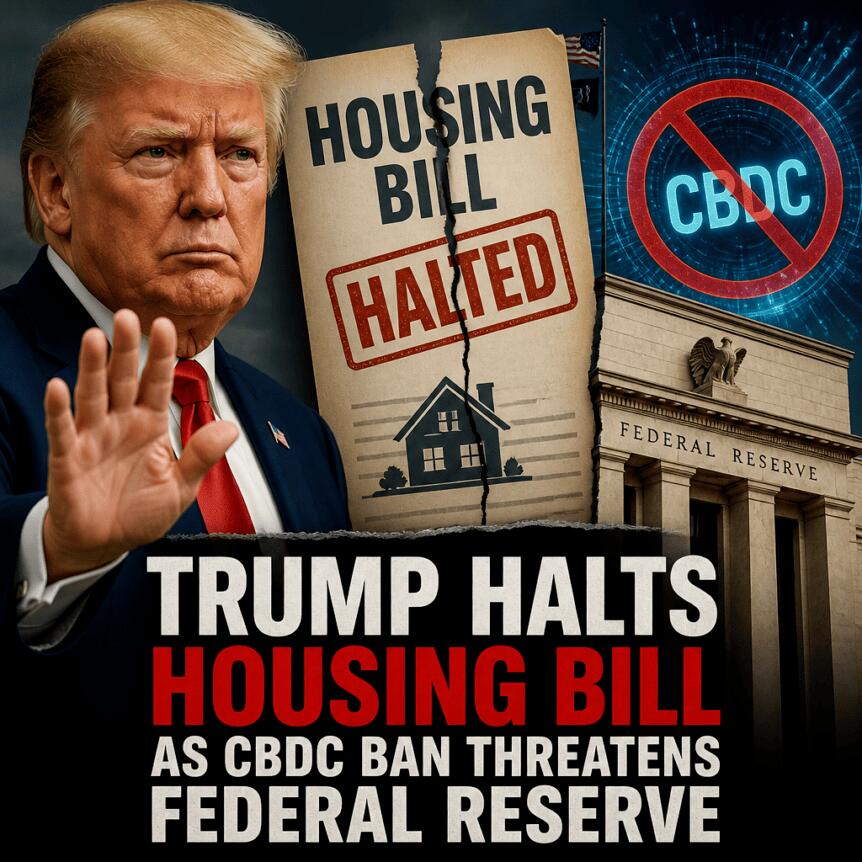
U.S. President Donald Trump has postponed the signing of a housing affordability measure that includes a moratorium on the Federal Reserve issuing a central bank digital currency (CBDC). In a
U.S. President Donald Trump has postponed the signing of a housing affordability measure that includes a moratorium on the Federal Reserve issuing a central bank digital currency (CBDC). In an announcement posted on Truth Social, Trump linked the delay to a separate voting-related proposal, signaling that broader legislative priorities may continue to affect the pace of crypto policy.
The decision matters for digital-asset compliance planning because it directly touches the legal framework around CBDCs and stablecoins, while leaving unresolved questions about how quickly the U.S. may advance wider reforms to digital asset regulation.
Key takeaways
- Trump cancelled the planned signing of the 21st Century ROAD to Housing Act, which contains a CBDC ban covering the Federal Reserve through the end of 2030.
- The housing bill includes a stablecoin carve-out permitting “dollar-denominated” tokens that meet specified openness and access characteristics.
- Trump said he would not sign other bills until the SAVE America Act is passed, raising uncertainty for other pending crypto-related legislation.
- The U.S. Senate is still awaiting potential action on the Digital Asset Market Clarity (CLARITY) Act, which would alter regulatory roles for digital asset oversight.
Housing legislation with a CBDC constraint paused
The 21st Century ROAD to Housing Act was passed by both chambers of the U.S. Congress and would have proceeded to Trump’s signature. According to the text described in reporting by Cointelegraph, the law would prohibit the Federal Reserve from issuing or creating a CBDC “or any digital asset that is substantially similar” until the end of 2030.
At the same time, the legislation provides a limited exception for certain stablecoins. The provision, as described in coverage, would allow “dollar-denominated currency that is open, permissionless and private,” creating a delineation between CBDCs and particular stablecoin structures. For regulated intermediaries, this distinction is operationally important: it frames how institutions may classify and handle different token categories under U.S. policy as lawmakers debate broader digital-asset rules.
Trump’s latest move therefore does not eliminate the policy concept already approved by Congress, but it delays its immediate legal effect. For compliance programs, that delay can affect timelines for internal mapping of token offerings, product gating, and risk assessments that rely on clear statutory boundaries between CBDCs and stablecoins.
Why timing and leverage are central to U.S. crypto policy
Trump indicated that the housing bill signing would be cancelled “until such time as we pass the desperately needed SAVE America Act.” This aligns with earlier statements from March that he would not sign other bills until the SAVE America Act is enacted. While the housing measure is aimed at addressing housing affordability, the president’s approach ties its fate to a separate political and legislative agenda.
The SAVE America Act proposal, as described in reporting, would require voters to provide proof of U.S. citizenship in person to register. Critics have argued that the measure would disenfranchise voters who are already eligible to participate under existing systems. Although this is not a crypto bill, the linkage between the signing timeline and broader legislative leverage has direct implications for the digital-asset domain, where regulatory certainty is often dependent on timely enactment of statutory text.
From a governance and legal risk perspective, the core uncertainty is whether the housing measure will be signed promptly, vetoed, or indefinitely delayed. If legislative disputes continue to spill over into crypto-related provisions, firms may face extended periods where they must operate under partially settled expectations rather than a clearly controlling statute.
Congressional support remains, but next steps are uncertain
Support for the housing bill was present within Congress before Trump’s intervention. Senate Republicans largely backed the measure, which passed the chamber in an 85-5 vote, according to reporting. Tim Scott, chair of the Senate Banking Committee, voiced support shortly before Trump’s announcement, and Democratic Senator Elizabeth Warren, a co-sponsor, also endorsed the bill.
Warren’s public remarks, as cited in coverage, highlighted that Congress “actually passed something good,” underscoring that the CBDC limitation was not solely a partisan initiative but rather part of a broader legislative package that drew backing across party lines.
Despite this, Trump’s stated condition for signing other legislation introduces uncertainty that could affect the practical implementation of the CBDC moratorium and the stablecoin exception. In the U.S. system, Congress retains the ability to override a veto through a two-thirds majority in both chambers, but the immediate sequence—signature versus veto versus delay—remains the critical variable for legal compliance planning.
Trump’s stance also raises questions about other pending digital asset measures. As of the announcement, the U.S. Senate was waiting for a potential vote on the Digital Asset Market Clarity (CLARITY) Act. The legislation is widely expected to address the allocation of responsibilities among U.S. financial regulators and to clarify enforcement and oversight structures for digital assets.
Cointelegraph reported that Trump said in May he intended to codify a “future-proof digital asset market structure,” which observers generally interpret as aligned with reforms such as CLARITY. However, the president has not confirmed whether those bills will move on the same timetable as housing or whether signing could be conditioned on unrelated legislative priorities.
If Trump vetoes either crypto-related legislation or other bills that include digital-asset provisions, Congress may attempt an override, but that path requires substantial bipartisan consensus and time—factors that can delay regulatory clarity. For institutions—particularly banks, payment providers, broker-dealers, and exchanges—such delays complicate compliance roadmaps tied to licensing expectations, supervision approaches, and the interpretation of what constitutes permissible activity in the U.S. market.
Any outcome that slows statutory action also risks extending the reliance on existing enforcement frameworks and agency guidance, which can vary in interpretation and can affect how AML/KYC obligations are implemented across product lines. While AML/KYC compliance is not determined solely by new legislation, statutory clarity can influence how firms structure compliance controls around token classification, custody, and customer activity monitoring.
Closing perspective
Trump’s postponement of the housing bill keeps the CBDC-related constraint Congress approved in limbo while he conditions broader legislative signing on the SAVE America Act. The near-term watch items for institutional stakeholders are whether the housing bill ultimately receives a signature, faces a veto, or continues to be delayed, and how quickly the Senate can advance CLARITY or other digital-asset bills under the same political timetable.
This article was originally published as Trump Halts Housing Bill as CBDC Ban Threatens Federal Reserve on Crypto Breaking News – your trusted source for crypto news, Bitcoin news, and blockchain updates.