President Donald Trump has a new man in charge of America's artificial intelligence push. And like almost everyone in this administration, he comes with a crypto backstory. On Oct. 4, Trump a
President Donald Trump has a new man in charge of America's artificial intelligence push. And like almost everyone in this administration, he comes with a crypto backstory.
On Oct. 4, Trump announced the Super Intelligence Force, or SIF, a task force charged with coordinating the federal government's efforts to keep the U.S. on top in AI, which the president has taken to calling "super intelligence."
Understanding Ripple, XRP and XRPL (3:17)
Heading it: Jay Clayton, the current Director of National Intelligence.
Clayton is a former Wall Street lawyer turned spy chief. For the crypto industry, his name is tied to a date: the SEC he chaired filed one of the most consequential lawsuits in crypto history one day before he walked out the door.
The lawsuit that followed him
Clayton ran the U.S. Securities and Exchange Commission — the regulator that polices stock markets and decides what counts as a "security," an investment that falls under its strict disclosure rules — from May 2017 to Dec. 23, 2020.
On Dec. 22, 2020, the second-to-last day of his tenure, the SEC suedRipple Labs, accusing the company of raising over $1.3 billion by selling XRP as an unregistered security.
Clayton left the very next day.
Worth being precise about his role: enforcement actions are brought by the agency, not its chairman personally, and Clayton is not quoted anywhere in the SEC's announcement, the case came out of its Enforcement Division's Cyber Unit. He never publicly commented on the Ripple suit, then or since.
The case was litigated almost entirely under his successor, Gary Gensler, who chaired the SEC from April 2021 to January 2025, pursued the appeal after the 2023 ruling, and became the industry's defining adversary in Washington.
More on XRP:
The stakes were bigger than one company. If XRP was a security, most cryptocurrencies could be too, and the entire U.S. industry would answer to the SEC. The question of what crypto actually is — security or currency — became one of Washington's defining tech fights, and the Ripple case was its main battlefield.
Judge Analisa Torres delivered a landmark split ruling in 2023: XRP itself isn't a security, and Ripple's sales on public crypto exchanges didn't break securities laws — but its direct sales to institutional investors did. Both sides appealed, the case dragged on for years, and it only ended in a settlement in August 2025, after Trump returned to the White House.
Related: I asked America.gov what's the status with U.S. strategic Bitcoin reserve
Was Clayton anti-crypto? Not exactly
In a December 2017 statement, at the height of the initial coin offering mania — ICOs were crypto's version of a stock market debut, startups selling new tokens to raise money — he acknowledged they "serve a useful purpose" for entrepreneurs.
His warning was about labels: calling a token a "utility" token doesn't stop it from being a security in the law's eyes.
A month later, in a joint statement with then-CFTC chairman J. Christopher Giancarlo, he warned retail investors that crypto risks were "high" — while conceding that regulators of markets so "new, evolving and international" needed to be "nimble and forward-looking."
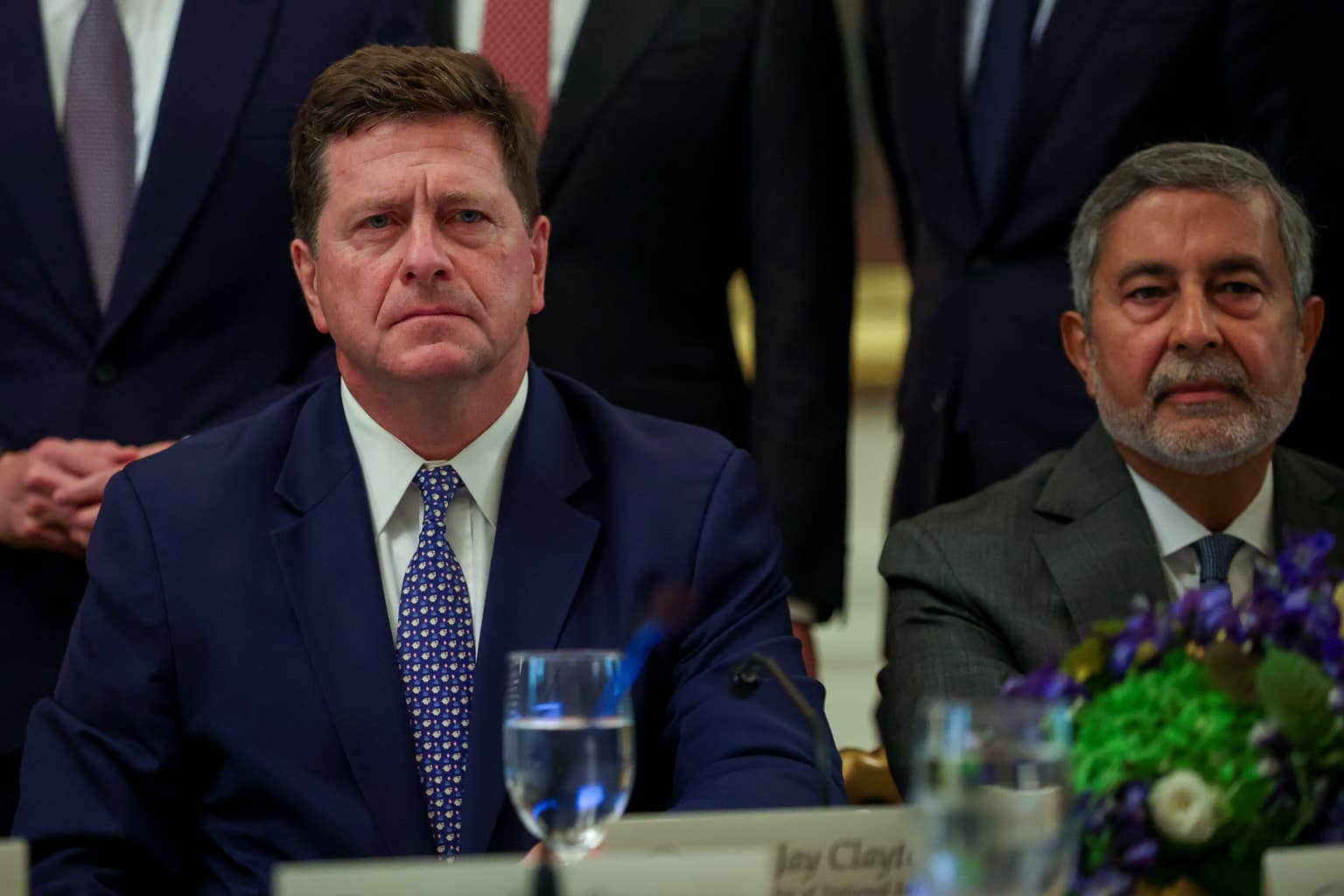
U.S. Director of National Intelligence Jay Clayton (L) and Micron CEO Sanjay Mehrotra attend a meeting on artificial intelligencein the East Room of the White House on September 29, 2026 in Washington, DC.
Getty Images
He fits a pattern
A crypto connection is practically a prerequisite in this administration.
Elon Musk, who ran the Department of Government Efficiency until May 2026, personally ownsBitcoin and Ethereum.
Defense Secretary Pete Hegseth disclosed he still holds Bitcoin.
Vice President J.D. Vance has revealed Bitcoin holdings of his own.
Editor's Take
The choice tells you how this administration thinks about AI. Clayton is a markets lawyer — a man who spent four years deciding which financial innovations fit inside old rules. Handing him "super intelligence" says the White House sees AI leadership as a competition to be coordinated and regulated into place.
Related: Your financial adviser could soon hold crypto for you under new SEC proposal