UK banks are still blocking or restricting payments to crypto exchanges and platforms, leaving customers unable to fund accounts or withdraw funds, even as crypto firms race to meet an approa
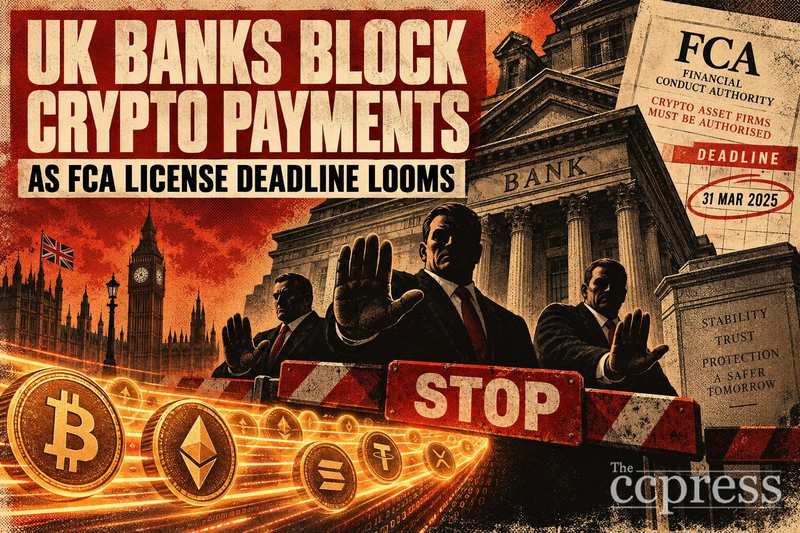
UK banks are still blocking or restricting payments to crypto exchanges and platforms, leaving customers unable to fund accounts or withdraw funds, even as crypto firms race to meet an approaching Financial Conduct Authority licensing deadline that could reshape who is allowed to operate in the country.
The payment friction is not new, but the timing makes it acute. Crypto Briefing reports that restrictions have persisted across a range of UK banking institutions, with customers encountering blocked transfers, declined card payments, or frozen transactions when attempting to move money to or from crypto-related services. These are bank-level risk decisions, not a UK-wide prohibition on owning or using crypto. For related coverage, see Trump Backs Crypto Bill as Banks Oppose Stablecoin Provisions.
That distinction matters. Holding bitcoin or ether is legal in the UK. The friction sits at the payment rails, where individual banks apply their own risk frameworks. The result is a patchwork experience: a customer at one bank may process a crypto deposit without issue while a customer at another hits a hard block. This issue has drawn direct scrutiny from lawmakers, with a UK Parliament inquiry examining whether banks are unfairly restricting crypto firms from accessing basic financial services. For related coverage, see 12 Crypto Regulators to Watch in 2026.
FCA licensing creates a pressure point for crypto businesses
Layered on top of the payment problem is a regulatory deadline that is forcing crypto businesses to make difficult decisions about their UK future. The FCA’s cryptoasset anti-money laundering and counter-terrorist financing regime requires firms offering crypto services to UK customers to be registered with the regulator. Operating without registration is not an option. For related coverage, see BIS Chief Says Stablecoins Lack Credibility for Payments.
The FCA has been building toward a more comprehensive framework. The regulator set out a roadmap for crypto regulation that covers admissions and disclosures, market abuse, and stablecoin oversight, among other areas. For firms still navigating the registration process, the deadline creates compliance costs and uncertainty about whether they will be approved, which in turn affects how they communicate with customers and plan their operations.
The regulatory status of a crypto firm and a bank’s independent decision to restrict payments are related but not the same thing. A firm can hold FCA registration and still find that certain banks decline to process its customers’ transfers. Registration signals a minimum compliance standard; it does not compel banks to extend services. Globally, banks are grappling with similar questions about how to approach the sector, and regulators in multiple jurisdictions are among those most closely watched in 2026 as frameworks evolve.
For ordinary UK crypto users, the practical effect is disrupted access. Blocked deposits mean missed trades. Blocked withdrawals mean funds are temporarily inaccessible. Platforms caught between uncertain licensing timelines and uncooperative banking partners face a compounded problem: they may be compliant on paper but operationally hamstrung. The contrast with markets like South Korea, where the country’s top bank has launched a 24/7 blockchain payment network, highlights how differently major economies are approaching crypto’s integration into mainstream finance.
For firms that do clear the FCA’s registration bar, the licensing milestone could improve their standing with banking partners over time, since demonstrated compliance reduces the perceived risk that drives payment blocks in the first place. Whether UK banks will treat FCA registration as a meaningful signal, or continue applying broad restrictions regardless, is the question that will define what the UK crypto market actually looks like when the deadline passes.
Disclaimer: This article is for informational purposes only and does not constitute financial or investment advice. Cryptocurrency and digital asset markets carry significant risk. Always do your own research before making decisions.
The article UK Banks Block Crypto Payments as FCA License Deadline Looms first featured on theccpress.com.