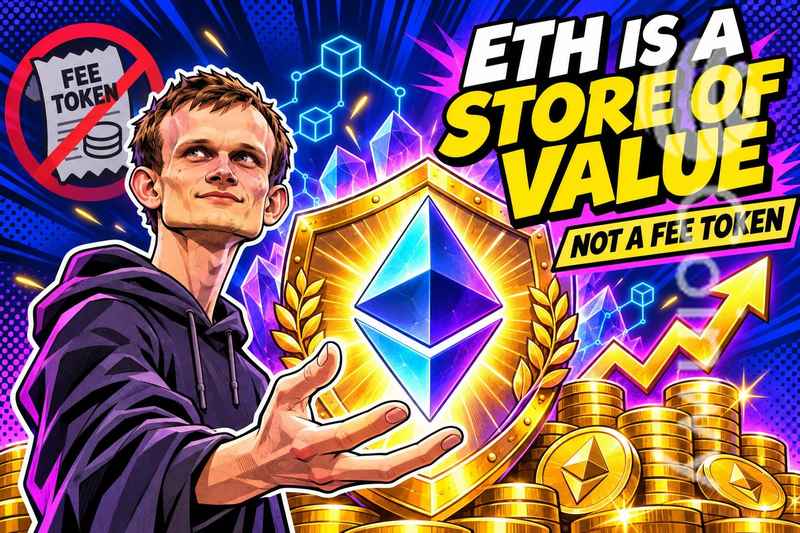
Vitalik Buterin has argued, according to unconfirmed reports, that ETH should be valued as a store of value rather than primarily as a fee-burning token, reopening a long-running debate about
Vitalik Buterin has argued, according to unconfirmed reports, that ETH should be valued as a store of value rather than primarily as a fee-burning token, reopening a long-running debate about how Ethereum's native asset derives its worth. The framing puts two distinct narratives in direct tension: one that ties ETH's value to its deflationary burn mechanics, and one that treats it as a durable monetary asset regardless of network fee levels.
What valuing ETH as a store of value means
A store-of-value framing evaluates an asset by its capacity to preserve purchasing power over time, independent of its day-to-day utility in transaction fees. For ETH, that would mean the asset's worth is not primarily derived from how much of it gets burned when users pay to transact on Ethereum, but from broader monetary properties such as scarcity, security, and long-term demand. For related coverage, see Vitalik Buterin Says AI Identified His Anonymous....
According to a single source reported by The Block on November 8, 2026, Buterin specifically contrasted this view with a fee-burning-token thesis, though the underlying article could not be independently retrieved and the exact wording remains unconfirmed. Buterin is one of the original authors of EIP-1559, the upgrade that introduced the fee-burn mechanism itself, which gives his framing particular weight in the debate. Context on this theme: Ethereum Node Setup Proposal Revived by Buterin.
According to CoinGecko market data cited in this report, ETH was trading at $2,121.44, down 4.96% over the prior 24 hours, with a market capitalization near $259.3 billion. The Crypto Fear & Greed Index sat at 28, a reading classified as Fear.
ETH market snapshot
$2,121.44
24-hour change: -4.96%
CoinGecko market-data snapshot; retrieval time was not specified and values may have changed.
Why the fee-burning-token framing is different
The fee-burning model gained traction after EIP-1559 activated on August 5, 2021. The upgrade split each gas fee into two parts: a base fee set by the protocol, which is permanently destroyed, and a priority fee, or tip, paid directly to validators. The base fee burn created a supply-reduction mechanism that is directly tied to network usage.
Under the fee-burning-token thesis, high network activity means more ETH is destroyed, tightening supply and supporting price. Under low-activity conditions, burn falls below issuance and the net supply expands. Ultrasound.money tracks this dynamic in real time, showing that ETH supply decreases only when burn outpaces new issuance to validators.
The store-of-value framing Buterin reportedly advanced separates ETH's worth from that activity-dependent cycle. Rather than depending on sustained high transaction demand to remain deflationary, a store-of-value asset holds worth through network security, decentralization, and scarcity properties that persist regardless of fee conditions in any given period. This distinction matters for how investors and developers think about ETH's role within the Lean Ethereum roadmap Buterin has outlined separately.
ETH market scale
$259.3B
Market capitalization · $6.85B 24-hour volume
CoinGecko market-data snapshot; retrieval time was not specified and values are rounded for display.
Key considerations for following this debate
Key Takeaways
- Buterin co-authored EIP-1559 but, according to a single unconfirmed source, now cautions against using its burn mechanism as the primary valuation lens for ETH.
- The store-of-value thesis and the fee-burning-token thesis produce different conclusions when network activity is low and burn falls below issuance.
- Neither framing is a price forecast; both are frameworks for interpreting what ETH represents as an asset.
Observers evaluating the two frameworks can watch several factors. How does ETH's supply trajectory on Ultrasound.money respond during extended periods of low mainnet activity? Does demand hold when fees are suppressed and burn turns inflationary? Those data points test the store-of-value thesis directly.
The counter-argument is straightforward: if burn falls persistently below issuance, the deflationary narrative that attracted many ETH holders weakens. The store-of-value framing would then need to stand on other properties, such as network security or the asset's settlement role, without the tailwind of shrinking supply.
Buterin has also addressed related questions about the Ethereum Foundation's long-term resource model and its ETH selling practices, both of which intersect with how the foundation's own holdings signal confidence in the asset's monetary properties. The valuation framing Buterin reportedly described fits a broader pattern of separating Ethereum-the-network from ETH-the-asset and asking which properties of the asset merit independent monetary status.
Whether the store-of-value thesis ultimately displaces or complements the fee-burn narrative is a question that remains open. Readers should note that the core statement attributed to Buterin in this report comes from a single news source whose article could not be independently verified at publication time.
Editorial credits
TA
Thiago Alvarez
Writer · Coinwy
DB
Daniel Brooks
Duty editor · Coinwy
Monitors published articles around the clock and can correct or withdraw them.
Checked by Coinwy QC Team before publishing on November 8, 2026 for headline accuracy, original value, factual consistency, metadata and authorship claims: our AI review system checks every article before it goes live, and our duty editor monitors it after publication.
Coinwy uses AI for research, drafting and review. Our editorial team is responsible for every article and corrects or withdraws articles when needed. How we review.
Disclaimer: This article is for informational purposes only and does not constitute financial or investment advice. Cryptocurrency and digital asset markets carry significant risk. Always do your own research before making decisions.
Read original article on coinwy.com
Read also :