The Nigerian government’s vision to cover the nation with 90,000 kilometres of fibre optic cable under Project BRIDGE is a bold digital infrastructure undertaking. Yet, beyond the fanfare, th
The Nigerian government’s vision to cover the nation with 90,000 kilometres of fibre optic cable under Project BRIDGE is a bold digital infrastructure undertaking. Yet, beyond the fanfare, there are glaring vulnerabilities in the broader strategy.
Spearheaded by the Ministry of Communications, Innovation and Digital Economy, the initiative aims to expand the national fibre backbone to roughly 120,000 kilometres, targeting all 774 Local Government Areas of the federation.
Recently incorporated as an independent Special Purpose Vehicle named Bridge Open Access, the project signals a necessary shift from political rhetoric to physical execution. The financial package, estimated at $1.6 billion, is anchored by a complex web of sovereign loans and private equity, securing backing from the World Bank, the African Development Bank, and the European Bank for Reconstruction and Development.
But fibre is merely the conduit. The ultimate destination is compute capacity. Over the past year, the Nigerian technology ecosystem has witnessed a surge of investment flowing into local facilities to meet domestic broadband demand.
Industry operators and government documents have casually floated a staggering 283-megawatt long-term capacity projection for local data centres. Independent tracking paints a slightly different, though still aggressive, trajectory.
An Estate Intel pipeline report projects Lagos’s total data centre capacity will exceed 218 MW by 2030, while models from Verraki suggest the national installed capacity could push past 400 MW in the same timeframe if power and fibre gaps are aggressively bridged.
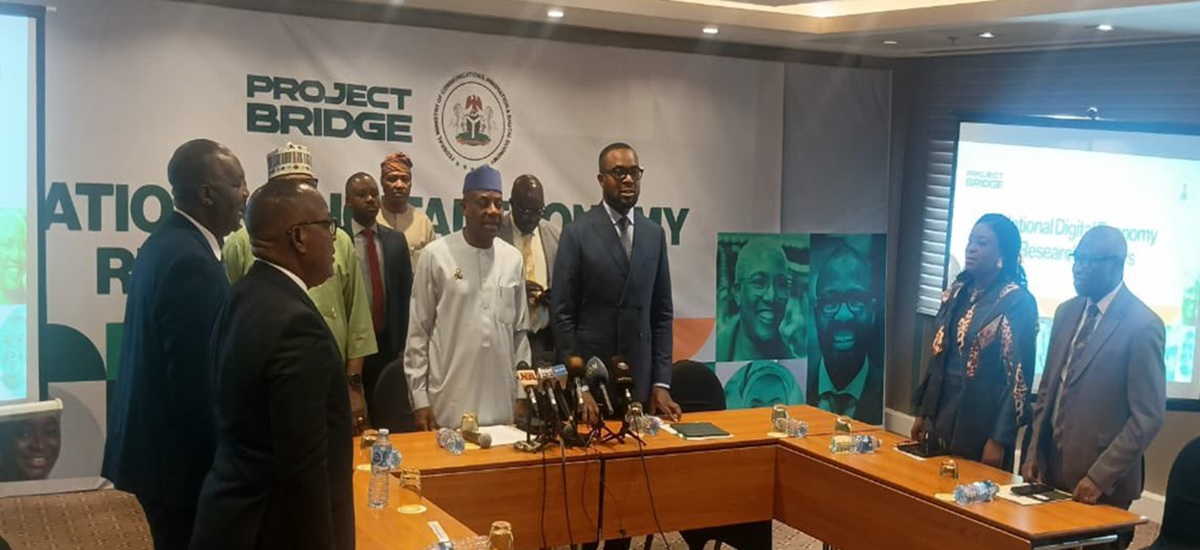 A Project Bridge discussion session with the Minister of Education, Dr Tunji Alausa and the Minister of the Digital Economy, Dr Bosun Tijani
To capitalise on this physical expansion, the National Information Technology Development Agency (NITDA) formally commenced the implementation of the National Sovereign Cloud Initiative (NSCI) in August 2026. This was followed by a comprehensive policy package featuring the National Digital Infrastructure Assurance Framework and the formation of a Sovereign Cloud Governance Committee.
The core objective is ambitious and seemingly patriotic: the federal government wants to corral its massive IT spending and channel a substantial chunk of federal technology demand into local hosting to ensure critical data remains under Nigerian jurisdiction.
Yet, the country is building an artificial intelligence-ready, cloud-first infrastructure on a power grid that routinely collapses and a logical layer entirely dependent on foreign software. The true test of Nigeria’s digital ambition is not simply how much fibre they can bury, but whether they can power, govern, and actually control the infrastructure that will rely on it.The hurdles ahead of Project BRIDGE
However, true sovereignty requires operational control at the software layer. If the hypervisors, the artificial intelligence models, and the enterprise architecture still belong to global hyperscalers, the data might physically sit in Yaba or Eko Atlantic, but the keys remain definitively offshore.
We risk a scenario where capital flight is not halted but redirected. Instead of paying overseas providers for cloud subscriptions, the Nigerian government and private sector will funnel those same dollars into software licensing fees to run proprietary foreign platforms on local iron.
Moreover, the regulatory landscape guiding this cloud push remains disjointed. The open-market approach of the new national policies occasionally rubs against stringent sector-specific mandates. The Central Bank of Nigeria has drawn a firm line on data localisation for financial institutions, forcing banks and fintech companies to host primary workloads domestically.
While this creates an ironclad investment case for local facilities, the friction between strict sovereign ring-fencing and a globally integrated cloud policy creates operational grey areas for multinational providers looking to scale within our borders. Investors demand regulatory harmony, not a patchwork of conflicting directives.
Executing the physical layer of Project BRIDGE also presents a staggering civil engineering challenge.
To meet the ambitious 2030 deadline for nationwide broadband access, construction plans target 17,500 kilometres of fibre in the first year alone, scaling up to 25,000 kilometres annually by 2028. Telecom operators and independent companies must constantly navigate state-level right-of-way disputes, local community pushback, and the perennial threat of infrastructure vandalism.
We still lack a unified federal security protocol to protect these critical assets once they are in the ground, leaving expensive glass lines vulnerable to deliberate sabotage or careless road construction.
The most critical blind spot in Nigeria’s sovereign cloud agenda, however, remains electricity. Data centres are colossal power guzzlers. The massive server farms required to process daily digital payments, host sovereign government data, and train intensive AI models require continuous, uninterrupted energy. A single hyperscale facility requires the equivalent electricity output of a small town.
Industry operators often downplay this reality during investment pitches, pointing to expensive backup batteries and industrial diesel generators as viable fail-safes. But a facility running entirely on diesel is not a sustainable anchor for sovereign infrastructure. Powering a Tier III data centre on backup solutions is a massive capital drain, skewing PUE metrics and making local hosting inherently less competitive than operating in regions with stable national grids.
A core argument for building local data centres is to host data locally and reduce the foreign exchange burden. If facility operators must burn millions of dollars on diesel to keep their servers running, that economic advantage quickly evaporates.
Electricity liberalisation and software autonomy are the uninvited guests at the digital infrastructure table. If we want global enterprises and local startups to run heavy computational workloads locally, they must trust that the lights will stay on and the software economics make sense.
Nigeria is correctly positioning itself to lead the African technological revolution. Project BRIDGE and the influx of data centre capital are absolute necessities for true digital independence. However, treating physical connectivity, software governance, and power generation as isolated silos will only yield a fractured ecosystem.
Hence, the government must reconcile its cloud policies, demand software-layer accountability, and treat national grid stability as a fundamental component of digital infrastructure. Without fixing these critical gaps, we risk building a world-class bridge that leads nowhere.