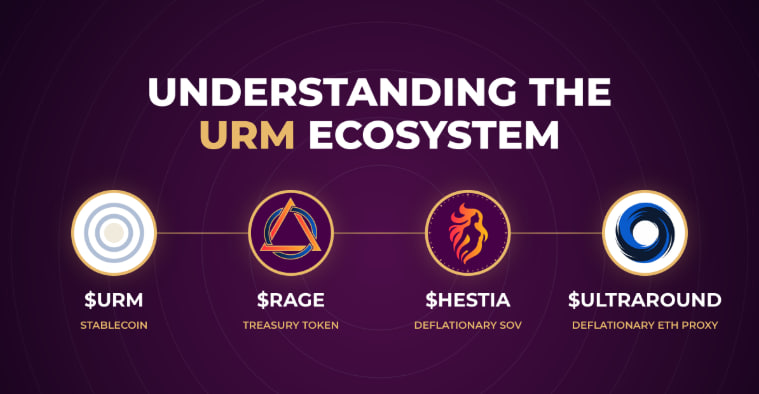
The URM ecosystem brings together four interconnected crypto assets, each with a distinct role: URM, the stablecoin; RAGE, the treasury token; HESTIA, a deflationary store of value; and ULTRA
The URM ecosystem brings together four interconnected crypto assets, each with a distinct role: URM, the stablecoin; RAGE, the treasury token; HESTIA, a deflationary store of value; and ULTRAROUND, a deflationary ETH proxy.
Together, these assets form an ecosystem built around stablecoin liquidity, treasury management, collateral-backed borrowing, and deflationary token mechanics.
Three core products connect the system: the URM Fortress, the Collateralized Debt Position (CDP), and Fountain.
Understanding the role of each asset and how these products interact helps explain the structure of the URM ecosystem and the opportunities and risks it presents.
1. URM: The stablecoin
URM is designed to maintain a soft peg to USDC on Base. At the center of the ecosystem, it provides the stablecoin layer that connects the other assets and products.
The URM Fortress manages liquidity, supports minting and burning mechanisms, and uses automated strategies to help defend the peg. It also connects URM to liquidity-related revenue and returns generated through ecosystem operations.
The Fortress plays a central role in the system by supporting URM’s liquidity and stability mechanisms.

2. RAGE: The treasury token
RAGE is a derivative token backed by a treasury composed of HESTIA and ULTRAROUND. Through the Rage Buying Protocol, USDC investments are allocated to these two assets, with a published distribution of 80% to HESTIA and 20% to ULTRAROUND.

This treasury structure connects RAGE to the performance and composition of its underlying assets. RAGE also serves as eligible collateral in the URM CDP, linking the treasury strategy directly to the stablecoin system.
RAGE OTC adds another connection between the four assets, allowing holders of URM, HESTIA, or ULTRAROUND to access RAGE through a dedicated exchange mechanism.
RAGE therefore serves two key roles within the ecosystem: treasury exposure and collateral for minting URM.
3. HESTIA: The deflationary store of value
HESTIA is designed as a deflationary store of value paired with USDC liquidity. Its Chaos Engine combines liquidity mechanisms, token burns, and buy pressure as part of its economic design.

The ecosystem also includes Hestia Mine, a staking-style product integrated with Peapods. Users should understand its contract mechanics, reward structure, and withdrawal conditions before participating.

HESTIA also forms the largest share of the treasury allocation managed through RAGE, connecting its token economics to the wider ecosystem.
4. ULTRAROUND: The deflationary ETH proxy
ULTRAROUND is designed as a deflationary asset that provides an economic model linked to ETH. Its Chaos Engine uses liquidity mechanisms and token burns to support its supply strategy.

The project also offers Temple, a staking-style product integrated with Peapods. Its contract mechanics, reward structure, and withdrawal conditions are important considerations for participants.

ULTRAROUND represents the second component of the RAGE treasury, receiving 20% of the USDC investments allocated through the Rage Buying Protocol.
5. How the four assets work together
Each asset has a distinct role, while the ecosystem’s products connect their functions.
URM provides the stablecoin layer and connects users to the Fortress, CDP, and Fountain.
RAGE provides exposure to the HESTIA and ULTRAROUND treasury and can serve as collateral in the CDP.
HESTIA combines deflationary token mechanics with USDC-related liquidity strategies.
ULTRAROUND applies deflationary mechanisms to an asset designed around ETH exposure.
The Fortress supports URM’s liquidity and peg-defense mechanisms. The CDP allows users to lock eligible assets as collateral and mint URM. Fountain lets users deposit URM and receive fURM, a vault share designed to accumulate yield through changes in its share price.
These connections give each component a place within the broader system. They also mean that the assets can be affected by shared market conditions, liquidity changes, smart-contract risks, and the performance of the underlying mechanisms.
6. Fountain: Generating yield from URM
Fountain adds a yield-bearing product to the ecosystem. Users deposit URM and receive fURM, which represents their share of the vault.
The project advertises a 12% target APY, with yield funded by the Fortress. The effective yield reflects the product’s actual performance and can differ from its target.
For example, the dashboard snapshot dated October 23, 2026, showed a 12% target APY and a 9.55% effective yield. These figures illustrate the difference between a stated target and the yield reported at a particular time.

7. URM ecosystem dashboard
The following snapshot provides additional context for the ecosystem’s reported state on October 23, 2026:
URM price: $0.998
Market capitalization: $811,885
Total liquidity value: $299,405
Backed supply: 80,809 URM
Total defense: $123,316
CDP utilization: 61%
Fountain target APY: 12%
Fountain effective yield: 9.55%
These metrics offer a point-in-time view of price, liquidity, collateral usage, and yield. Readers can consult the official URM page for current information.
Conclusion
The URM ecosystem brings four distinct crypto assets into one connected structure. URM serves as the stablecoin, RAGE represents the treasury strategy, HESTIA focuses on deflationary store-of-value mechanics, and ULTRAROUND provides a deflationary ETH proxy.
The Fortress supports URM’s liquidity and peg-defense mechanisms. The CDP connects eligible collateral to URM borrowing, while Fountain provides a yield-bearing option for URM holders. RAGE links HESTIA and ULTRAROUND through its treasury allocation, adding another connection between the four assets.
Together, these components form the foundation of the URM ecosystem. Understanding each asset’s purpose, how the products connect, and how the underlying mechanisms perform gives readers a clearer basis for evaluating the system and its risks.
Explore the ecosystem | X | Telegram