Crypto users sent about $2,260 to an attacker after malicious code on 178 companies' websites replaced payment addresses, according to blockchain intelligence firm Bitquery. Its investigation
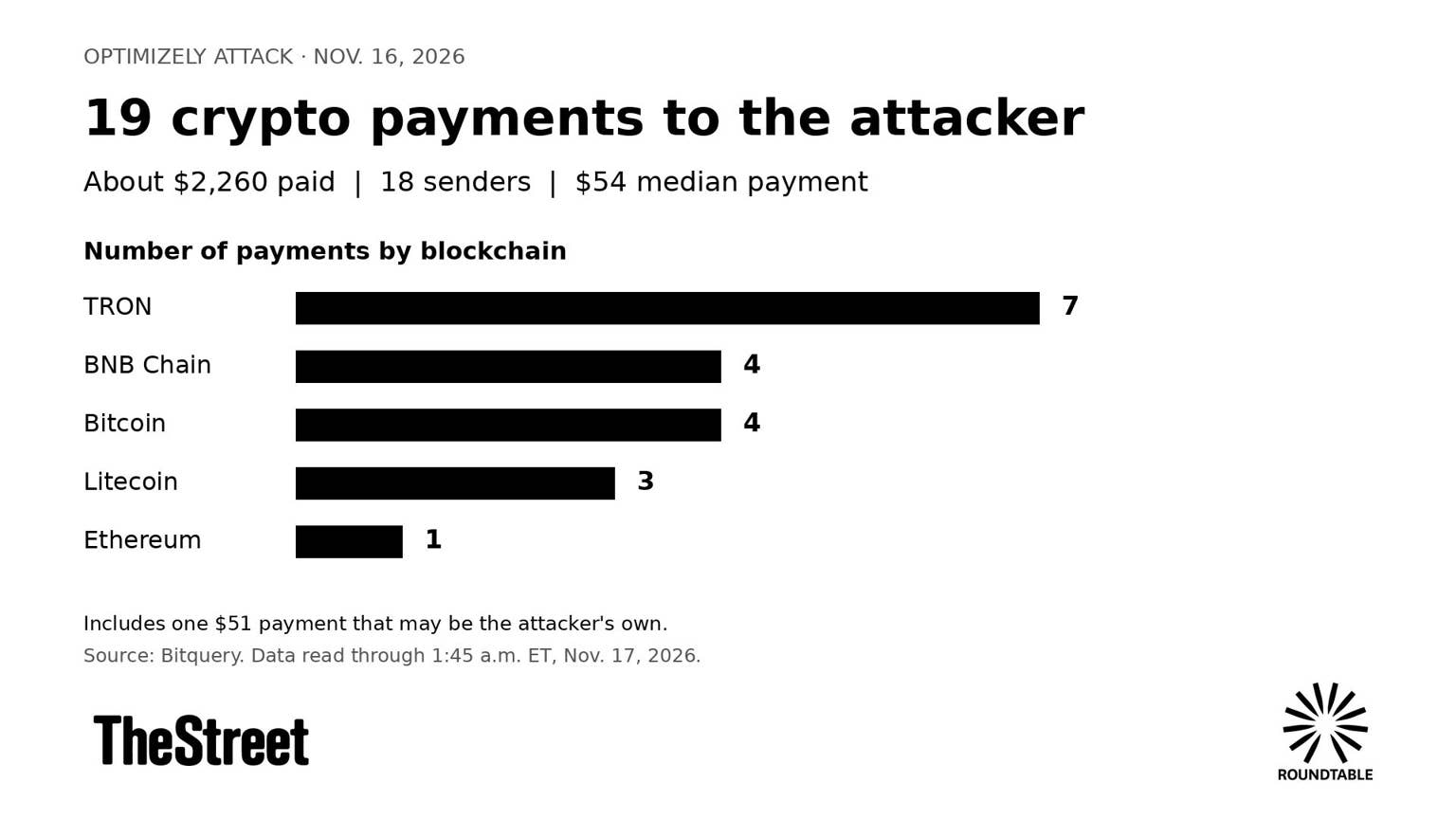
Crypto users sent about $2,260 to an attacker after malicious code on 178 companies' websites replaced payment addresses, according to blockchain intelligence firm Bitquery. Its investigation traced 19 payments from 18 senders on Nov. 16.
Gaurav Agarwal of Bitquery summarized the findings in the firm's Nov. 17 analysis. "Victims paid $2,260 in 19 payments."
The payments ranged from $1 to about $674. Two came from addresses Bitquery labels as belonging to Revolut and Bybit, suggesting users copied the attacker's address into exchange withdrawal forms.
Read more: What is Crypto? Cryptocurrency explained
Malware changed the payment address
The attacker did not have to break into 178 websites one by one. Those sites used Optimizely, a tool that helps companies test different versions of a web page. Each site loaded a small piece of Optimizely code in visitors' browsers.
According to security firm StepSecurity, the attacker added bad code to a custom-code field in customers' Optimizely projects. Optimizely then delivered those altered scripts to the sites. The code came through a service the sites already trusted, so visitors loaded it while browsing normally.
That is a supply chain attack. Instead of attacking each website directly, someone used a shared supplier to reach many of them. StepSecurity said Optimizely fixed the flaw and removed the injected code. How a signup flaw gave the attacker access to unrelated customer projects has not been explained publicly.
The bad code looked for crypto addresses near words such as "wallet," "deposit" or "send," StepSecurity said. It replaced the intended address with one controlled by the attacker. It could change the address displayed on the page, in links and form fields, and in text a visitor copied.
A user could therefore copy an address from a familiar website and paste the attacker's address into a wallet or an exchange withdrawal form. The address could already be wrong before the user pressed paste. Bitquery calls this an address swapper, or clipper.
The switch could be hard to spot because the code changed both what appeared on the page and what was copied. Comparing a pasted address with the same altered page would not reveal the switch. The replacement was a valid crypto address, so a wallet could accept it, StepSecurity said.
The user still sent the payment, but to the wrong destination. StepSecurity advises checking the address on the wallet or hardware-wallet screen against the intended recipient's address, not simply against the text that was copied.
Bitquery said the affected sites included the BBC, CNN, Zoom and hardware wallet maker Ledger. Its count of affected companies and list of eight attacker addresses came from security firm Report URI. Bitquery traced the payments rather than examining the malware itself.
Only six of the 178 affected companies work in crypto or trading. A page without a crypto address gave the address-swapping code nothing to replace, Bitquery said.
From our archives: Explained: What is a hot wallet?
What is a hot wallet? Explained (5:26)
The 178 affected companies
A company on this list had the infected supplier code served to visitors of its website; it does not mean the company itself was hacked.
Banking and Finance (32)
- Paychex
- HSBC US
- Equifax
- SmartAsset
- HSBC Hong Kong
- ABN AMRO
- TaxAct
- HSBC Mexico
- HSBC Singapore
- NetCredit
- Associated Bank
- S-Pankki
- Equifax Canada
- Equifax UK
- The Work Number (Equifax)
- Funding Circle
- HSBC Australia
- CashNetUSA
- OnDeck
- ICS Cards
- HSBC UAE
- HSBC Malaysia
- Rest Super
- HSBC Taiwan
- HSBC Vietnam
- HSBC Egypt
- HSBC Philippines
- SmartAdvisor Match (SmartAsset)
- Compare Club
- ABN AMRO Lease
- Energy Scout
- Hang Seng Investment
Technology and SaaS (23)
- Zoom
- Bitly
- Salesforce
- GitLab
- Optimizely
- Mixpanel
- Typeform
- InMotion Hosting
- Wasabi
- Perforce, Zend and Puppet
- Tableau
- Hootsuite
- Smartsheet
- MuleSoft
- Thales and Imperva
- Tricentis
- Web Hosting Hub
- QR Code Generator
- ServiceChannel
- Brandfolder
- Intelex
- Enverus
- Accruent
Retail and Fashion (20)
- IKEA (home-design site)
- ASOS
- Mattel
- American Eagle
- Scheels
- Ariat
- American Girl
- StackSocial
- Crocs India
- Levi's Japan
- Todd Snyder
- Levi's Indonesia
- Just Russel
- Loloi Rugs
- Levi's Australia
- Levi's Malaysia
- Levi's Philippines
- Levi's Singapore
- Levi's Korea
- Levi's New Zealand
Streaming and Entertainment (12)
- Peacock
- D&D Beyond
- Wizards of the Coast
- NOW TV
- Zattoo
- Crave
- Starz
- SkyShowtime
- Bravo
- SeaWorld and Busch Gardens
- WOW (Sky Deutschland)
- NOW Italia
News and Media (10)
- CNN
- BBC
- Fox News
- NPR
- CTV News
- Fox Sports
- BNN Bloomberg and CP24
- TSN
- Top Gear
- BBC Earth
Airlines and Travel (9)
- Alaska Airlines and Hawaiian Airlines
- Transavia
- Air France-KLM
- KLM Netherlands
- Trafalgar
- Contiki
- Insight Vacations
- The Travel Corporation
- Costsaver
Healthcare and Pharma (8)
- Invisalign
- Takeda
- Covetrus
- iTero (Align)
- Covetrus Pharmacy
- myCovetrus
- RaySafe (Fluke)
- Takeda Oncology
Industrial and Manufacturing (8)
- Fluke
- eMaint (Fluke)
- Fluke Networks
- Vaillant Germany
- Fluke Process Instruments
- Fluke Biomedical
- Landauer
- Vaillant Spain
Telecoms (7)
- Virgin Media
- Virgin Media O2
- Vodafone Australia
- O2
- TPG Telecom
- Mint Mobile
- TalkTalk
Crypto and Trading (6)
- Ledger
- IG
- OANDA and Coinpass
- interactive investor
- TMS Brokers
- Betashares
Insurance (6)
- Asurion and uBreakiFix
- Mutual of Omaha
- Admiral
- Securian Financial
- eRenterPlan
- AKA (Danish unemployment fund)
Property and Real Estate (6)
- Buildium (managebuilding.com)
- Loft Living apartments
- Buildium
- HireAHelper
- Flytte.no (and sister comparison sites)
- MovingPlace
Food and Hospitality (5)
- Order.online restaurant ordering sites
- Heineken
- Home Chef
- Starbucks Canada
- Cinnabon
Home and Smart Home (5)
- Resideo
- Honeywell Home
- myQ (Chamberlain)
- Chamberlain
- First Alert
Nonprofit and Civic (4)
- Change.org
- ASPCA
- UNICEF USA
- DonorsChoose
Gambling (4)
- Betsson
- PokerStars
- tombola
- Betfred
Professional Services (4)
- Freshfields
- CohnReznick
- Baringa
- Cro Metrics
Logistics and Shipping (3)
- ShipStation and ShipEngine
- Stamps.com
- ShipEngine
Automotive (3)
- Lucid Motors
- O'Brien Glass
- Chevrolet dealer sites (Bill Rapp and others)
Education (3)
- Walden University
- Perlego
- Chamberlain University
Who paid
Bitquery counted payments on five blockchains, the public records that track crypto transfers. They arrived between 4:57 a.m. and 2:57 p.m. ET on Nov. 16, with a median payment of $54 and six below $25.
The largest payment was 15 Litecoin, worth about $674. Four of the eight addresses embedded in the malware, for Solana, TON, Bitcoin Cash and Dogecoin, received no coins.
"In those cases, the victim likely pasted the swapped address into a withdrawal form," Agarwal wrote of the payments from Revolut- and Bybit-labeled addresses.
One $51 payment in TRX may have come from the attacker to cover network fees. Excluding it would put the total at about $2,210.
Where the money went
At 12:39 a.m. ET on Nov. 17, 0.085 Bitcoin moved to what looked like a deposit address at a custodial service, a firm that holds coins for its users, Bitquery said.
Bitquery said coins at that address had previously been collected in one transaction with coins from almost 1,000 other addresses. The firm could not identify the service.
The Litecoin moved to a new address and stayed there when Bitquery last checked. The ether went to an address that forwards funds to a wallet Bitquery labels as belonging to crypto payment gateway OxaPay.
A freeze may still be possible
Bitquery said nobody can reverse a crypto payment sent to the wrong address. It said a freeze may still be possible because the Bitcoin appeared to be at a custodial service and the attacker also used exchange-linked addresses.
The firm urged anyone who paid one of the eight addresses after copying it from a website that day to contact police and provide the transaction ID. Users who withdrew from an exchange should also report the payment there, it said.
Bitquery warned against people offering to recover the coins for a fee. Anyone who entered a card number on an affected site should treat it as exposed and contact their bank, it said.
Where things stand now
The malicious code is gone.
Report URI said every infected Optimizely file had been cleaned by 6:11 p.m. ET on Nov. 16 and stayed clean through its last check, at 4:17 a.m. ET on Nov. 17. Optimizely says it fixed the flaw, removed the injected code from affected projects and secured the accounts involved.
The attacker's infrastructure is also being taken down. The main server that delivered the code and collected stolen data stopped resolving at 7:37 p.m. ET on Nov. 16, and a domain used in an earlier wave followed at 10:37 p.m., Report URI said. Of two related domains used against iPhones, one no longer resolves and the other no longer responds.
Optimizely has acknowledged the incident on its status page, which still showed it as under monitoring at 2:30 a.m. ET on Nov. 17, according to StepSecurity.
The attacker emptied the crypto wallets early on Nov. 17. Report URI said one transfer went to an address the same actor used to cash out earlier attacks in March and on Nov. 3, tying this campaign to previous ones.
What the investigation cannot establish
Bitquery classified a transfer as a victim payment if it reached one of the eight addresses after the address-swapping code first appeared, from a sender with no other tie to the attacker. That method cannot confirm what each sender intended to do.
The firm used prices at the time of each transfer, with daily prices for TRON. It excluded fake coins sent by automated accounts and checked Bitcoin and Litecoin totals against public blockchain records.
Exchange and payment-service names come from Bitquery's address labels. Those labels can be incomplete or wrong and do not show that the companies knew where the funds came from.
The firm does not know who controlled the attacker addresses. Its findings cover blockchain data read through about 1:45 a.m. ET on Nov. 17, and do not measure card theft or the malware's attempts to compromise iPhones.
TheStreet has covered similar hits to the industry, including a Cloudflare outage that disrupted Coinbase, Kraken and other major exchanges.
Read more: Cloudflare outage disrupts Coinbase, Kraken and major exchanges
Readers who follow our market coverage can check out the Roundtable 100, our weekly ranking of the top 100 investable tech stocks, including digital asset companies. The board updates every Friday.
Disclaimer: This article is for informational purposes only and is not financial advice. Consult a qualified financial adviser before making any investment decision.