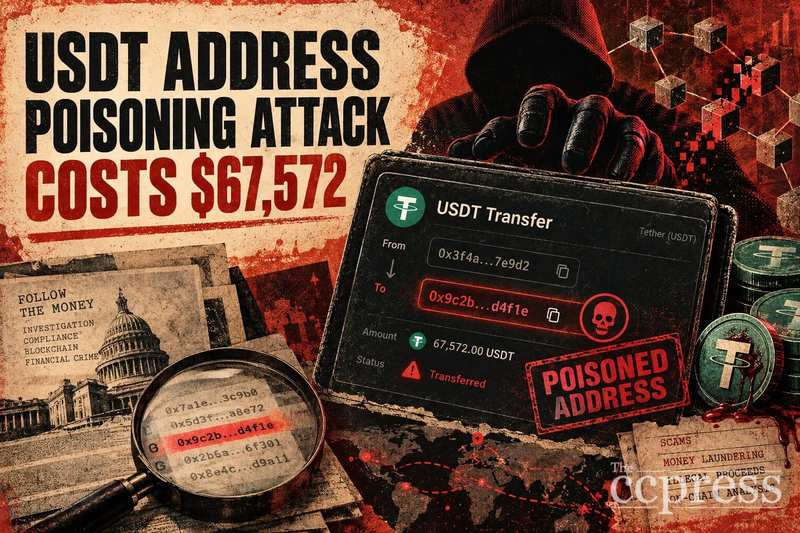
A crypto user lost $67,572 in USDT after falling victim to an Ethereum address-poisoning attack, according to on-chain security monitor ScamSniffer. The funds were sent to an attacker-control
A crypto user lost $67,572 in USDT after falling victim to an Ethereum address-poisoning attack, according to on-chain security monitor ScamSniffer. The funds were sent to an attacker-controlled wallet after the victim copied what appeared to be a familiar address from their transaction history.
What Happened in the $67,572 USDT Loss
On-chain security firm ScamSniffer flagged the incident on X, identifying it as a confirmed address-poisoning loss on Ethereum. The stolen asset was USDT, and the transfer is recorded on-chain with no reversal mechanism available.
This is not an isolated case. A similar technique was used in a far larger theft when a crypto trader lost $50M USDT in an Ethereum address scam, one of the largest single losses of its kind on record. For related coverage, see Crypto Trader Loses $50M USDT in Address Scam.
How Ethereum Address Poisoning Misdirects USDT
The scam exploits a habit nearly every crypto user has: copying a wallet address from past transactions rather than typing it out fresh. Attackers generate vanity addresses that visually match the target’s known contacts, brute-forcing addresses with matching prefix and suffix characters. For related coverage, see Crypto Investor Loses $2.6M in USDT Scam.
Once they have a look-alike address, they send a zero-value or dust transaction from it to the victim’s wallet. This plants the poisoned address directly in the victim’s transaction history, right next to the legitimate one it mimics. For related coverage, see Ducat Integrates TRON for USDT Settlements of Bitcoin-Backed Dollar Tokens.
USDT transfers on Ethereum are ERC-20 token transactions recorded permanently on the blockchain. There is no freeze, chargeback, or reversal mechanism once the transaction is confirmed. Tether can freeze USDT at specific addresses under certain circumstances, but that requires a formal process and is not guaranteed for smaller losses, as a prior $2.6M USDT scam victim discovered. For related coverage, see Tron Surpasses Ethereum as USDT Supply Climbs to $94B.
How to Prevent a Similar USDT Address-Poisoning Loss
The attack does not exploit a bug in USDT or Ethereum. It exploits human behavior. The only reliable defense is changing how you verify addresses before signing a transaction.
Always verify the full destination address, not just the first four and last four characters. Attackers specifically match those visible fragments. Checking only the ends is exactly what they are counting on.
For any recipient you send to regularly, save the verified address in a trusted address book inside your wallet application. Never copy an address directly from your transaction history without cross-referencing it against a known-good source, such as an exchange withdrawal page or a previously verified bookmark.
For large transfers to a new or unconfirmed address, send a small test amount first and confirm receipt before sending the full sum. This extra step costs a small gas fee and takes a few minutes. Losing tens of thousands in a single misdirected transfer costs considerably more.
Confirm all recipient details on your signing device, whether that is a hardware wallet screen or a software wallet confirmation dialog. If anything looks off at that final step, reject the transaction. One verification habit could have saved this victim the entire loss. Could yours?
Additional source references: source document 1.
Disclaimer: This article is for informational purposes only and does not constitute financial or investment advice. Cryptocurrency and digital asset markets carry significant risk. Always do your own research before making decisions.
The article USDT Address-Poisoning Attack Costs $67,572 first featured on theccpress.com.