USDT buyers face 22% VAT when Moscow Exchange opens crypto trading
Buyers of Tether’s USDt (USDT) stablecoin will pay a 22% value-added tax (VAT) on top of the trade price when Moscow Exchange (MOEX) opens crypto trading on Dec. 1, according to the exchange’
A
AnonymousCryptoCompass newsroom
November 24, 2026
2 min read
NEWS
CryptoCompass editorial visual for policy coverage.
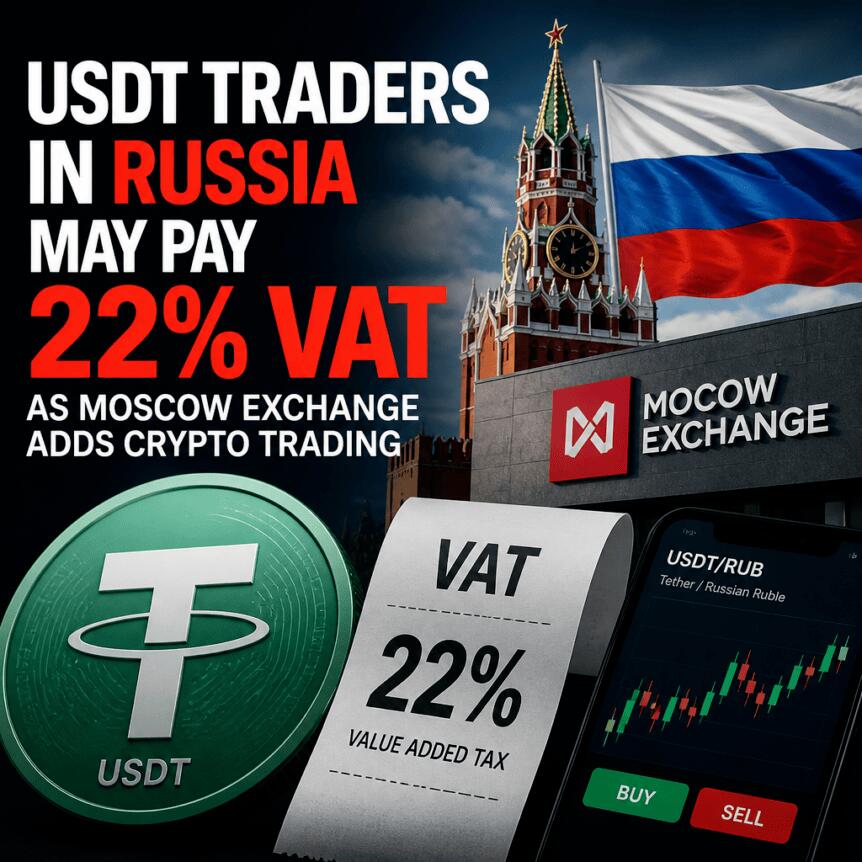
Buyers of Tether’s USDt (USDT) stablecoin will pay a 22% value-added tax (VAT) on top of the trade price when Moscow Exchange (MOEX) opens crypto trading on Dec. 1, according to the exchange’s clearinghouse.
The National Clearing Centre (NCC) said it would apply VAT to USDT purchases, sales and swaps through Dec. 31. A buyer purchasing 100,000 rubles worth of USDT would pay an additional 22,000 rubles in VAT.
Unlike Bitcoin (BTC) and Ether (ETH), which Russia classifies as digital currencies, USDT falls under a separate legal category known as foreign digital instruments. Russia’s tax code excludes sales of digital currencies from VAT, but it provides no explicit exemption for foreign digital instruments, according to the NCC.
The NCC said it had asked Russia’s Federal Tax Service and Finance Ministry for guidance. It said it would update market participants if it received clarification or if lawmakers exempted trades conducted before Jan. 1, 2027.
Bank of Russia rules that took effect Nov. 17 allow non-qualified investors to buy Bitcoin, Ether and USDT through intermediaries, with annual purchases capped at 300,000 rubles (about $3,650) per intermediary.
Key takeaways Anthropic shares fall below their $83 IPO price ANT loses nearly 27% from its opening trade Up to 303 million shares could unlock December 15 Anthropic (NASDAQ: ANT) fell 6.7% t
Moscow Exchange (MOEX) is set to open regulated crypto trading on Dec. 1, but Tether’s USDt (USDT) will come with a new cost for traders in Russia: a 22% value-added tax (VAT) applied on top
Former New York Gov. Andrew Cuomo accused competing trading platforms of encouraging companies to reject OKXICE’s tokenized stock plans, saying the rivals wanted more time to launch their own