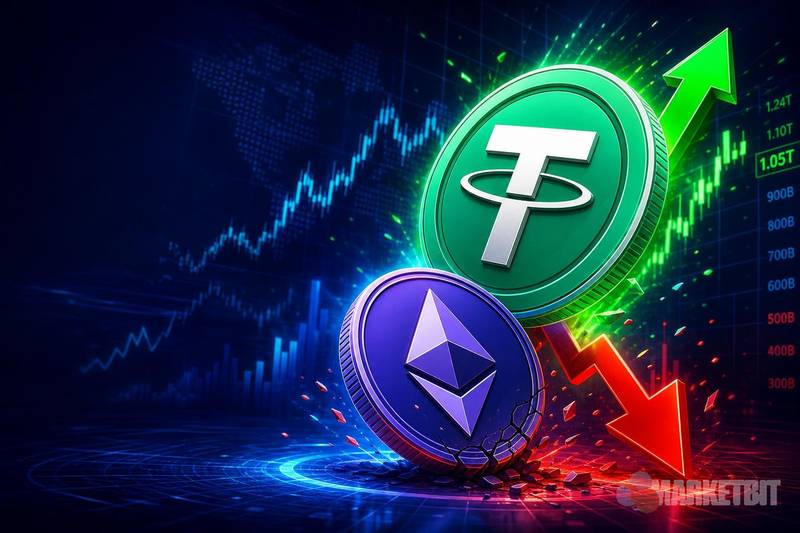
USDT’s market capitalization has reached approximately $187.05 billion, trailing Ethereum by only $1.34 billion. The gap between Ethereum and USDT has narrowed to less than 1%, bringing a pot
- USDT’s market capitalization has reached approximately $187.05 billion, trailing Ethereum by only $1.34 billion.
- The gap between Ethereum and USDT has narrowed to less than 1%, bringing a potential flippening into focus.
- Growing demand for stablecoins reflects investors’ preference for liquidity and stability amid market uncertainty.
- Ethereum remains the leading smart contract platform despite recent price weakness and declining market valuation.
Tether’s Stablecoin Climbs Within Striking Distance of the Crypto Market’s No. 2 Spot
Tether’s USDT stablecoin is on the verge of achieving a historic milestone as it closes in on Ethereum’s position as the second-largest cryptocurrency by market capitalization. The development highlights a significant shift in investor sentiment, with traders increasingly favoring stable assets amid heightened market volatility.
 Crypto MarketCap
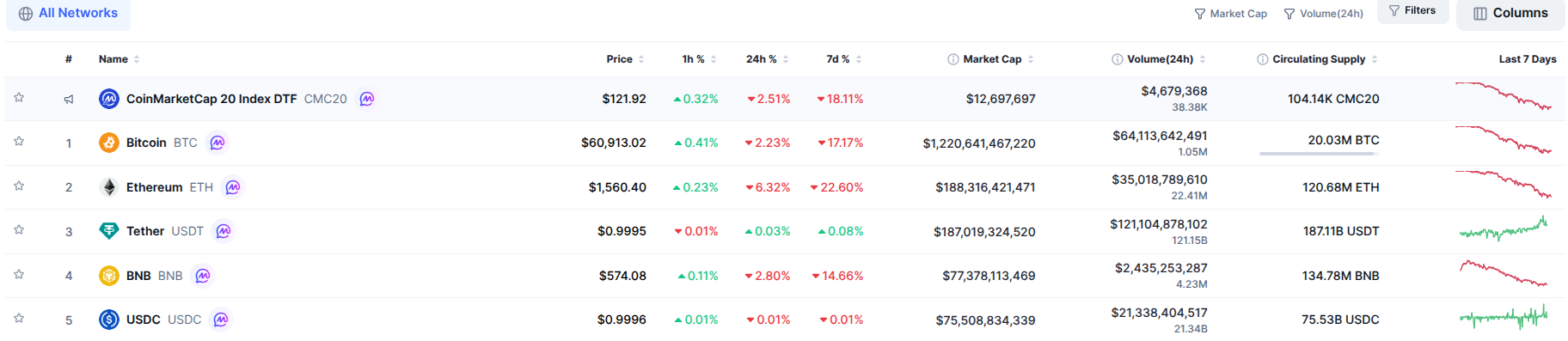
According to the latest market data, Ethereum remains the second-largest cryptocurrency with a market capitalization of approximately $188.38 billion, while USDT has surged to around $187.05 billion. The difference between the two assets now stands at just $1.34 billion, meaning USDT is less than 1% behind Ethereum in total market value.
While Ethereum still holds the No. 2 position, the narrowing gap has fueled widespread discussion across the crypto industry about a potential “flippening” unlike any seen before: a stablecoin challenging a major blockchain network for one of the market’s top spots.
Current Market Snapshot
- Bitcoin (BTC): $1.22 trillion
- Ethereum (ETH): $188.38 billion
- Tether (USDT): $187.05 billion
Bitcoin continues to dominate the market by a wide margin, but the battle for second place has become one of the most closely watched developments in the digital asset sector.
Why USDT Is Closing the Gap
Investors Are Moving Toward Safety
Periods of market uncertainty often lead investors to reduce exposure to volatile assets and seek stability. USDT has become the preferred destination for many traders looking to preserve capital while remaining active within the cryptocurrency ecosystem.
As market conditions remain uncertain, demand for dollar-pegged assets has increased significantly, driving continued growth in USDT’s circulating supply and market capitalization.
Ethereum Faces Market Pressure
Ethereum has experienced notable selling pressure in recent weeks. The asset recently traded near $1,560, reflecting broader weakness across the altcoin market.
Several factors have contributed to Ethereum’s declining market cap, including:
- Risk-off investor sentiment
- Broader crypto market weakness
- Reduced speculative activity
- Macroeconomic uncertainty affecting digital assets
Although Ethereum’s underlying technology and ecosystem remain strong, short-term price declines have reduced its overall market valuation.
Stablecoin Adoption Continues to Expand
USDT remains the dominant stablecoin across centralized exchanges, decentralized finance protocols, and cross-border payment networks. Its widespread availability on major blockchain networks, including Ethereum and Tron, has helped support sustained demand.
As more users rely on stablecoins for trading, settlements, and liquidity management, USDT’s market capitalization has continued reaching new highs.
Tether Expands Real-World Payment Utility
Tether has recently invested in Axiym, a regulated global payments infrastructure provider, to accelerate the adoption of USDT in cross-border transactions. The partnership aims to enable near-instant settlements across more than 140 countries and support payments in over 70 currencies.
The investment highlights Tether’s broader strategy to expand USDT beyond crypto trading and into real-world payment applications. By integrating stablecoin-based settlement into regulated payment networks, Tether is strengthening USDT’s position as a global liquidity and settlement asset.
What a USDT Flippening Would Mean
If USDT were to surpass Ethereum in market capitalization, the event would be largely symbolic but still highly significant for the crypto industry.
Such a shift would signal that:
- Investors currently prioritize liquidity and stability over risk assets.
- Stablecoins have become a foundational component of crypto infrastructure.
- Market participants are increasingly using on-chain dollars as a safe haven during volatile periods.
Importantly, a flippening would not diminish Ethereum’s role as the leading smart contract platform. Ethereum continues to power thousands of decentralized applications, DeFi protocols, NFT ecosystems, and Layer-2 scaling networks.
Instead, the event would reflect changing capital allocation trends rather than a fundamental decline in Ethereum’s technological relevance.
Industry Reactions
The prospect of USDT overtaking Ethereum has generated significant discussion among traders, analysts, and market commentators. Many view the development as evidence of the growing influence of stablecoins within the digital asset economy.
Crypto commentators have also highlighted the rapidly shrinking gap between the two assets. In a widely shared post on X, crypto analyst Gaurav remarked that “USDT is getting dangerously close to flipping Ethereum in market cap,” reflecting growing market attention on the possibility of a historic shift in the cryptocurrency rankings.
Rather than signaling weakness in blockchain innovation, the trend underscores how critical stablecoins have become for maintaining liquidity and facilitating activity across the crypto market.
Analysts have also noted that rising stablecoin market capitalizations often indicate that substantial capital remains within the ecosystem, potentially positioning the market for future growth once risk appetite returns.
What Comes Next for Ethereum and USDT?
Ethereum could regain a wider lead if market sentiment improves, Bitcoin stabilizes, or positive catalysts emerge, such as stronger institutional inflows, increased network activity, or successful ecosystem upgrades.
Meanwhile, continued stablecoin adoption could push USDT even closer to Ethereum’s valuation. With the market cap gap now reduced to less than one percent, even relatively small changes in ETH’s price or USDT’s supply could alter the rankings.
Conclusion
The race between Ethereum and Tether’s USDT has become one of the most compelling developments in the cryptocurrency market. With less than a 1% difference in market capitalization, the possibility of a stablecoin overtaking Ethereum is no longer a distant scenario. Whether Ethereum maintains its position or USDT claims the second spot, the shrinking gap reflects a broader shift in investor behavior toward stability and liquidity. Ultimately, the trend highlights the growing importance of stablecoins as a foundational pillar of the digital asset ecosystem while reinforcing Ethereum’s continued significance as a leading blockchain platform.