USDT Transfers Resumed: What the Ethereum-TRON Bridge Reopening Means A short but nervous pause in the stablecoin market has ended. USDT transfers resumed between Ethereum and TRON in the ear
USDT Transfers Resumed: What the Ethereum-TRON Bridge Reopening Means
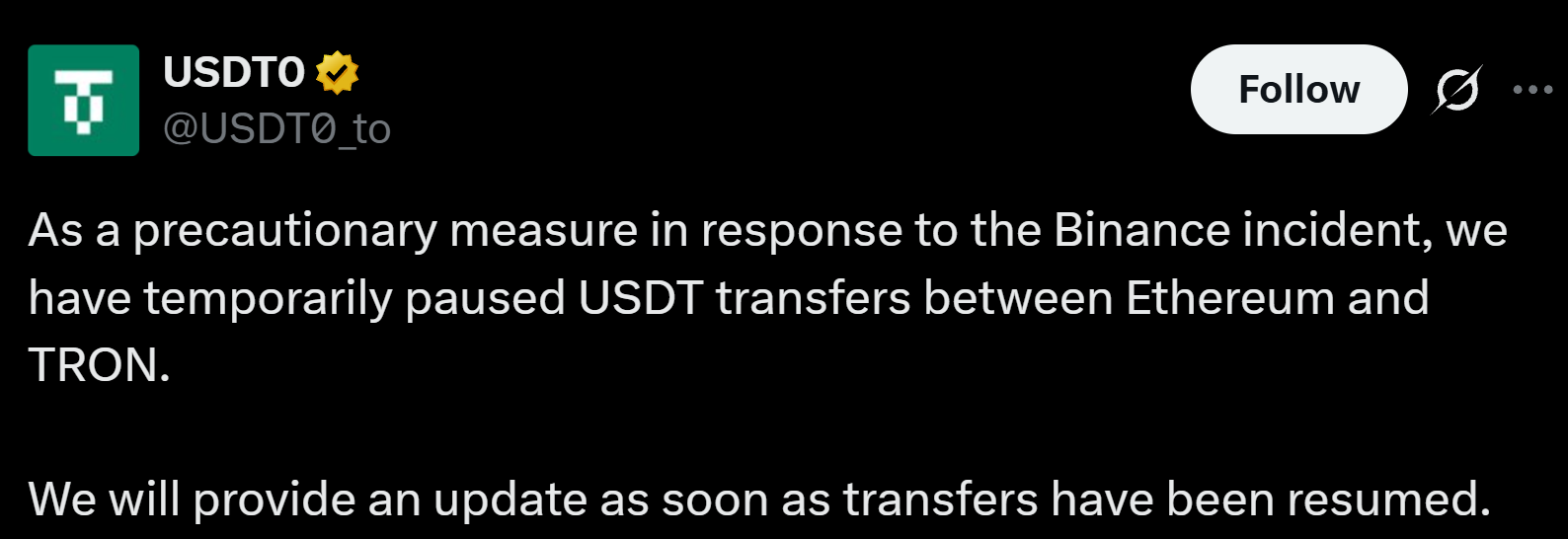
A short but nervous pause in the stablecoin market has ended. USDT transfers resumed between Ethereum and TRON in the early hours of 30 October 2026, about three and a half hours after the USDT0 team stopped them as a precaution during the Binance security incident.
The route is one of the busiest in the stablecoin market, so any pause matters. Here is a clear, plain-language timeline of how this route works, what Binance has confirmed so far, and what users should do now.
What Happened and When
The first alert came on 29 October at about 21:27 UTC.
In itspause announcement on X, the USDT0 team said it had temporarily stopped moves between the two networks as a precautionary response to the Binance incident and promised an update once service returned.
Time (UTC)
Event
29 October, about 21:27
USDT0 pauses the Ethereum and TRON route
30 October, about 01:00
USDT0 says the route is running again
30 October, about 01:36
Binance says it will cover all losses
30 October, 02:23
Binance publishes a detailed incident update
Theresumption post thanked users for their patience and explained the goal: to help prevent the movement of stolen funds.
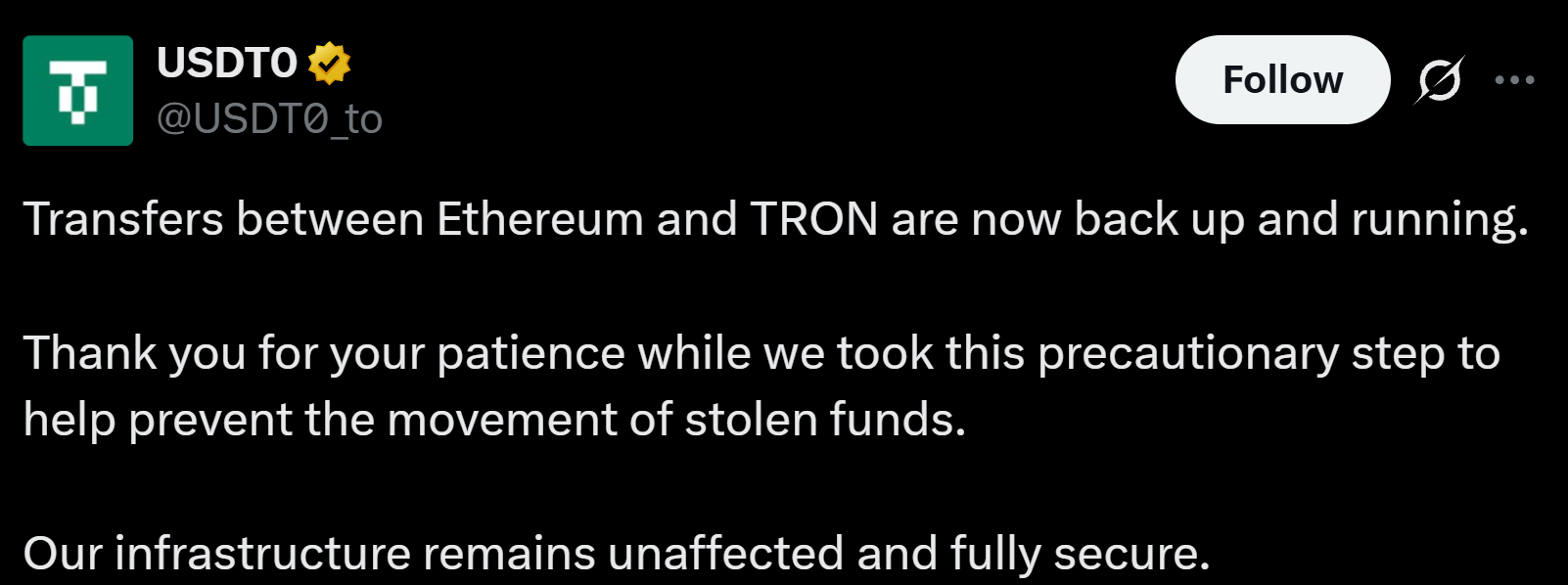
It also stated that the team’s own infrastructure remains unaffected and fully secure.
By our own count, the pause lasted about 3 hours and 32 minutes. Times come from the posts’ own dates.
The pause began nearly five hours before the exchange published its detailed update, which means the bridge team acted before the full explanation was public.
Why the Pause Was Needed
A bridge lets money hop from one blockchain to another, which is exactly what thieves want once they hold stolen coins.
Stopping that hop for a short time can slow them down while investigators work.
That reasoning matches the official explanation and shows why the move is described as precautionary rather than a sign of a technical fault.
Now that USDT transfers resumed, users are still told to stay careful. USDT0 did not say that stolen funds touched this route, and no source we read says so either.
The pause also affected only the path named in the announcements. Official posts do not mention any other path, so readers should not assume that other networks were stopped or that other tokens were affected.
How the Route Works
Moving the stablecoin between the two networks runs through the Legacy Mesh, described on theofficial route page as a non-custodial hub-and-spoke layer routed through an Arbitrum hub.
Because the design is non-custodial, users keep control of their funds during a move. Both networks keep their own native coins, with no wrapped tokens, and each transfer is backed one-to-one by redeemable assets.
A three-of-three attestation group made up of USDT0, LayerZero, and Canary must approve each message, so no single verifier can sign off alone.
Route
Typical time
Fee
30-day volume
Ethereum to TRON
About 3 min 43 sec
0.03% plus gas
$451 million
TRON to Ethereum
About 4 min 4 sec
0.03% plus gas
$370 million
Both directions rank among the 10 busiest routes for this stablecoin.
By simple maths, the two volumes add up to $821 million, or roughly $27 million a day.
These figures are live page data and may include the pause period. Thetechnical documentation adds that the Legacy Mesh moves older native deployments across chains without minting or burning.
Users also pay network gas and a LayerZero messaging fee, both quoted before they confirm.
The Binance Incident Behind the Pause
The exchange’sofficial security update, published on 30 October 2026, gives the first details.
The initial investigation suggests a compromised laptop belonging to a DevOps engineer let an attacker reach a service container and submit unauthorized withdrawal transactions.
The exchange says it has found no evidence of a wallet private key leak, and it worked with blockchain partners to freeze affected assets.
Estimated total impact: around $6.3 billion
Frozen on-chain so far: about $3 billion, or roughly 48% by our maths
Losses covered from the SAFU fund and company funds
Deposits and withdrawals suspended while checks finish
Affected address authorization revoked
Law enforcement and blockchain intelligence partners engaged
An updated proof of reserves, a public check that customer assets are backed, promised after remediation
The company also promises a detailed technical report once the facts are fully verified. These findings are preliminary and may change.
What Users Should Do Now
The exchange repeated that it will cover all losses and urged people to rely only on official channels.
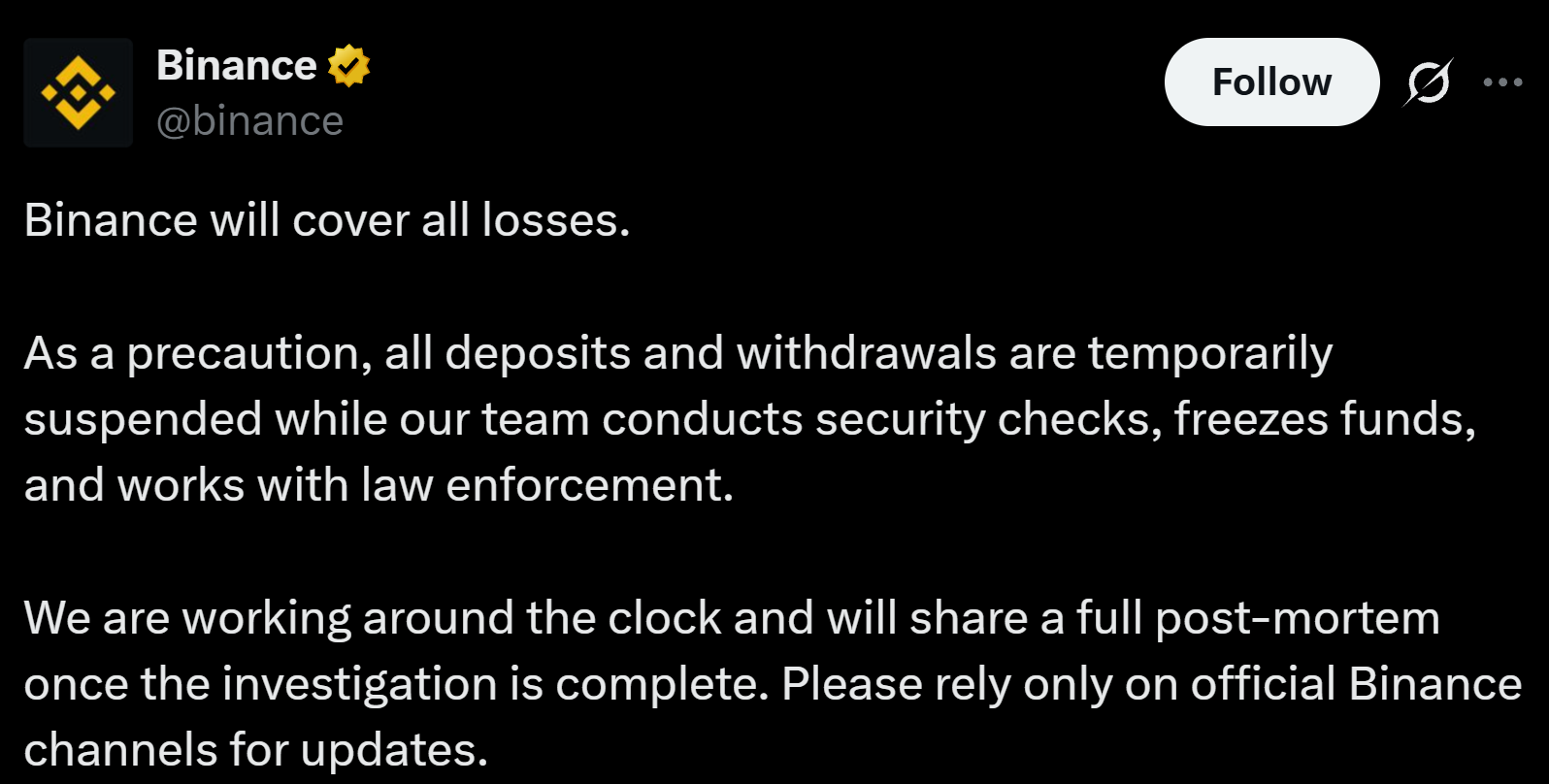
Source: Binance on Post
The same caution applies to the path that just reopened, so USDT transfers resumed does not mean every risk is gone.
Check the official transfer page or X account before sending large amounts
Send a small test amount first, since delays can still occur
Confirm the route, network, and address before approving anything
Ignore messages promising refunds or recovery help
Remember that Binance deposits and withdrawals were suspended at the last report, so check the current status before moving funds there
Several questions remain open: whether any other path was paused, how much stolen money moved across chains, what the final cause will be, and when the exchange will reopen deposits and withdrawals.
Conclusion
Because USDT transfers resumed quickly and no problem with the bridge itself was reported, the pause looks like a short, careful response to a much larger incident at the exchange.
The Binance investigation is still active, the figures may change, and the full technical report is pending. Stay with official channels, avoid rushing, and remember that this article is not financial advice.
Disclaimer
This article is for educational and informational purposes only and is not financial or investment advice. Crypto assets are high risk, their prices can be very volatile, and you can lose some or all of your money. Always do your own research and consider speaking with a licensed financial advisor before making investment decisions.